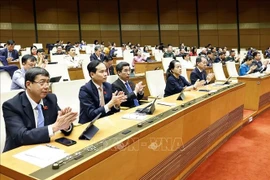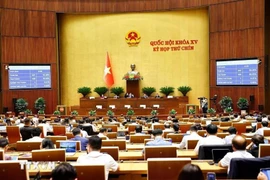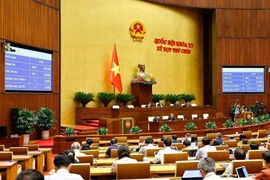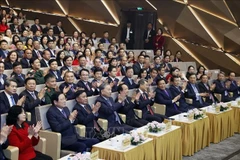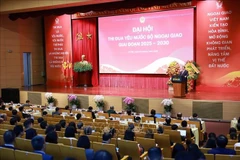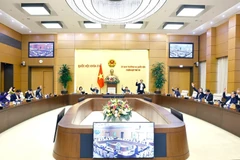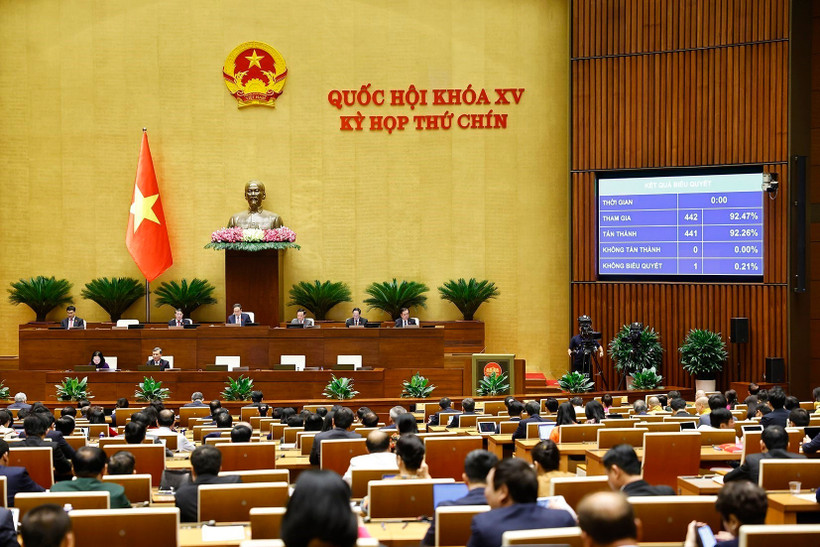
Hanoi (VNA) – The 15th National Assembly (NA) adopted seven important laws spanning science and technology, atomic energy, rail transport, banking regulation, mass organisations, military defence, and criminal procedure during its plenary session on June 27.
With 435 out of 438 lawmakers present voting in favour, the NA passed the revised Law on Science, Technology and Innovation, which comprises seven chapters and 73 articles. The law will come into force on October 1, 2025, except for certain provisions that will take effect earlier, on July 1.
The law institutionalises major Party resolutions and includes forward-looking, flexible provisions to encourage innovation. It marks a shift from input-based financial control to results-based governance, allowing final-result-based funding mechanisms. Organisations gain ownership of assets and research outcomes from the outset, with no reimbursement to the state budget. These research outcomes can be commercialised flexibly, and profits reinvested or used to incentivise further innovation. A coordinated system of financial support, including risk-tolerant innovation funds, is also introduced to foster science and technology breakthroughs.
The Law on Atomic Energy (amended) sailed through the legislature with 441 out of 442 deputies saying "yes". The law contains eight chapters and 73 articles, effective from January 1, 2026.
It regulates the development and use of atomic energy, including radiation safety, nuclear power plant management, nuclear security, accident response, and state oversight.
The legal document applies to both domestic and foreign entities operating in Vietnam’s nuclear energy sector.
With 426 out of 440 votes in support, the revised Law on Railways was adopted. The four-chapter law will take effect on January 1, 2026, with some parts effective earlier on July 1, 2025.
The law sets out comprehensive regulations on railway operations and responsibilities of involved entities.
It decentralises power by delegating rail network planning approval from the Prime Minister to the Minister of Construction. Importantly, it enables private-sector investment in railway projects through public-private partnerships (PPP) and direct investment. To encourage participation, the law ensures state funding for site clearance and resettlement will not be counted as part of state capital in PPP projects.
The NA approved the law amending and supplementing several articles of the Law on Credit Institutions with 435 out of 443 approval votes. Under the the law, the authority to grant special loans with yearly interest rate of 0% without collateral has been transferred from the Prime Minister to the State Bank of Vietnam (SBV) from October 15.
The law also stipulates that special loans by the SBV can only be granted when a credit institution falls into a very difficult liquidity situation or to implement a recovery plan or a compulsory transfer plan with the aim of protecting the legitimate rights of depositors and ensuring the safety of the credit institution system.
With 440 out of 447 lawmakers voting in favour, the NA passed the law amending and supplementing several articles of the Law on the Vietnam Fatherland Front, the Law on Trade Unions, the Youth Law, and the Law on Grassroots Democracy Implementation.
The law, consisting of five articles, will come into force on July 1.
Receiving the approval of all 451 deputies present at the meeting, the law amending 11 military and defence-related laws will take effect on July 1. It harmonises military and defence legislation with the restructuring of local administrative units and aligns with new models of local governance.
The law amending and supplementing several articles of the Criminal Procedure Code received the support from 445 out of 449 lawmakers present. It modifies 120 out of 150 articles and adds one new provision. The changes take effect from July 1.
A notable change relates to the handling of death penalty cases: if the President does not issue a clemency decision within one year of receiving recommendations from the Chief Justice of the Supreme People's Court and the Prosecutor General of the Supreme People's Procuracy, competent agencies may proceed with execution./.
VNA