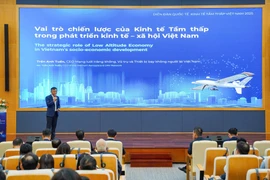
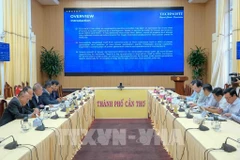
Hanoi (VNA) - The Vietnam Low-Altitude Economy Forum 2025, held for the first time in Vietnam, featured strategic discussions on exploiting airspace below 5,000 metres, which could become a new economic pillar worth 10 billion USD.
The Vietnam Low-Altitude Economy Forum 2025, held for the first time in Vietnam on November 14, marked a new chapter in the country’s high-tech development ambitions. With an estimated market potential of 10 billion USD, the “low-altitude economy” is expected to become a groundbreaking growth driver, helping Vietnam take off in the global value chain.
The forum was jointly organised by the Vietnam Aviation, Space, Unmanned Aerial Vehicle Technology Network (UAVS VN) in collaboration with the FPT Group, the Vietnam Low-Altitude Economy Alliance, and the Vietnam National Innovation Centre (NIC). It attracted over 200 delegates from management agencies, research institutes, leading technology companies, and international experts.
This activity was a concrete step to implement the objectives set out in the Politburo’s Resolution No. 57-NQ/TW on breakthrough development in science, technology, and innovation, as well as the Prime Minister’s Decision No. 1131/QD-TTg on the list of strategic technologies.
Opportunities to open new economic space
NIC Deputy Director Vo Xuan Hoai emphasised that global trends have shifted. He noted that many countries now consider aerospace and UAVs as strategic technology sectors. With the rapid rise of these technologies, a new economic model - the “low-altitude economy” - is emerging as a prominent global development trend.

The low-altitude economy refers to economic activities conducted below 1,000 metres, extendable up to 5,000 metres depending on a country’s demands. This sector leverages manned and unmanned flight technology and low-altitude smart networks to develop infrastructure, manufacture aerial vehicles, provide related services, and ensure flight safety. Its applications span agriculture, logistics, environmental monitoring, transport, media, and entertainment, tapping into the underutilised lower airspace.
Experts predict that the global low-altitude aviation market could reach 700 billion USD by 2035. In Vietnam, this industry has the potential to hit 10 billion USD. With stable geopolitical conditions, innovation-friendly policies, and a young, dynamic workforce, Vietnam is now in the ‘golden time’ to become a regional hub for the low-altitude industry.
Sharing this vision, Nguyen Thi Hai Hang, Vice President of AUVS VN and Director of the Vietnam Aviation Academy, said that the low-altitude economy is not merely about aircraft, it represents a strategic shift to open low-altitude airspace as a new business space, driving economic growth through technological innovation.
At the national level, Tran Anh Tuan, CEO of AUVS VN, affirmed that the low-altitude economy plays a strategic role as a new growth driver, a bridge for digital transformation, a creator of high-quality jobs, and a booster of national capacity.

The low-altitude economy is not just a technological trend but a national development strategy, encompassing three core values - innovation, high productivity, and sustainable development, Tuan said.
Security challenges and air traffic problems
To turn this potential into reality, experts held that Vietnam needs a clear development roadmap.
Tuan proposed five key solutions - establishing a flexible legal framework, focusing on domestic research and development (R&D) investment, developing low-altitude economy industrial clusters and testing centres, training a high-quality workforce, and building a fully-connected ecosystem.
FPT Group’s Chief Technology Officer Vu Anh Tu described the low-altitude economy as a new growth driver, where Vietnam can tap its strengths in knowledge and technology. He said that it is an arena where the country can “take off” through intelligence, technology, and multi-dimensional collaboration among the State, businesses, universities, research institutes, and the people.
By seizing the opportunity and investing in the low-altitude economy, Vietnam is advancing all three pillars of the new era - digital economy, green economy, and knowledge economy - while also unlocking the creative potential of its engineers and scientists, he said.
The forum also recorded many policy proposals, including establishing a regulatory sandbox, developing low-altitude airspace management infrastructure, and promoting research and production of unmanned aerial vehicles for socio-economic applications. These initiatives aim to chart a new path for the country in the low-altitude aviation era, laying the foundation for resource integration, knowledge sharing, and the application of modern technologies./.