“Golden time” for Vietnam to begin low-altitude economy

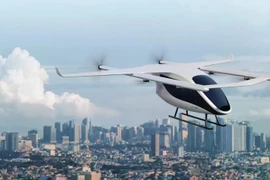
The low-altitude economy refers to economic activities conducted below 1,000 metres, extendable up to 5,000 metres depending on a country’s demands.

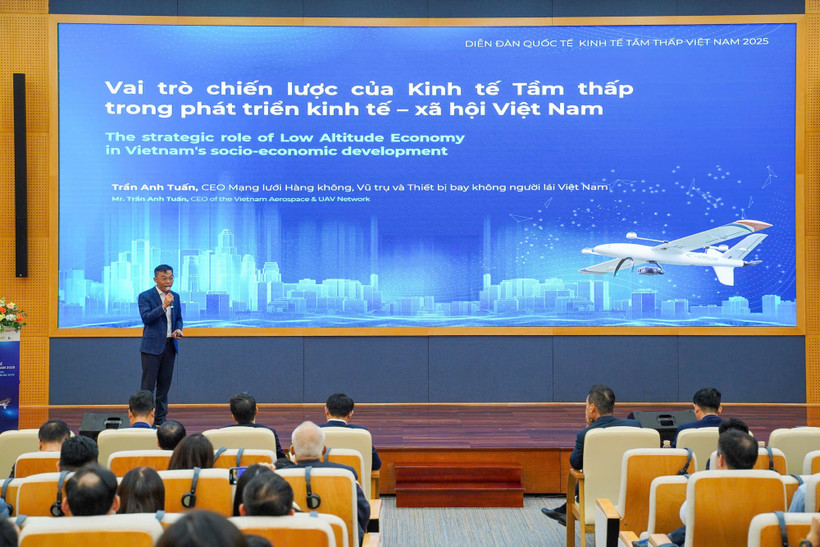
A view of the Vietnam Low-altitude Economy Forum 2025 in Hanoi on November 14, 2025 (Photo: VNA)

Hanoi (VNA) – Vietnam is now at the ‘golden time’ to develop a low-altitude economy, creating an entirely new economy based on aerospace and UAV technology, FPT Group’s Chief Technology Officer Vu Anh Tu stated at the Vietnam Low-altitude Economy Forum 2025 in Hanoi on November 14.

The event was jointly held by the Vietnam Aerospace, Space, and Unmanned Aerial Vehicles (UAVS VN) in collaboration with FPT Group, the Vietnam Low-Altitude Economy Alliance, overseas Vietnamese innovation networks, and the Vietnam National Innovation Centre (NIC). It gathered representatives from global companies, innovation networks, and international partners, highlighting the potential of UAVs and aerospace technology in developing the low-altitude economy, fostering a new and sustainable industry and serving as a pillar for the digital economy, smart cities, and modern agriculture.

In his opening remarks, Tu stressed that the global market of low-altitude economy has reached hundreds of billions of dollars, growing 30% annually, and is recognised by major economies such as the US, China, and Europe as a strategic industry.

He noted that the ‘Vietnamese sky’ offers an unprecedented development space, especially as the Mekong Delta becomes the country’s largest UAV application area and a testing ground for many international corporations.

Analysing the growth potential of the low-altitude economy, Tu noted that it opens the door to an entirely new sector in Vietnam. Beyond UAV manufacturing, it encompasses devices, chips, sensors, air traffic management platforms, 3D mapping, operational services, insurance, training, and applications in agriculture and other fields.

This sector stands at the intersection of the digital, green, and knowledge economies, he said, adding that investing in the low-altitude economy is an investment in Vietnam’s three new pillars of scientific development.
hoai.jpg
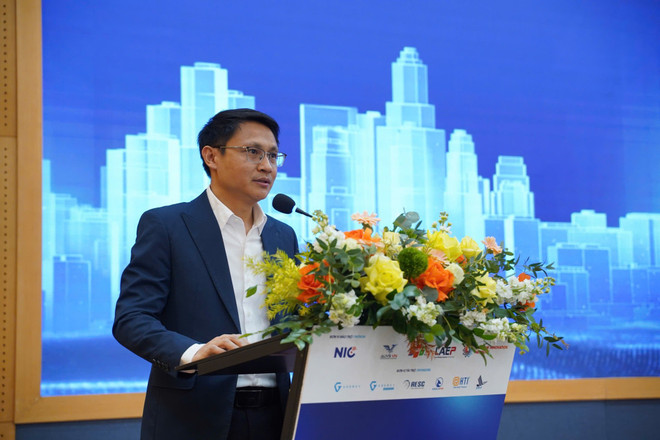
Vo Xuan Hoai, Deputy Director of NIC speaks at the event (Photo: VNA)

Vo Xuan Hoai, Deputy Director of NIC, affirmed that aerospace and UAV are among the world’s strategic industries, with 70% of the UAV market dominated by major companies. He emphasised that this presents an opportunity for Vietnam to engage deeply in the value chain, from research and manufacturing to software development, AI and air traffic management.

He also praised the technological self-reliance of Vietnamese UAV companies and stressed the need for close coordination among the State, businesses, research institutes, and international partners.

A notable step is NIC’s recent proposal to establish Vietnam’s first UAV testing airspace, laying the groundwork for domestic product commercialisation, Hoai said.

Analyses at the forum highlighted that the low-altitude economy not only creates new industries but also directly boosts economic productivity. In agriculture, which accounts for 12-14% of the national GDP and employs up to 40% of the workforce, UAVs are driving a leap in automation. Vietnam’s agricultural robotics market is projected to reach 400 million USD by 2030.

In logistics, as e-commerce is forecast to reach 63 billion USD by 2030, UAVs are expected to cut delivery costs, especially in challenging terrains. Successful trials in Thai Nguyen, Tuyen Quang, and Lang Son have shown positive results.

For smart cities, UAVs are expected to become vital tools for monitoring traffic and infrastructure safety, enhancing emergency response capabilities.

The low-altitude economy refers to economic activities conducted below 1,000 metres, extendable up to 5,000 metres depending on a country’s demands. This sector leverages manned and unmanned flight technology and low-altitude smart networks to develop infrastructure, manufacture aerial vehicles, provide related services, and ensure flight safety. Its applications span agriculture, logistics, environmental monitoring, transportation, media, and entertainment, tapping into the underutilised lower airspace./.
VNA

See more

From early December, major retail chains in Ho Chi Minh City have recorded a noticeable increase in shoppers seeking Tet products. (Photo: VNA)

HCM City businesses ramp up production to meet Lunar New Year demand

From early December, major retail chains in the city have recorded a noticeable increase in shoppers seeking Tet products. Many consumers are taking advantage of promotional programmes to purchase gift items with long shelf lives, such as confectionery, soft drinks and processed foods, well ahead of the holiday peak.

Workers process fish to be tinned for export at KTC Canned Food Factory under Kien Giang Trading JSC. (Photo: VNA)

Vietnam to host seminar on export growth strategies

Vietnam's exports rose 16.1% to 430.2 billion USD in the first 11 months of 2025, while total trade hit 839.8 billion USD during the same period. This strong performance shows that exports remain a key driver of economic growth, boosting Vietnam's standing on the world stage in recent years.

The vessel carrying the 2 millionth TEU arrives at Hai Phong Port. (Photo:VNA)

Hai Phong Port reaches 2-million-TEU milestone

Handling the 2 millionth TEU in 2025 not only demonstrates Hai Phong Port’s operational capacity and the collective efforts of its workforce, but also highlights its increasingly important role in regional and global supply chains, the confidence of shipping lines, logistics firms and the business community, and the effectiveness of policies to improve the investment climate and strengthen maritime infrastructure and services.

Melons labelled with traceability codes on display at the Song Van agricultural produce store in Ninh Binh city, Ninh Binh province. (Photo: VNA)

Tracing origins hindered by fragmented data systems

As the Government accelerates the digital economy, establishing a unified national traceability system has become a crucial move to end data fragmentation and disconnection among ministries, sectors and localities.

Hyundai unveils its new Avante Hybrid model in Seoul, the Republic of Korea, on August 13, 2020. (Photo: Yonhap/VNA)

Tax cuts poised to ignite Vietnam’s hybrid vehicle boom from 2026

Experts forecast that 2026-2030 will mark a period of strong growth for hybrid vehicles in Vietnam, a trend that will invigorate the automotive sector while supporting national objectives on emissions reduction, sustainable development and the broader transition to green mobility.

Illustrative image (Photo: VNA)

Vietnam targets 1 billion USD in banana exports

Bananas have been identified as a priority product under the Project for the Development of Key Fruit Crops to 2025, with a vision to 2030, approved in October 2022. Under the plan, banana acreage is projected to reach 165,000–175,000ha by 2030, with output of 2.6–3 million tonnes.

Deputy Minister of Foreign Affairs Nguyen Minh Hang (Photo: VNA)

Event connects Vietnamese businesses with African countries

Deputy Foreign Minister Nguyen Minh Hang held that to develop Vietnam – Africa ties more strongly and substantively, it is necessary to promote the engagement of businesses, and that the Government will create favourable conditions for them to enhance fruitful cooperation.

Deputy Prime Minister Ho Duc Phoc (R) and Independent Non-executive Chairman of AIA Mark Tucker at their meeting in Hanoi on December 12. (Photo: VNA)

AIA Group envisions long-term investment, cooperation in Vietnam

Over 25 years of operation in Vietnam, AIA has achieved positive results. Its premium revenue ranks among the top five life insurers, reaching nearly 14.83 trillion VND (563.71 million USD) in 2024 and an estimated 15.73 trillion VND in 2025, equivalent to around 10% of the market share.