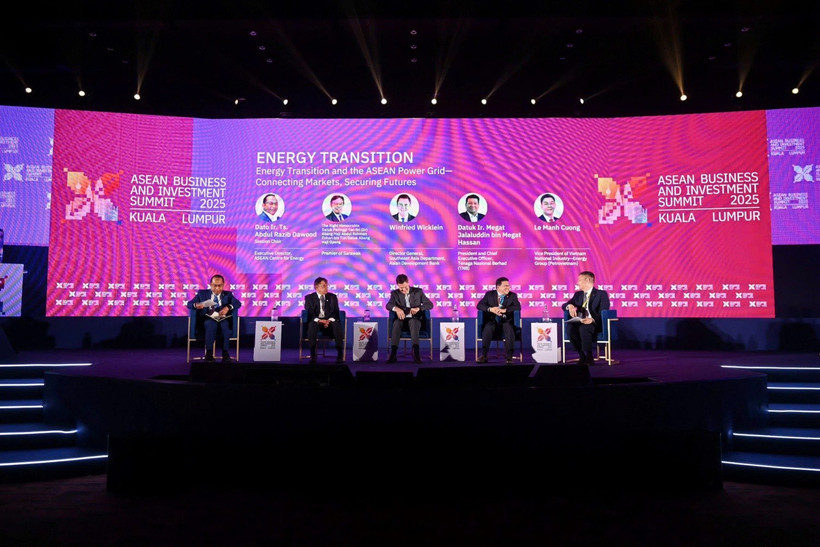
Hanoi (VNA) - The ASEAN Business and Investment Summit 2025 (ABIS 2025) took place in Kuala Lumpur from October 25-26 with the participation of ASEAN leaders, international financial institutions, major energy corporations, and regional business communities.
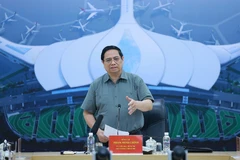
Held as part of the 47th ASEAN Summit under the theme "Unifying Markets for Shared Prosperity", the event brought together more than 1,500 delegates, including heads of state, senior ASEAN leaders, CEOs of leading corporations, and global economists. Discussions focused on private sector-driven initiatives to foster policy reform and strengthen ASEAN’s role in the global economy. Vietnamese Prime Minister Pham Minh Chinh attended a high-level dialogue held in the framework of the summit.
Representing the Vietnam National Industry - Energy Group (Petrovietnam), Deputy General Director Le Manh Cuong joined the roundtable discussion on “Energy Transition and the ASEAN Power Grid – Connecting Markets, Securing the Future”, alongside the Premier of Sarawak, the ADB Southeast Asia Director General, and the President and CEO of Tenaga Nasional Berhad (TNB).
Speakers highlighted the ASEAN Power Grid’s (APG) strategic importance in ensuring regional energy security and discussed policy, regulatory, and financial frameworks for cross-border energy integration. They also examined green financing mechanisms, investment models, and business engagement to accelerate regional grid interconnection.
Earlier, the 43rd ASEAN Ministers on Energy Meeting (AMEM), held on October 16-17, announced three key initiatives: the Enhanced MOU on the ASEAN Power Grid (a new intergovernmental commitment to energy cooperation), the ASEAN Power Grid Finance Initiative (APGF) – a World Bank- and ADB-backed financial platform to mobilise infrastructure investment, and the ASEAN Plan of Action for Energy Cooperation (APAEC) 2026–2030, which sets ambitious renewable energy targets of 30% of primary energy and 45% of installed capacity by 2030.
Cuong noted that the Enhanced MoU on APG lays the foundation for stronger coordination in cross-border energy projects. He emphasised that leading corporations such as TNB, Petronas, and Petrovietnam should enhance cooperation to overcome technical challenges in implementation.
He underscored Vietnam’s vast offshore wind potential, estimated at 600 GW, and stressed the need for regional collaboration between both governments and energy enterprises to mobilise resources and develop synchronised connectivity infrastructure. He also highlighted the importance of supply chain coordination in executing large-scale transnational projects.
Cuong affirmed that the oil and gas sector is the core and the resource for Petrovietnam to implement the energy transition.
It is still the main production sector and the core sector, and this is the resource for Petrovietnam to contribute to the country's development, promote energy transition, and develop sustainable renewable energy projects in the context of Vietnam and the region transitioning to a low-carbon economy, he said.
Cuong concluded the session by affirming that through its renewable energy development strategy, particularly in offshore wind power, Petrovietnam aims to become a trusted regional partner alongside TNB, ADB, and other ASEAN stakeholders in transforming the APG vision into reality.
Petrovietnam’s active participation in ABIS 2025 not only underscores its stature as Vietnam’s leading energy enterprise but also demonstrates the country’s proactive and responsible role in building a unified, secure, and sustainable ASEAN energy community./.