Post COVID-19: How “green passports” will help revive tourism

“Green passports” must be “green”, friendly, and provide more benefits to everyone while ensuring convenience if they are to help the tourism industry recover.
Post COVID-19: How “green passports” will help revive tourism ảnh 1Will “green passports” help recover Vietnam’s tourism industry? (Photo: Vietnamplus)

In order to reach the “new normal”, “green passports” (also known as COVID-19 vaccination certificates) are considered a solution to help resume all economic activities, including tourism.

Is vaccination really a “talisman”?

On July 1, the European Union (EU) issued digitally-recognized COVID-19 vaccination certificates in its 27 member states as well as in Switzerland and Norway. When crossing a border, citizens need only scan a QR code to be exempted from quarantine or inspection.

Many European Union (EU) member countries have also exempted people from nearly 20 countries on a “safe list” if they have tested negative for COVID-19, even if they have not completed their vaccinations. Therefore, in some countries, vaccination against COVID-19 is not entirely a “talisman” for the reconnection of air travel.

Post COVID-19: How “green passports” will help revive tourism ảnh 2 People in Ishoej, Denmark, receive vaccinations. (Photo: AFP/VNA)

The World Health Organization (WHO) is yet to issue any specific standards to develop global “vaccine passports”.

However, if countries want to soon apply “vaccine passports” as a safe solution, more than 200 governments will need to find agreement about recognising them.

According to experts, the full resumption of disrupted flights around the world will take months or even years, but international travel has a chance to restart sooner as blocs like the European Union (EU) and the Group of Seven (G7) are creating their own standards for recognizing vaccinated travellers.

In particular, countries, including China and Japan, are also developing independent “vaccine passport” platforms. The two countries also want to negotiate tourism corridors with other countries on a bilateral basis.

In the future, if countries were to recognise one or more digital document systems known globally, particularly when the pandemic is brought under control, this would create more favourable conditions for people to travel around the world, paving the way for the tourism industry to recover.

To prepare for that future, a global “vaccine passport” system has been recognised by some groups, including the International Air Transport Association, the Commons Project, and IDEMIA, a multinational technology group from France.

The acceptance of a global health certification system is very important for many countries in the Asian region, where large numbers of people rely on tourism for their livelihood and have been hit hard by the Delta variant.

Many European countries, which currently have a vaccination rate of more than 60 per cent, have already opened their doors to tourists, such as France, Germany, Austria, and Sweden. They have applied similar certificates, like the European Union (EU) Digital COVID Certificate (EUDCC), or allow the use of the European Union (EU) Digital COVID Certificate for travel within the European Union (EU) and Schengen area.

Members of the Tourism Advisory Council emphasised that those granted a “green passport” should not only include people who are fully vaccinated but also those who have recovered from the virus or who tested negative within 72 hours prior to travel, even if they have not completed their vaccinations.

Members of the council have said that the Viet Nam Government needs to negotiate with countries around the world to recognize the country’s “green passport”.

According to experts, the tourism industry should propose the Viet Nam government assign the task of researching, piloting, and synchronizing “green passports” to a particular ministry or industry as the focal point.

It is worth mentioning that this passport must be truly “green”, providing benefits to everyone and ensuring convenience for users in order to help recover economic activities as well as the tourism industry./.


VNA

See more

An image of a Vietnamese game. CIS region has potential for gaming developers from Viet Nam. (Photo: Courtesy of cellphones.com.vn_

CIS: Opportunity for game developers in Vietnam

The CIS region, which includes Eastern Europe and Central Asia, has potential for gaming developers from Vietnam as this market displays user behaviour patterns that are highly favourable for mobile gaming growth, particularly around major holiday periods.

Banks, including MB Bank, have issued alerts about scams conducted via social media platforms such as Zalo and Facebook, where criminals impersonate acquaintances. (Photo: The Courtesy of MBBank)

Financial scams surge ahead of Tet

As the Lunar New Year (Tet) approaches, financial and banking scams in Vietnam are showing a sharp upward trend, prompting banks and law enforcement agencies to issue repeated warnings.

Hai Phong targets 4.3 billion USD in FDI in 2026 (Photo: VNA)

Hai Phong city targets 4.3 billion USD in FDI in 2026

Hai Phong’s investment appeal is underpinned by a rapidly expanding development space, including the Southern Coastal Economic Zone covering more than 20,000 hectares, a planned free trade zone, deep-water ports at Lach Huyen, and 12 industrial parks newly established in 2025.

The relocation of check-in counters aims to better meet the travel needs of residents and visitors. (Photo: VNA)

Vietjet shifts domestic check-in at Tan Son Nhat from January 13

During the recent New Year 2026 holiday peak, Vietjet added 380 flights, equivalent to nearly 78,000 additional seats, on many key domestic routes linking Hanoi and Ho Chi Minh City with destinations such as Vinh, Thanh Hoa, Hai Phong, Da Nang, Phu Quoc, Nha Trang and Da Lat.

Commercial banks are providing approximately 88% of total green credit outstanding in Vietnam. (Photo: nhandan.vn)

Capital sources expanded for sustainable growth

According to the State Bank of Vietnam (SBV), by the end of November 2025, outstanding green credit was estimated at around 750 trillion VND (28.55 billion USD), with an average growth rate exceeding that of overall credit in the economy.

Customers select goods at a supermarket. (Photo: VNA)

Retail market expands sharply, sustainability challenges persist

According to a report on recently released by the Ministry of Industry and Trade’s Agency for Domestic Market Surveillance and Development, the size of the market reached more than 7 quadrillion VND (about 266 billion USD) in 2025, up around 10% compared with 2024.

Oil rigs at the Bach Ho oil field. (Photo: VNA)

Resolution 79: State economy to lead growth

Resolution 79 is described as a “clear action declaration” by the Politburo, saying the state economy is not only responsible for maintaining macroeconomic stability, but must also become the force leading a new growth model that is green and sustainable.

Workers at Garment 10 Corporation produce apparel for export. (Photo: Nhan Dan)

Vietnam leverages export advantages within RCEP region

In 2025, seafood exports to China alone exceeded 2.2 billion USD, up about 33% compared to 2024. Shipments to Japan fetched nearly 1.7 billion USD, a year-on-year increase of 14.6%, while those to the Republic of Korea and Australia grew by 9.6% and 3.2%, respectively.

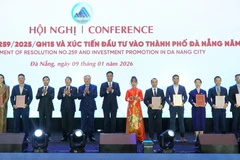
Certificates of membership in the Vietnam International Financial Centre in Da Nang are awarded at the conference on January 9. (Photo: VNA)

Da Nang continues targeted investment promotion approaches

According to Chairman of the Da Nang People’s Committee Pham Duc An, the city prioritises building sustainable economic ecosystems and focuses on key breakthrough sectors with strong spillover effects, including high technology and digital transformation, logistics, urban infrastructure, finance, processing and manufacturing industries, high-tech agriculture, and the pharmaceutical and medicinal herb industry.

In 2025, Hyundai sales reached 53,229 vehicles across the Vietnamese market. (Illustrative photo: Yonhap/VNA)

Hyundai sales in Vietnam rise almost 23% in December

In 2025, sales reached 53,229 vehicles across the market, a result considered a testament to the efforts by TC Group, Hyundai Thanh Cong, and the entire Hyundai dealership network nationwide amidst a volatile market.