Public-private partnerships hold key to sustainable development: PM

Prime Minister Pham Minh Chinh has affirmed the significance of the public – private partnership (PPP) model to not only the green transition process but also many socio-economic sectors, considering it an effective approach to mobilise both domestic and international resources for sustainable development.

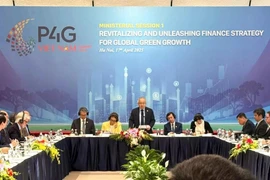
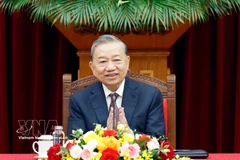
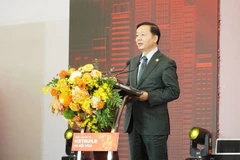
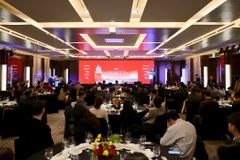
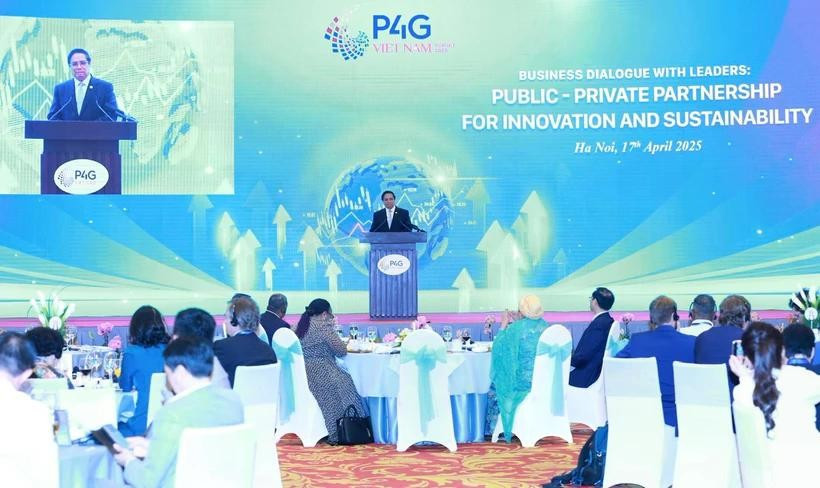
Prime Minister Pham Minh Chinh presides over a dialogue between leaders and the business community on public-private partnership for innovation and sustainability held in Hanoi on April 17. (Photo: VietnamPlus)

Hanoi (VNA) – Prime Minister Pham Minh Chinh has affirmed the significance of the public – private partnership (PPP) model to not only the green transition process but also many socio-economic sectors, considering it an effective approach to mobilise both domestic and international resources for sustainable development.

The PM chaired a business dialogue with leaders on public-private partnership for innovation and sustainability held in Hanoi on April 17 within the framework of the 4th Partnering for Green Growth and the Global Goals 2030 (P4G) Summit.

The Government leader said in some models, capital may come from the public sector and project operation could be entirely entrusted to the private sector, which boasts more experience and more flexible and effective governance. The coordination will create synergistic power, helping accelerate projects in a faster and more economical manner while delivering more substantive value to the economy and the people.

PM Chinh highlighted that the business community and international investors play an essential role in Vietnam's journey towards green transformation and sustainable growth. In particular, the country is strongly committed to creating an open, transparent, and most favourable investment environment for foreign investors.

Vietnam is implementing extensive administrative reforms, reorganising its governmental apparatus, streamlining administrative units, and moving towards an efficient government. This will remove administrative procedure bottlenecks and reduce barriers for investors and businesses operating in Vietnam, he added.
p4g.jpg
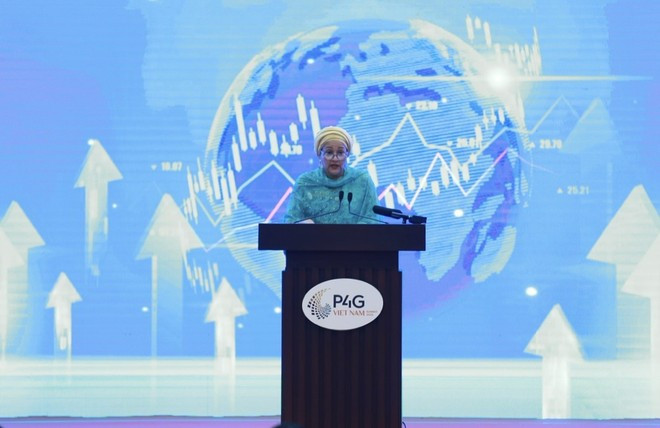
UN Deputy Secretary-General Amina J. Mohammed speaks at the dialogue. (Photo: VietnamPlus)

In the same vein, UN Deputy Secretary-General Amina J. Mohammed held that strengthening public-private partnerships is a key factor in the journey towards green transformation and sustainable development globally. She underscored the need to cooperate, given today's challenges exceeding the capacity of any individual government or business to solve alone.

In this partnership, the public sector plays a formative role, building legal frameworks, appropriate fiscal policies, providing financial instruments, and ensuring public benefits and the ability to implement large-scale projects. Meanwhile, the private sector brings flexibility, capital mobilisation capability, modern technology, and innovation.

Only through close coordination can the two sectors balance profit objectives with environmental, social, and development targets, thereby promoting clean energy transition, circular economy development, nature restoration, and inclusive digital transformation, she said.

To ensure the efficacy of the partnership, it is a must to create clear incentives for facilitating highly liquid projects, attracting investment inflows, developing localities’ capacity, and generating harmonised benefits for all stakeholders, she stressed.

Meanwhile, Italian Government's Special Envoy for Climate Change Francesco Corvaro emphasised that public-private cooperation has strategic significance beyond resource mobilisation in the transition to a green economy. He noted this model is especially suitable for developing countries like Vietnam where public finances are limited but investment need for green infrastructure is surging.
khai-mac-p4g-2.jpg
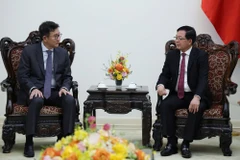
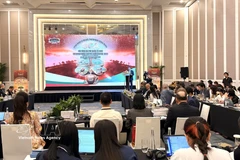
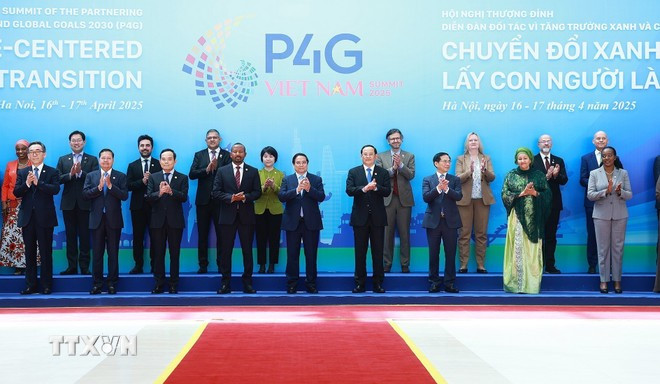
Prime Minister Pham Minh Chinh and heads of foreign delegations at the dialogue (Photo: VNA)

Drawing from Italy's experience, Corvaro highlighted how the Government’s leadership in steering investment flows has opened opportunities for private sector engagement in key areas like renewable energy, green technology, and smart urban development, helping restructuring the national energy system and creating new jobs for the youth – the core force in creating a green and sustainable future.

He cited Milan city's sustainable public transportation as a successful example of local government involvement in PPP implementation—a model Vietnam could adapt.

At the dialogue, representatives from international corporations and Vietnamese enterprises shared their visions for sustainable development. All agreed that public-private cooperation is the key factor helping them realise green transition goals and move towards a more harmonious, inclusive, and sustainable economic development.
thaihuong.jpg
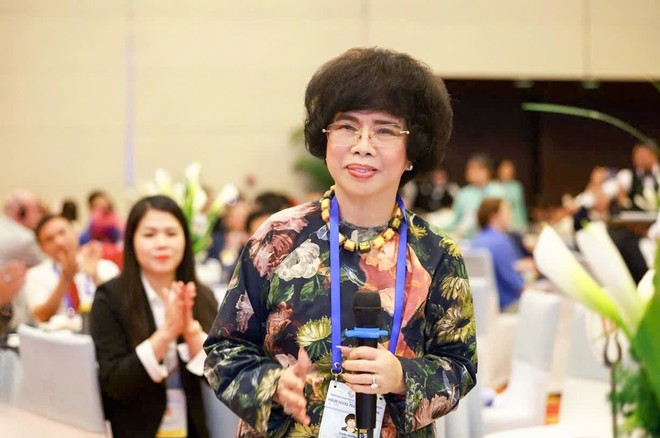
Labour Heroine Thai Huong, Founder and Chairwoman of the Strategy Council of the TH Group, speaks at the event. (Photo: VietnamPlus)

Labour Heroine Thai Huong, Founder and Chairwoman of the Strategy Council of the TH Group, explained how her company emerged in response to China's 2008 melamine milk scandal, saying she built TH Group with a closed-loop chain approach that prioritise the nature, people, and advanced technology to make the impossible possible.

She underscored that that while green transformation and innovation generate substantial benefits, effective public-private partnerships are essential for widespread adoption. She outlined three key requirements, namely policies that create industry leaders, promotion of data and experience sharing among businesses, and economic development in tandem with life quality and human stature improvement through investment in high-tech agriculture and circular economy./.
VNA

See more

The interest rate policy has been adjusted in line with market movements to ensure system liquidity and reduce capital costs. (Photo: VNA)

Banking sector anchors macroeconomic stability, setting stage for new growth cycle

Throughout 2025, the State Bank of Vietnam (SBV) has reaffirmed its role as the central regulatory authority in managing monetary policy, stabilising the financial market, and maintaining macroeconomic balance. Closely monitoring international and domestic economic trends, the SBV steered the monetary policy proactively while closely coordinating with the fiscal policy to achieve the dual objective of controlling inflation and supporting growth.

Professor Reena Marwah from the University of Delhi, and Secretary-General of the Association of Asia Scholars. (Photo: VNA)

Vietnam – A rising star in Asia: Indian professor

Vietnam’s projected GDP growth of around 8% in 2025 shows that its economy is on an impressive growth trajectory, driven by multiple reinforcing engines, said Professor Reena Marwah from the University of Delhi, and Secretary-General of the Association of Asia Scholars (AAS).

Harvesting jackfruit (Photo: VNA)

China to allow import of Vietnamese fresh jackfruits from June 1, 2026

To ensure smooth customs clearance, all orchards and packing facilities participating in exports must be registered and approved by competent authorities of both countries. The list of approved entities granted export codes will be published and regularly updated on the GACC website.

The fruit and vegetable sector is also set to hit a record, with exports projected at around 8.5 billion USD in 2025. (Photo: VNA)

Agro-forestry-fishery exports poised to hit record high in 2025

Agro-forestry-aquatic exports totalled 64.01 billion USD in the first 11 months of 2025. If performance in the final month matches that of recent months, the figure could approach 70 billion USD, far exceeding the 65-billion-USD target set for the year.

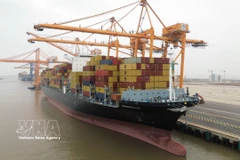
A view of Dinh Vu port in Hai Phong city. (Photo: VNA)

Circular on domestic maritime transport permits for foreign vessels issued

Under the circular, which will take effect from February 1 next year, the Minister of Construction will grant the permits for cases such as transporting oversized or overweight cargo or other types of goods using specialised vessels; clearing congested cargo, passengers, and luggage at ports when Vietnamese ships are unable to handle them; and conducting disaster relief, disease control, or emergency humanitarian aid.

At a tax office in Hanoi (Photo: VNA)

Decree regulates corporate income tax incentives

A CIT rate of 15% applies to enterprises with a total revenue in the preceding year of not more than 3 billion VND (114,000 USD), while a CIT rate of 17% applies to enterprises with a total revenue in the preceding year of over 3 billion VND but not more than 50 billion VND.

Ho Chi Minh City’s downtown area and the Thu Thiem peninsula, where the International Financial Centre is being developed. (Photo: VNA)

GOE Alliance commits to partnering with HCM City IFC

The GOE Alliance was officially launched at the Autumn Economic Forum in November 2025, bringing together technology firms, financial institutions, policy experts and international partners, including Viettel Digital Services, Dragon Capital, Tether, Ava Labs, Sky Mavis, Republic and Onchain Academy. The alliance aims to pilot on-chain economic models within a policy-oriented legal framework.

Vietnam's foreign trade is projected to hit a record of over 900 billion USD in 2025, positioning the country among the top 15 global trade powers. - Illustrative image (Photo: dantri.vn)

Vietnam joins elite group of 15 largest trading countries

The country recorded its first trade surplus in 2012 and has maintained a continuous streak of surplus for 10 years since 2016. The surplus grew steadily, hitting 19.9 billion USD in 2020, a record of 28.3 billion USD in 2023, and 24.9 billion USD in 2024.