PVChem, Messer launch Cai Mep industrial gas joint venture

The joint venture will develop an industrial gas plant at the Cai Mep Industrial Park in Ho Chi Minh City, with an annual capacity of 200,000 tonnes and total investment of around 37 million USD. Construction is scheduled to begin in the third quarter of 2026 and commercial operations in the third quarter of 2028.

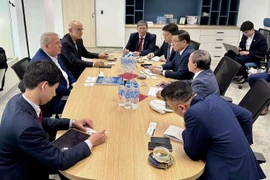
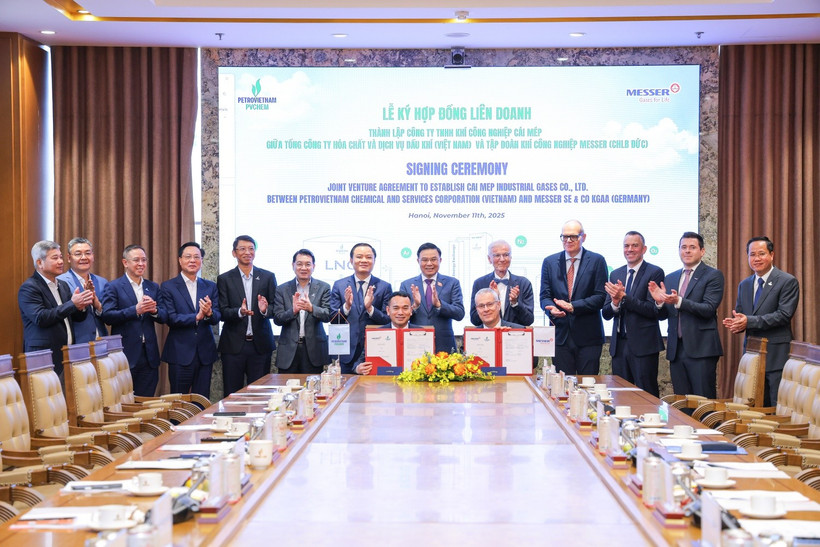
PVChem’s Board of Directors Chairman Truong Dai Nghia and Messer CEO Bernd Eulitz sign the agreement to launch a joint-venture agreement to establish Cai Mep Industrial Gas Co., Ltd. (Source: petrotimes.vn)

Hanoi (VNA) - Petrovietnam Chemical and Services Corporation (PVChem), a member of the Vietnam National Industry - Energy Group (Petrovietnam), and Germany’s Messer SE Co. KGaA on November 11 signed a joint-venture agreement to establish Cai Mep Industrial Gas Co., Ltd.

The joint venture will develop an industrial gas plant at the Cai Mep Industrial Park in Ho Chi Minh City, with an annual capacity of 200,000 tonnes and total investment of around 37 million USD. Construction is scheduled to begin in the third quarter of 2026 and commercial operations in the third quarter of 2028.

Designed under green and circular economic principles, the plant will use cold energy from PV GAS’s LNG storage to support deep-cooling in the air separation process. It will apply European cryogenic air separation (CAS) technology while recovering cold energy from LNG regasification, significantly cutting electricity and cooling-water consumption, reducing indirect carbon emissions and improving environmental performance. The facility will form a key link in Petrovietnam’s LNG–industrial gas–clean energy value chain.

The project is a pioneering initiative in energy transition, green production and value-chain integration for both Petrovietnam and PVChem, and one of Messer’s flagship global projects, underscoring its commitment to low-carbon production.

PVChem’s Board of Directors Chairman Truong Dai Nghia said the company had proactively sought partnership with Messer to address market demand and growth needs, creating a model of international cooperation combining global technology, domestic infrastructure and a stable market.

Under Petrovietnam’s value-chain strategy, PVChem and PV GAS are advancing the LNG–industrial gas–clean energy link, leveraging cold energy from PV GAS’s Thi Vai LNG Terminal to reduce dependence on electricity. This circular approach turns one unit’s by-product into another’s production input, reinforcing internal synergy. PVChem pledged to deliver the project on schedule.

Messer CEO Bernd Eulitz said the company was honoured to work with PVChem and Petrovietnam on integrating LNG and ASU technologies to optimise energy efficiency and meet European environmental standards.

Chairman of the Supervisory Board of Messer Stefan Messer added that the project would help Vietnam reduce industrial carbon emissions through the use of low-emission gases vital to multiple economic and medical sectors.

Petrovietnam General Director Le Ngoc Son congratulated the two companies, stressing the group’s role in ensuring national energy security and leading the transition towards clean energy through improving existing value chains and investing in low-carbon solutions, green energy, hydrogen and green chemicals. He described the Cai Mep project as a model of this strategic direction.

He urged PVChem, PV GAS and all partners to continue close coordination, noting that PV GAS will be crucial in providing a stable LNG supply for the plant. Petrovietnam’s leadership expressed confidence that the cooperation would open opportunities for further joint ventures with Messer, particularly in clean energy and emerging technologies.

Marking its 50th anniversary in 2025, Petrovietnam has grown into Vietnam’s leading economic group and a cornerstone of national development and energy security, supported by strong financial capacity, advanced technology and a skilled workforce. Its ecosystem spans three pillars: Energy, Industry and Services.

PVChem specialises in oil and gas chemicals, technical services, green production and renewable energy. With more than 35 years of development, it aims to become a regional leader in chemicals and industrial services and a pioneer in green transition and circular-economy initiatives.

Messer, the world’s largest privately owned industrial, medical and specialty gases group, operates in over 60 countries with 127 years of experience. Active in Vietnam since 1997, it is among the country’s largest German investors, with plants in Hai Phong, Thai Nguyen, Quang Ngai, Binh Duong and Tay Ninh./.
VNA

See more

VinFast EV sales jump 127% in March 2026. (Photo: Vinfast)

VinFast EV sales jump 127%, cementing market dominance

According to its report, all models in VinFast’s EV lineup recorded strong growth in March. Notably, on March 28 alone, the company completed 3,520 orders, the highest number ever recorded in a single day by an automotive brand in Vietnam.

Illustrative image (Photo: VNA)

Australia announces import conditions for Vietnamese pomelos

Australia’s formal publication provides an important legal basis, marking the completion of the review, assessment and agreement on technical requirements for fresh Vietnamese pomelos. This represents a significant step forward in market access, creating favourable conditions for relevant agencies, localities and businesses to prepare for export activities in the coming time.

Containers of fresh Vietnamese durian for export are subject to a full-chain traceability system. (Photo: VNA)

First “green lane” durian shipment exported to China

​Under the “green lane” process, quality control begins at the cultivation stage, including soil sampling and monitoring, and continues through harvesting and processing, with traceability labels attached to trees and applied to fruit at the time of picking. It also allows plant quarantine procedures and the issuance of certificates of origin (C/O) directly in the localities where the orchards are located.

Delegates at the Vietnam Expo 2026 (Photo: VNA)

Vietnam pushes for deeper auto supply chain ties with RoK

The RoK stood as Vietnam’s largest foreign investor with more than 95.2 billion USD in registered capital as of February 2026, or about 18% of all foreign cash flowing in, with thousands of active projects. In January-February alone, the RoK led the pack with nearly 2 billion USD in pledges, grabbing a whopping 32.7% of total registered capital and showing no signs of slowing down.

More than 600 tourism firms, 15 countries and territories, and 34 provinces and cities are promoting destinations and introducing tourism products at the fair (Photo: VNA)

Digital transformation key to elevating Vietnam’s tourism: official

Speaking at the opening of the Vietnam International Travel Mart (VITM) 2026 in Hanoi on April 10, Deputy Minister of Culture, Sports and Tourism Ho An Phong noted that despite challenges in 2025, Vietnam largely fulfilled its socio-economic development goals. Tourism remained a bright spot, recording 21.5 million foreign arrivals and 135.5 million domestic visitors, with total revenue exceeding 1 quadrillion VND (37.9 billion USD).

A drone sprays fertiliser over rice fields. (Photo: VNA)

Low-altitude economy emerges as new growth driver for Vietnam

The UAV technology is particularly effective in addressing challenges faced by ground infrastructure, especially in densely populated urban areas and remote regions. Smart aerial devices also enable real-time data collection, improving governance, decision-making and digital transformation across industries.

Passengers at Cat Bi Airport in Hai Phong city (Photo: VNA)

Aviation sector ensures fuel supply for April 30–May 1 peak

Aviation fuel suppliers are actively negotiating and diversifying supply sources both domestically and internationally, while strengthening coordination, storage and distribution capacity to meet immediate demand. These efforts aim to support airlines in optimising operations and maintaining stable flight schedules.