Quality, branding, sustainability essential for Vietnamese coffee to go global: Insiders

With proactive business measures, market expansion policies, and improved product quality, Vietnam's coffee industry is still expected to achieve export turnover of around 7 billion USD in 2025.

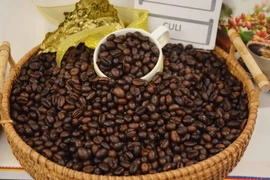
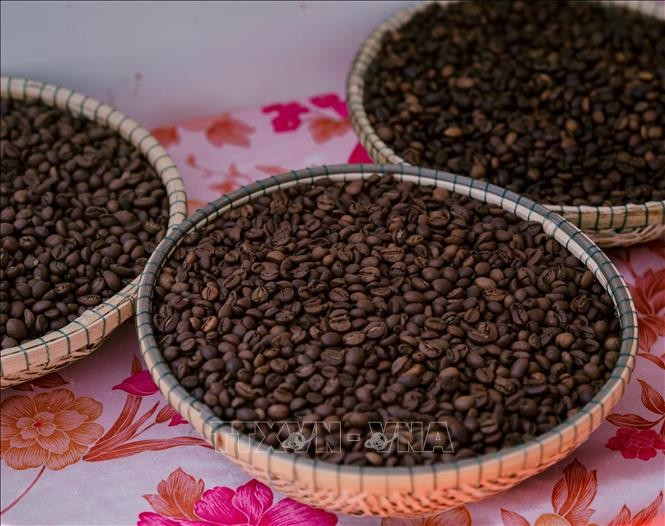
High-quality robusta coffee of the Central Highlands (Photo: VNA)

Hanoi (VNA) – With coffee prices consistently high and export markets showing impressive growth, Vietnam’s coffee industry is entering a golden phrase, requiring it to reposition itself on the global map through better quality, branding, transparent traceability, and sustainability, according to insiders.

In key Central Highlands regions, coffee prices are hovering around 125,000-126,000 VND (4.82 – 4.86 USD) per kilogramme, with expectations of increasing to above 130,000 VND in the coming period.

Chairman of Simexco Daklak Company Limited Le Duc Huy, also Vice President of the Dak Lak Coffee Association, said farmers hold about only 15% of the coffee supply. Farmers are releasing their stock cautiously while international buyers are proactively purchasing coffee with stable volumes to stockpile while waiting for the coffee harvests in Brazil and Indonesia in Quarter 2.

Huy noted that this year's coffee supply cannot meet market demand. However, due to ongoing complex global geopolitical situations, customers are shifting to a strategy of purchasing just enough for actual needs to minimise risks.

According to the Ministry of Agriculture and Environment, Vietnam shipped 3.78 billion USD worth of coffee abroad in the first four months of the year, a 51.1% increase compared to the same period last year. The average export price of coffee reached 5,698 USD per tonne, up more than 67%, reflecting a clear improvement in the quality and position of the product in the global market. Robusta coffee, Vietnam's flagship product, has been particularly favoured in Asian and European markets due to its consistent flavour and abundant supply compared to competitor nations.

However, Europe, accounting for 41% of Vietnam’s total exports, is preparing to implement the EU Deforestation Regulation (EUDR) in the end of this year, forcing products to be fully traceable and sourced from deforestation-free supply chains. Against the backdrop, experts said the Vietnamese coffee industry must urgently transform cultivation methods, apply digital technology, and implement sustainable certification processes throughout the entire supply chain.
ca-phe-viet-nam.jpg
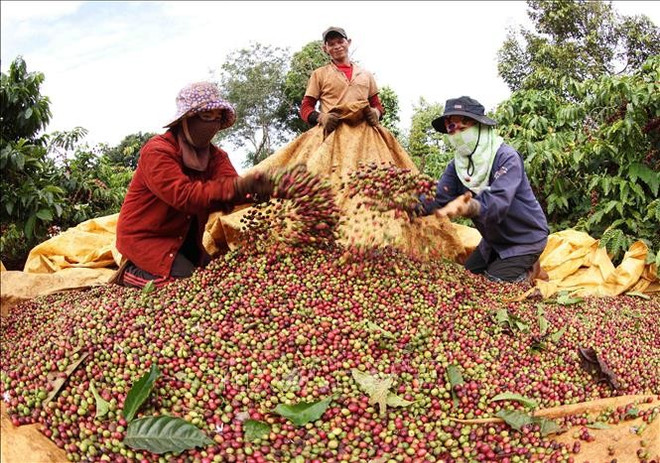
Farmers in coffee harvesting season (Photo: VNA)

Some players have already adapted. The Bu Dop coffee cooperative in Binh Phuoc province is pioneering specialty coffee production using organic practices, intensive processing and advanced freeze-drying techniques to preserve the fruit flavour. The cooperative is also reforming its operations to retain the essence of native coffee varieties.

Notably, industry collaboration is also gaining traction. A recent strategic Memorandum of Understanding between Highlands Coffee and Simexco Dak Lak marks a significant step towards redefining Vietnamese robusta as a value-added product meeting the international standards of quality and sustainability.

Alongside these positive signals, the coffee industry still faces many internal challenges such as climate change, aging plantations, and limited processing technology.

Deputy Director of the Department of Agricultural, Forestry and Fishery Quality Management in Dak Lak province Bui Duc Thien believed that for sustainable development, the industry needs comprehensive reform from cultivation to harvesting, processing, and market linkages. If farmers receive support in accessing sustainable farming techniques and businesses invest heavily in deep processing, Vietnamese coffee is able to stand firm in the global competition.

With proactive business measures, market expansion policies, and improved product quality, Vietnam's coffee industry is still expected to achieve export turnover of around 7 billion USD in 2025./.

VNA

See more

An image of a Vietnamese game. CIS region has potential for gaming developers from Viet Nam. (Photo: Courtesy of cellphones.com.vn_

CIS: Opportunity for game developers in Vietnam

The CIS region, which includes Eastern Europe and Central Asia, has potential for gaming developers from Vietnam as this market displays user behaviour patterns that are highly favourable for mobile gaming growth, particularly around major holiday periods.

Banks, including MB Bank, have issued alerts about scams conducted via social media platforms such as Zalo and Facebook, where criminals impersonate acquaintances. (Photo: The Courtesy of MBBank)

Financial scams surge ahead of Tet

As the Lunar New Year (Tet) approaches, financial and banking scams in Vietnam are showing a sharp upward trend, prompting banks and law enforcement agencies to issue repeated warnings.

Hai Phong targets 4.3 billion USD in FDI in 2026 (Photo: VNA)

Hai Phong city targets 4.3 billion USD in FDI in 2026

Hai Phong’s investment appeal is underpinned by a rapidly expanding development space, including the Southern Coastal Economic Zone covering more than 20,000 hectares, a planned free trade zone, deep-water ports at Lach Huyen, and 12 industrial parks newly established in 2025.

The relocation of check-in counters aims to better meet the travel needs of residents and visitors. (Photo: VNA)

Vietjet shifts domestic check-in at Tan Son Nhat from January 13

During the recent New Year 2026 holiday peak, Vietjet added 380 flights, equivalent to nearly 78,000 additional seats, on many key domestic routes linking Hanoi and Ho Chi Minh City with destinations such as Vinh, Thanh Hoa, Hai Phong, Da Nang, Phu Quoc, Nha Trang and Da Lat.

Commercial banks are providing approximately 88% of total green credit outstanding in Vietnam. (Photo: nhandan.vn)

Capital sources expanded for sustainable growth

According to the State Bank of Vietnam (SBV), by the end of November 2025, outstanding green credit was estimated at around 750 trillion VND (28.55 billion USD), with an average growth rate exceeding that of overall credit in the economy.

Customers select goods at a supermarket. (Photo: VNA)

Retail market expands sharply, sustainability challenges persist

According to a report on recently released by the Ministry of Industry and Trade’s Agency for Domestic Market Surveillance and Development, the size of the market reached more than 7 quadrillion VND (about 266 billion USD) in 2025, up around 10% compared with 2024.

Oil rigs at the Bach Ho oil field. (Photo: VNA)

Resolution 79: State economy to lead growth

Resolution 79 is described as a “clear action declaration” by the Politburo, saying the state economy is not only responsible for maintaining macroeconomic stability, but must also become the force leading a new growth model that is green and sustainable.

Workers at Garment 10 Corporation produce apparel for export. (Photo: Nhan Dan)

Vietnam leverages export advantages within RCEP region

In 2025, seafood exports to China alone exceeded 2.2 billion USD, up about 33% compared to 2024. Shipments to Japan fetched nearly 1.7 billion USD, a year-on-year increase of 14.6%, while those to the Republic of Korea and Australia grew by 9.6% and 3.2%, respectively.

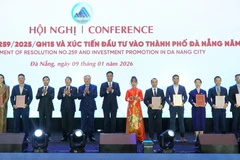
Certificates of membership in the Vietnam International Financial Centre in Da Nang are awarded at the conference on January 9. (Photo: VNA)

Da Nang continues targeted investment promotion approaches

According to Chairman of the Da Nang People’s Committee Pham Duc An, the city prioritises building sustainable economic ecosystems and focuses on key breakthrough sectors with strong spillover effects, including high technology and digital transformation, logistics, urban infrastructure, finance, processing and manufacturing industries, high-tech agriculture, and the pharmaceutical and medicinal herb industry.

In 2025, Hyundai sales reached 53,229 vehicles across the Vietnamese market. (Illustrative photo: Yonhap/VNA)

Hyundai sales in Vietnam rise almost 23% in December

In 2025, sales reached 53,229 vehicles across the market, a result considered a testament to the efforts by TC Group, Hyundai Thanh Cong, and the entire Hyundai dealership network nationwide amidst a volatile market.