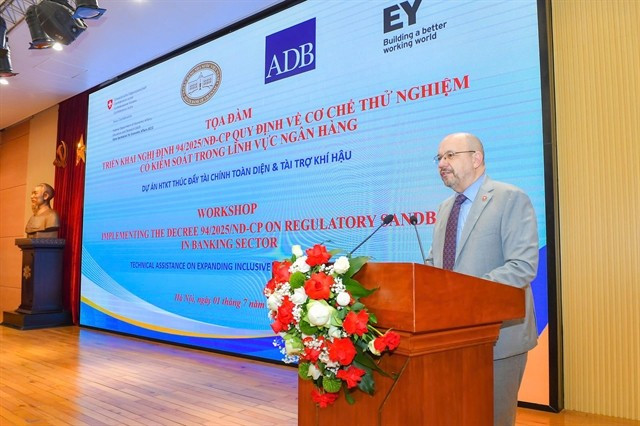
Hanoi (VNS/VNA) - Vietnam’s Regulatory Sandbox Decree is more than just a legal instrument, it is a bold policy innovation, Swiss Ambassador to Vietnam Thomas Gass said at an event on July 1.
At the workshop implementing Decree 94/2025/ND-CP on regulatory sandbox in the banking sector, which is Vietnam’s first regulatory sandbox and takes effect from July 1, held by the State Bank of Vietnam (SBV), Gass said: “The official launch of the Regulatory Sandbox Decree is a milestone in Vietnam’s journey towards digital financial transformation, and a shining example of what strong partnerships and shared vision can accomplish.
"The decree provides a structured, transparent, and agile testing environment for fintech solutions, an environment that enables innovation while safeguarding consumers and maintaining the integrity of the financial system.”
According to Gass, small- and medium-sized enterprises (SMEs) are vital to Vietnam’s future. With more than 95% of registered enterprises being SMEs, the private sector plays a decisive role in driving economic growth, innovation, and digital transformation.
Resolution 68 of the Vietnamese Government underscores this by identifying the private sector as a key engine for economic growth and innovation. Yet, they often struggle to access adequate financing. Traditional banks still view SMEs as high-risk clients, leading to collateral-heavy lending policies. For many SMEs, this presents a barrier too high to overcome. In addition, highly centralised credit approval systems make small loan processing inefficient and costly.
To unlock the potential of SMEs, Vietnam must re-imagine how financial services are delivered, and fintech offers a promising path forward. Digital finance brings not only efficiency gains but also new channels for reaching underserved populations and tailoring services to their needs. More importantly, it fosters financial inclusion, giving more individuals and businesses the tools they need to thrive.
The Swiss Ambassador said: “The Regulatory Sandbox Decree is a timely response to this challenge. It provides an enabling space for fintech firms to test and scale solutions in a controlled environment. This not only encourages innovation from existing providers but also lowers entry barriers for start-ups and new market players. By offering a simplified, flexible, and time-bound licensing process, this decree enables new technologies, such as AI, blockchain and open banking, to emerge and scale safely.”
Ron H. Slangen, Deputy Country Director, Vietnam Resident Mission, Asian Development Bank (ADB) told the event that the financial landscape worldwide, specifically in Vietnam, is currently undergoing a remarkable transformation fueled by revolutionary technologies like cloud computing, big data analytics, open application programming interface (Open API), blockchain, and Artificial Intelligence.
This dynamic shift is reshaping traditional banking structures and giving rise to innovation of non-bank entities and financial technology start-ups, distinctly referred to as fintechs. In this context, a well-defined regulatory framework will provide fintechs with the confidence to innovate free from fears of legal or operational uncertainties.
The Deputy Country Director said: “In Vietnam, the banking sector, including fintechs, has made significant progress in digital transformation with increased availability of mobile wallets, digital lending platforms and API-driven banking services.
"The SBV has taken decisive actions to promote digital banking transformation and the development of a vibrant fintech ecosystem. Significant policy and regulatory reforms have been made, especially the new Law on Credit institutions 2024, which includes a critical provision on the Fintech sandbox, setting the legal basis for a more open and innovative financial landscape.
“The newly issued Decree 94/2025/NĐ-CP on Fintech regulatory sandbox represents an important milestone in establishing a legal framework for fintech firms piloting new products and services under the close supervision of the SBV.
"The sandbox will further accelerate the banking digital transformation journey by providing a clear, controlled environment where innovative financial products and services can be tested and refined before widespread implementation. This allows regulators to assess risks, ensure consumer protection, and fine-tune regulatory frameworks, enabling the safe and effective scaling of digital solutions that enhance financial inclusion, particularly in rural areas.”
According to SBV’s Deputy Governor Pham Tien Dung, under Decree 94/2025/ND-CP, there are three solutions considered to participate in the sandbox: credit scoring, data sharing via open API and peer-to-peer lending (P2P Lending).
During the implementation of the decree, the SBV will continue to review and update new products, services, and business models in the banking sector to evaluate and propose expanding the solutions participating in the regulatory sandbox.
The workshop was aimed at equipping banks, fintech firms, and government agencies with the knowledge and tools needed to operationalise the sandbox safely, ignite innovation, and fortify the foundation for a resilient, inclusive digital finance ecosystem./.

Regulatory sandbox, a game-changer for innovative enterprises
Translating resolutions into real actions requires strong State and enterprise participation. With the right policies, the private sector can make breakthroughs and become a solid pillar of the national economy.