Minister of Education and Training Phung Xuan Nha works with Hung Yen leaders on school violence (Source: VietnamPlus)
Hanoi (VNA) - School violence is a pressing issue of not only Vietnam but also many other countries worldwide. What other nations have done to address it? What will Vietnam do to make improvements?
Given increasing school violence cases, the Government has joined in the fight against the phenomenon, requesting relevant ministries and sectors to sit down together for new and practical solutions that could solve the problem at its root.
Problem of not only Vietnam
According to Education and Training Minister Phung Xuan Nha, school violence is present not only in Vietnam but also in other parts of the world, even developed nations like Japan, Australia, and Republic of Korea.
In Japan, the situation is getting more intense, even leading to suicides among students. In 2013, the country issued a law on bullying prevention, under which each school has to set up an anti-bullying policy and make reports on the issue.
In Australia, the third Friday of March is the annual National Day of Action against Bullying and Violence, an occasion for high schools to meet and share experience.
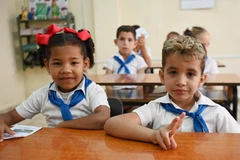
 School violence is a pressing issue of not only Vietnam but also many other countries worldwide. (Source: educhatter.wordpress.com)
The Republic of Korea, meanwhile, has launched a series of consultation programmes targeting the victims of school violence and training courses for teachers and parents to deal with bullying.
School violence is also nothing new thing in New Zealand, but it just happens among students and there is no case of teachers using physical force against students, said Chris Henderson – Associate Director of the International Education and Development Department, Waikato University, New Zealand.
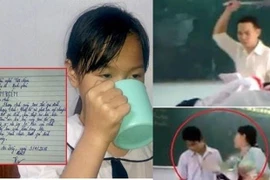
However, the situation is slightly different in Vietnam, as the country needs to tackle both bullying among students and teachers’ corporal punishment that goes too far.
 While other countries mostly focus on addressing bullying, the issue of teachers beating students is also causing great concern in Vietnam. (Source: internet)
New solutions
Given increasing school violence cases, the Government has requested relevant ministries and sectors to sit down together to tackle the problem.
Minister Nha said various solutions have been actively carried out over the recent past, but more measures are needed.
On April 4, the Ministry of Education and Training had a meeting with the Ministry of Labour, Invalids and Social Affairs (MoLISA) to put forth such measures.
The meeting resulted in five groups of solutions, namely common solutions to child abuse; coordination mechanisms among local departments and sectors; adults’ responsibilities in the school-family-society child protection model; dissemination of legal knowledge; and training self-protection skills against violence and sexual abuse for children.
Solutions specifically designed for each level of education was also discussed. While the preschool level needs an improvement in teachers’ virtue and problem-solving experience, secondary and high school education requires psychological consultation services.
 Ministries of Education and Training and of Labour, Invalids and Social Affairs discuss ways to handle school violence (Source: Ministry of Education and Training).
The MoLISA agreed to steer communications campaigns on anti-child abuse, particularly at schools. Meanwhile, the education ministry took the responsibility of boosting the education on children’s legal rights and duties; equipping children with knowledge, soft skills, and self-protection skills via consultation groups, forums and conferences; and popularizing the national child protection hotline 111.
The two ministries said they will work together to enhance the capacity of managers at provincial and municipal departments of education and of labour, invalids and social affairs in implementing measures to curb child abuse. They also agreed to collaborate with the Ministry of Public Security to build a standard process for coordination in the detection, verification, support and addressing of violence and abuse against children at schools.
[Experts propose solutions to school violence]
International cooperation to fight school violence
 The Ministry of Education and Training and the RoK's EBS sign a cooperation pact on combating school violence (Source: Ministry of Education and Training)
In late March, the Ministry of Education and Training, the Vietnam Television (VTV), and the Republic of Korea’s Educational Broadcasting System (EBS) signed a memorandum of understanding on communications cooperation in preventing school violence and educating virtue for Vietnamese students.
Accordingly, the EBS will provide related communications experts, programmes, and publications for the Vietnam national education channel VTV7, which will be in charge of turning out standard products in Vietnamese for broadcasting.
The ministry’s Department of Political Education and Students’ Affairs and the EBS will organise conferences, seminars, and forums to introduce models and measures to combat school violence and educate virtue from the RoK to personnel overseeing education and students’ affairs at educational management agencies and schools in Vietnam.
Minister Nha hoped such cooperation will result in practical outcomes./.