Self-reliance, resilience – defining elements in Vietnam’s development journey: Malaysian scholar

The expert noted that this spirit of independence continues to guide Vietnam today. The country has skillfully balanced relations with major powers such as the US and China, while refusing to let external forces dictate its policy decisions.

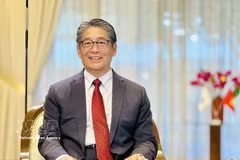
Malaysian international relations and politics researcher Sim Hong Chun. (Photo: VNA)

Kuala Lumpur (VNA) – Dr. Sim Hong Chun, a Malaysian international relations and politics researcher, has highlighted Vietnam’s historic path to independence and its continued achievements, stressing that self-reliance and resilience have been the two defining elements throughout the nation’s development.

Speaking to the Vietnam News Agency (VNA)'s resident reporter on the occasion of the 80th anniversary of the August Revolution (August 19, 1945) and Vietnam’s National Day (September 2), the researcher said that before gaining independence, Vietnam had endured decades of colonial rule under France. Since 1858 when French colonialists came to Vietnam, the national spirit was kindled and expressed through many patriotic movements, but it was not until the emergence of President Ho Chi Minh as leader of the Indochinese Communist Party (now the Communist Party of Vietnam) that this strength was consolidated into a nationwide revolution.

The opportunity came after World War II, when Japan ousted the French administration in Indochina in March 1945. For President Ho Chi Minh, both France and Japan were invaders intent on exploiting Vietnam’s resources. He charted the course for the August Revolution in 1945, which ultimately led to the establishment of the Democratic Republic of Vietnam (now the Socialist Republic of Vietnam). This was a profoundly self-determined act, free of external influence, he stressed.

When President Ho Chi Minh proclaimed independence at Ba Dinh Square on September 2, 1945, the young republic soon faced renewed conflict with France. Despite failed negotiations, President Ho Chi Minh remained steadfast, leading the people through years of resistance until the decisive Dien Bien Phu victory in 1954, which forced France to sign the Geneva Accords.

He underlined the significance of the August Revolution, saying Vietnam was among the first countries in the colonial world to claim independence. President Ho Chi Minh’s Declaration of Independence sent a powerful message to colonised nations that they were entitled to freedom. He shattered the entrenched belief that only Western powers had the right to govern, inspiring anti-colonial movements worldwide, including in Malaysia under British rule at that time.

The expert noted that this spirit of independence continues to guide Vietnam today. The country has skillfully balanced relations with major powers such as the US and China, while refusing to let external forces dictate its policy decisions. Despite global uncertainties, Vietnam maintains neutrality and pursues diversified diplomacy, expanding ties with partners ranging from Japan, the Republic of Korea and India to Brazil and other BRICS members.

Economically, he highlighted Vietnam’s financial autonomy, noting that the country has no outstanding debts to international institutions such as the International Monetary Fund (IMF). This demonstrates its capacity to chart an independent course in all fields.

Vietnam has also made important contributions to global peace. From a war-torn nation, it has become one of the world’s fastest-growing economies. More significantly, Vietnam has drawn on its own history to support international peacekeeping efforts, particularly in conflict-affected African countries such as South Sudan and the Central African Republic.

The researcher praised Vietnam’s practical contributions, including building field hospitals, delivering medical and food aid to refugees, and supporting local infrastructure reconstruction. He noted the special role of Vietnamese female peacekeepers, who have inspired women in host communities and provided hope and reassurance to vulnerable groups, especially women and children displaced by conflicts.

He concluded that Vietnam’s experience shows how a country once scarred by war can become a source of inspiration for global peace and development. Its resilience, independence and contributions to international stability are achievements that the world should value and learn from./.

VNA

See more

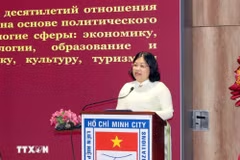
Nguyen Truong Nhat Phuong, Vice Chairwoman of the Ho Chi Minh City People's Council and President of the city's Vietnam-Russia Friendship Association, speaks at the gathering. (Photo: VNA)

Ho Chi Minh City seeks to strengthen cooperation with Russian localities

The Russian October Revolution laid the foundation for the longstanding friendship between Vietnam and Russia. Despite ups and downs of history, the traditional Vietnam-Russia friendship has been strengthened and nurtured by generations, with bilateral ties elevated to a Comprehensive Strategic Partnership.

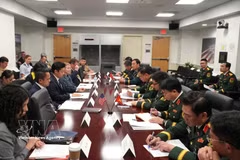
An overview of the 14th Vietnam–US Defence Policy Dialogue. (Photo: VNA)

14th Vietnam–US Defence Policy Dialogue held in Washington DC

Deputy Minister of National Defence Nguyen Truong Thang called for greater sharing of information, documents and memorabilia concerning Vietnamese servicemen killed or missing in action, as well as support in strengthening DNA identification capacity to accelerate Vietnam's 500-day campaign to intensify the search for, collection and identification of the remains of fallen soldiers.

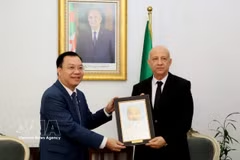
Vietnamese Ambassador to Algeria Vu Duy Long presents a portrait of President Ho Chi Minh to Abdelkrim Benmbarek, Secretary-General of Algeria’s National Liberation Front (FLN). (Photo: VNA)

Algeria holds a special place in Vietnamese hearts: Ambassador

The elevation of Vietnam–Algeria ties to a Strategic Partnership in November 2025 reflects strong political trust and the determination to usher bilateral cooperation into a new phase. The immediate priority is to translate this framework into concrete programmes and projects, particularly in defence, security, the economy, trade, investment, energy, agriculture, science and technology, said Ambassador Vu Duy Long.

Le Hong Phong Lower Secondary School in Ha Long ward, Quang Ninh city. Public science and technology organisations, public educational institutions, and non-profit private educational institutions are expected to be exempt from tax in accordance with government regulations. (Photo: VNA)

Amendments considered for rules on income, non-agricultural land use taxes

The draft law incorporates provisions on corporate and personal income tax exemptions for income generated from providing catering services for educational institutions and medical establishments, cases of non-agricultural land use tax exemption for educational institutions, and non-agricultural land use tax exemption for ethnic minorities.

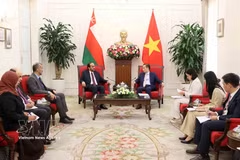
Minister of Foreign Affairs Le Hoai Trung receives Undersecretary for Political Affairs at the Foreign Ministry of Oman Khalifa bin Ali bin Issa Al-Harthy in Hanoi on November 5. (Photo: VNA)

Vietnam, Oman urged to open diplomatic missions soon

Minister of Foreign Affairs Le Hoai Trung praised the outcomes of the fifth political consultation between the two foreign ministries, held on November 4, and called on them to strengthen coordination, build political trust and promote exchanges of high-level and other delegations.

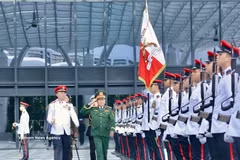
General Nguyen Tan Cuong (R) and Vice Admiral Aaron Beng inspect the guard of honour. (Photo: VNA)

Vietnam, Singapore enhance defence cooperation

Highlighting the positive development of relations between the two countries and their militaries, General Nguyen Tan Cuong, Member of the Central Military Commission’s Standing Board, Chief of the VPA General Staff and Deputy Minister of National Defence, noted that Vietnam and Singapore share strategic interests and considerable potential for cooperation, as well as a common commitment to peace, stability and prosperity.

Spokesperson of the Ministry of Foreign Affairs Pham Thu Hang (Photo: Ministry of Foreign Affairs)

Vietnam-Japan Comprehensive Strategic Partnership develops comprehensively, substantively: Spokesperson

Over recent years, the Vietnam-Japan Comprehensive Strategic Partnership has continued to develop comprehensively and substantively through all Party, Government and parliamentary channels, as well as people-to-people exchanges, and cooperation between ministries, sectors and localities, and across all fields, said Spokesperson of the Ministry of Foreign Affairs Pham Thu Hang.