Dong Thap (VNA) - The introduction of the “smart village” model in the Mekong Delta province of Dong Thap is helping to raise living standards for residents by improving infrastructure and supporting sustainable farming.
Digital tools for rural areas
Huynh Minh Tuan, Vice Chairman of the provincial People’s Committee, said the initiative aims to drive rural development, raise living standards, and promote sustainable agricultural production that yields high economic value.
Residents benefit from better connectivity, easier access to public services, and more efficient resource use, all while reducing environmental impact, Tuan noted.
Tan Thuan Tay commune, in Cao Lanh city, was the first locality in the province chosen to pilot the smart village model — a national research initiative approved by the Ministry of Science and Technology and led by the University of Technology (VNU–HCMC).
The province now has six certified smart villages, namely Doc Binh Kieu (Thap Muoi district), Dinh Yen (Lap Vo district), Binh Thanh and My Xuong (Cao Lanh district), and Tan Nhuan Dong and An Nhon (Chau Thanh district). This is a significant step forward in building digital governance, developing the digital economy, and shaping a digital society, bringing numerous benefits through technology-based platforms.
The smart village model builds on the farmers’ community centre in Tan Thuan Tay to encourage agricultural innovation, improve local livelihoods, and help communities adapt to climate change, according to Dang Van Nhung, head of the centre.
Farmers now use QR codes to trace every mango tree across 500 hectares of orchards and apply VietGAP and organic practices to improve income and market responsiveness. They also know how to conduct community-based tourism to promote the value of local resources, and apply advanced science and technology in production and daily life.
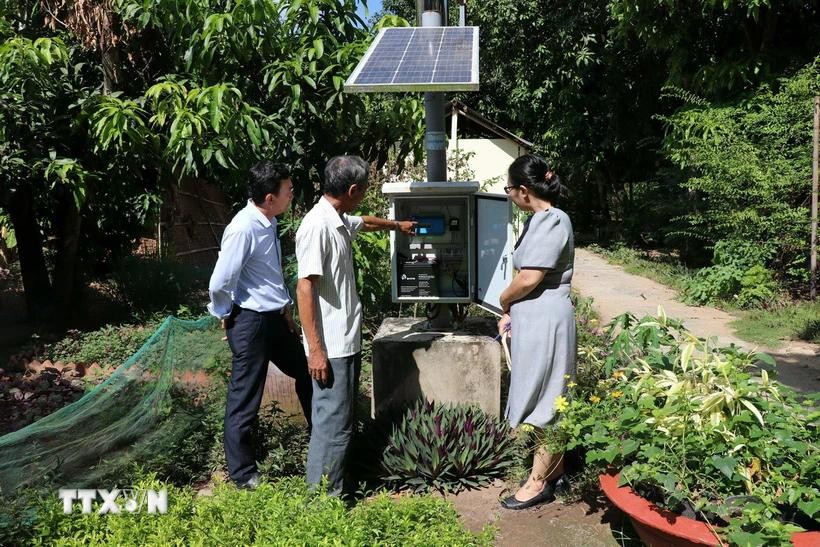
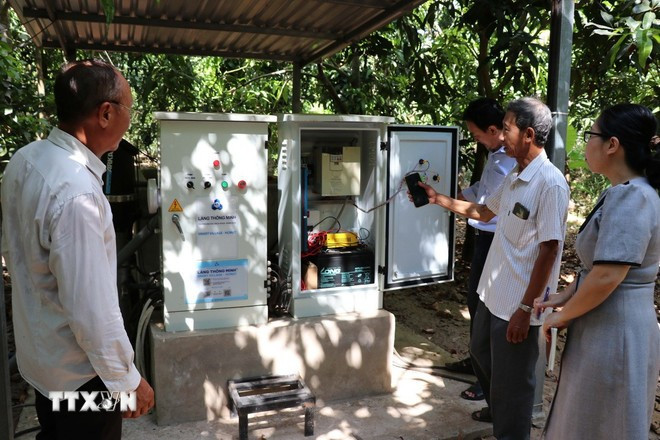
Tan Thuan Tay also features a smart village portal for farmers’ groups, data storage and analysis systems, automated irrigation powered by solar energy, smart street lighting, surveillance cameras, an environmental monitoring system, and a mobile app for community members and managers.
Smart tech in agricultural production
Meanwhile, My Xuong commune in Cao Lanh district is pursuing a complementary “e-commerce village” initiative, bringing digital tools into agricultural production.
The model helps build transparent data on farm produce, boosts consumer trust, and expands sales through both direct and online marketplaces in combination with cashless payment options.
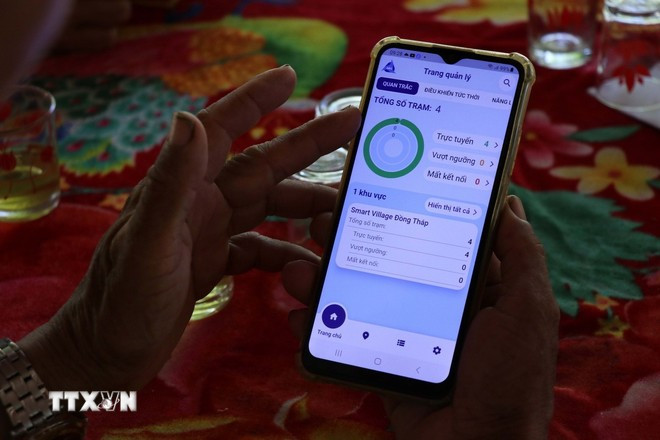
Tran Phu Hau, a farmer from My Xuong, said that applying technology to production helps save time and costs, optimise cultivation, easily monitor product quality, and increase output value thanks to traceability.
Previously, they mostly sold to small traders, but now they can list their mangoes on e-commerce platforms and reach customers outside the region, he said.
Public safety has also improved thanks to new security cameras installed at key locations, making people feel safer, he added.
The provincial Department of Science and Technology plans to continue investing in digital infrastructure, upskilling people in smart villages, and developing technology-driven agricultural models that meet rural needs.
The department will also deepen cooperation with research institutes and companies to deliver practical digital solutions, focusing on smart farm management, energy-saving equipment, and agricultural innovations to benefit rural communities./.