
Hanoi (VNA) – Prime Minister Pham Minh Chinh has reaffirmed the Government’s commitment to creating favourable conditions, accompanying stakeholders, and removing bottlenecks in institutions, infrastructure and human resources so that science and technology, innovation, digital transformation and administrative reforms truly become new growth engines.
PM Chinh, who is also Head of the Government’s steering committee for the development of science, technology, innovation, digital transformation and Project 06, made the remarks while chairing a conference on December 18 to review one year of implementing the Government’s action programme for the Politburo's Resolution No. 57-NQ/TW, five years of the overall public administration reform programme, and four years of performing Project 06.
He commended ministries, sectors and localities for their efforts and achievements, as well as the strong consensus and active participation of people and businesses, which have made significant contributions to science and technology, innovation, digital transformation, administrative reforms and Project 06.
However, the PM also pointed out existing shortcomings, including unfulfilled targets, insufficient financial resources for science and technology, innovation and digital transformation, and research and development spending still far below the 2% of GDP target. He noted delays in implementing programmes and plans, inadequate digital infrastructure, slow development of national and sectoral databases, limited progress in cutting and simplifying administrative procedures and low rates of fully online public services.
The government leader stressed that breakthroughs in science and technology, innovation, digital transformation and administrative reforms are an objective requirement and a strategic choice for Vietnam, serving as a priority for investment and a key lever for restructuring the economy, boosting labour productivity, improving state governance efficiency and national competitiveness, and creating new growth drivers to achieve double-digit economic growth in the coming period.
Emphasising three strategic digital breakthroughs - digital institutions, digital infrastructure and digital human resources - PM Chinh called for close integration of science and technology development, innovation, administrative reforms, digital transformation and Project 06 with efforts to streamline the organisational apparatus and modernise leadership, management and working styles.
For the time ahead, the government leader requested heads of ministries, sectors and localities to focus on strong leadership, prioritise timely and adequate resource allocation, and ensure progress and quality in fulfilling assigned tasks. He instructed ministries and sectors to promptly issue detailed regulations and implementation guidelines for laws passed by the 15th National Assembly at its 9th and 10th sessions, while accelerating the review and amendment of related legal documents.
The PM assigned the Ministry of Science and Technology to task enterprises, scientific organisations, universities and research institutes with developing strategic technology products. Regarding national digital transformation and Project 06, he urged ministries, sectors and localities to work closely with the Ministry of Public Security to register for and use shared infrastructure at the National Data Centre.
He also called for accelerated development of telecommunications infrastructure, expanded broadband 5G coverage, deployment of Starlink satellite Internet, and planning of power and green energy infrastructure for data centres. Priority should be given to data classification, completing and putting into immediate use key databases, especially 12 critical national databases, and rapidly developing the VNeID platform into a national digital tool serving people and businesses.
On online public services and administrative procedure simplification, the PM requested public disclosure of standardised procedures and maximum use of national databases to replace paper documents.
He urged the technology business community to uphold national spirit, take the lead in mastering core technologies, and bring Vietnamese intellect to the global stage, while calling on every person to proactively become a “digital citizen” by continuously learning and improving digital skills to shape the future and help build a prosperous and happy Vietnam.
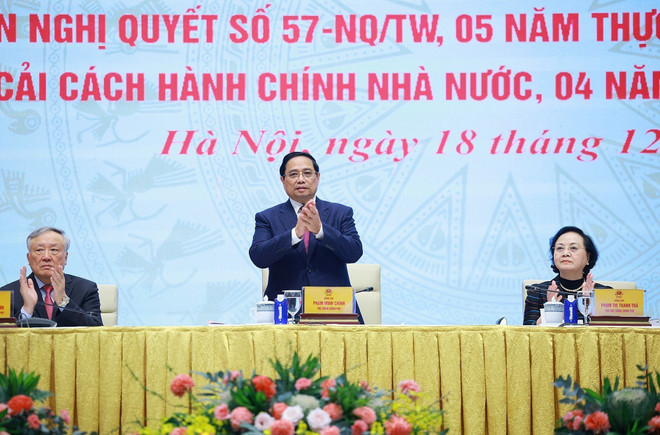
The conference noted that leadership and implementation efforts have been carried out decisively and in a coordinated manner from the central to grassroots levels. Institutional mechanisms and policies have been revised and improved to remove obstacles and mobilise resources for development.
Science, technology, innovation and digital transformation have expanded rapidly across sectors and aspects of life, with 11 groups of strategic technologies and 35 strategic technology products identified, the launch of innovation portals and technology exchanges, and Vietnam consistently ranking among the world’s top 50 countries in innovation.
Digital infrastructure has made major strides, with 5G coverage reaching nearly 59% of the population and Internet speeds climbing into the global top 20 in 2025. The National Data Centre No.1 operated in 2025, alongside the addition of three new submarine and terrestrial fibre-optic cables, doubling international connection capacity compared to the end of 2020.
Digital government development has accelerated, with online public services becoming more proactive and data-driven. The rate of fully online public service dossiers has reached 36.8%, while Vietnam’s e-government development index ranked 71st out of 193 countries in 2024, up 15 places from 2020.
The digital economy has grown strongly, with the number of digital technology enterprises rising from 58,000 in 2020 to about 80,000 in 2025. Digital technology exports are estimated at 172 billion USD in 2025, e-commerce at 36 billion USD, and cashless payments becoming widespread, alongside effective implementation of electronic tax and invoicing systems.
Project 06 has delivered tangible benefits, with the national population database increasingly effective through extensive data integration and cleansing. The VNeID platform has been widely used, integrating multiple services in finance, banking, education and healthcare.
Administrative reforms have been carried out vigorously and in close connection with digital transformation and Project 06, resulting in the reduction and simplification of 3,241 administrative procedures and business conditions during the 2021–2025 period.
At the conference, leaders of ministries, sectors and localities focused discussions on public–private–academic cooperation in high-quality human resource training, institutional reform, administrative reform experiences in construction and digital governance at grassroots levels, and civil service reform and talent attraction at the local level./.