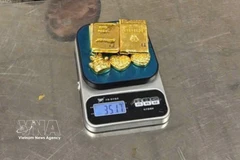
Ho Chi Minh City (VNA) - The People’s Court of Ho Chi Minh City on March 5 opened a first-instance trial for 19 defendants charged with illegally transporting currency across the border and money laundering in a particularly large-scale case involving underground money transfer networks between Vietnam and Cambodia.
The total value of transactions in the case is estimated at trillions of VND (with 1 trillion VND equal to about 38.15 million USD) and tens of millions of USD.
According to the indictment issued by the city People’s Procuracy, defendants Pham Van Nhan (born 1980, owner of the Vua (King) food business establishment), Do Viet Dai (born 1971, owner of Duc Long gold shop), Nguyen Thi Thu Thuy (born 1983), Duong Dai Nghia (born 1990, employee of Vua food company), Nguyen Thi Kim Ngan (born 1977, employee of Duc Long gold shop), and nine others were prosecuted for “illegally transporting currency across the border”.
Meanwhile, Mai Vu Minh (born 1995), Le Thi Tham (born 1976), Okoye Christian Ikechukwu (born 1985, Nigerian nationality), Nguyen Thi Thanh Thuy (born 1989), and Nguyen Thi Huong (born 1990) were charged with “money laundering”. Two other suspects, Mai Tra My (Minh’s elder sister) and Eneh Davidson Caleb (a Nigerian national), remain at large and have been placed on the wanted list.
According to prosecutors, Nhan was engaged in trading bird’s nests between Vietnam and Cambodia. Seeing the strong demand for cross-border money transfers, in 2016, Nhan and Thu Thuy rented premises to organise illegal money transfer operations, establishing networks on both sides of the border to facilitate transactions.
Nhan and Thu Thuy directly operated the network and hired Nghia, along with several employees, to handle money collection and delivery. Customers wishing to transfer money to Cambodia were instructed to meet Nghia to count the cash and record the recipient's details. Nghia or Nhan would then contact partners in Cambodia so that the recipients could collect the funds at pre-arranged locations. Transfer fees were deducted directly from the remitted amount.
Each transfer through this channel was limited to a maximum of 1 billion VND or 50,000 USD. Larger transfers were handled through another network run by Dai and Ngan.
Investigators determined that the network illegally transferred 304 billion VND and 4.8 million USD from Vietnam to Cambodia, while 303 billion VND and 4.9 million USD were transferred in the opposite direction. From 2016 until the ring was uncovered, Nhan and Thu Thuy allegedly earned illegal profits of about 24 billion VND, while Nghia received total wages of 828 million VND and other employees earned between 133 million VND and 600 million VND.
In the second network, Dai – owner of Duc Long gold and jewellery shop in Ho Chi Minh City – had previously been fined 1 billion VND by the People’s Court of Quang Nam province in 2022 for violations in gold trading.
Afterwards, Dai assigned Ngan to coordinate with Duyen, owner of Gold Shop 60 in Cambodia. Ngan rented premises on Cach Mang Thang Tam Street to manage transactions and record keeping, while instructions and payment details were exchanged via the Telegram application.
From late 2023 to April 2024, Ngan transferred about 2.05 trillion VND and 10.7 million USD from Cambodia to Vietnam, while receiving 35.4 billion VND and 8.1 million USD to send in the opposite direction, earning more than 1.2 billion VND in illegal profits. The pair also handled separate transfers of 150,000 USD for a client in China and 51,000 USD for a client in Cambodia.
Regarding money laundering, investigators found that Minh established multiple companies to conduct banking transactions, concealing illicit funds totalling 789,057 USD, earning more than 383 million VND under the direction of his sister My.
Tham similarly set up companies to disguise over 1.4 million USD, gaining more than 2 billion VND together with her husband, Ikechukwu. Other defendants also handled large sums, including Thanh Thuy with about 149.4 billion VND and Huong with about 56.7 billion VND in illicit transactions./.

Vietnam steps up anti-money laundering vigilance amid rising digital assets
Since the Anti-Money Laundering Law was enacted in 2022, the Anti-Money Laundering Department has received thousands of suspicious transaction reports (STRs) annually, with the number of reports growing by about 30% each year. Since 2023, based on these reports, the department has collected and analysed information, issuing nearly 600 documents related to over 5,000 STRs.