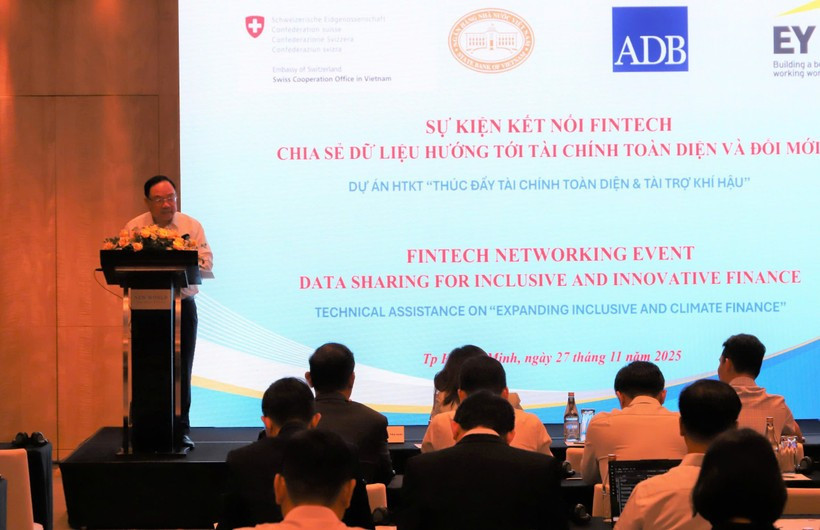
Hanoi (VNA) - Fintech Connect 2025, held in Hanoi and Ho Chi Minh City, brought together regulators, financial institutions and technology firms to discuss open banking, data sharing and digital innovation amid Vietnam’s rapidly advancing digital transformation.
The event was organised by the State Bank of Vietnam (SBV) on November 27 as part of the ADB-funded technical assistance project on promoting financial inclusion and climate finance.
Under the theme “Data Sharing for Inclusive and Innovative Finance,” discussions focused on open banking and the adoption of open APIs — key components of a modern digital financial ecosystem.
Speaking at the event, Pham Anh Tuan, Director General of the SBV’s Payment Department, said the banking sector has set out a clear roadmap for digital transformation and data governance. Since 2021, the Digital Transformation Plan for the Banking Sector to 2025 has been under implementation, followed in November 2025 by the Digital Transformation Strategy and the Data Strategy to 2030. These documents affirm the sector’s long-term vision to build a digital foundation and leverage data as a strategic asset.
According to Tuan, the overarching principle is to place people and businesses at the centre while treating data as a core driver of efficiency. This orientation supports new business models such as open banking, embedded finance and banking-as-a-service (BaaS), enabling safer and more convenient financial services at reasonable cost.
In recent years, the SBV has issued a series of key regulations that underpin digital banking, including the 2024 Law on Credit Institutions, Decree 52 on cashless payments, Decree 94 on the regulatory sandbox, and several circulars on payment security and digital operations. Notably, Circular 64/2024 on open APIs marks a significant milestone as it defines technical standards, responsibilities and principles for safe and transparent data sharing for the first time. The framework is expected to boost collaboration between banks and technology companies, making digital services more seamless for users.
This clearer and more flexible regulatory environment is accelerating innovation across Vietnam’s banking industry. Many banks are now partnering with Fintechs, e-commerce platforms, technology firms and public service portals to deliver payment, e-KYC, online lending and value-added “beyond banking” services such as ride-hailing, shopping, travel and entertainment. These developments demonstrate the strong potential of data sharing to expand financial access for citizens.
Despite these opportunities, Tuan noted that data sharing under open banking also brings challenges, most importantly data standardisation, third-party risk management, cybersecurity and the prevention of data misuse.
He stressed that digital transformation must go hand-in-hand with narrowing the digital divide, ensuring that everyone benefits from data and technology. This requires coordinated efforts among the SBV, credit institutions, and Fintech companies.
Representing Switzerland, Andri Meier, Deputy Head of Development Cooperation at the Swiss Embassy, said Vietnam has achieved major progress as it shifts from a cash-based economy to digital payments, a key foundation for deeper digitalisation through open APIs. Switzerland, ADB and EY are currently supporting Vietnam in capacity-building for regulators, financial institutions and non-bank lenders.

Meier said Open APIs bring greater transparency to financial markets by reducing information asymmetries and fostering innovation. He added that Fintech Connect 2025 provides an important platform for stakeholders to exchange experience on API implementation, contributing to future regulatory improvements and training needs.
Meier also emphasised that digital financial innovation should place small and medium-sized enterprises (SMEs) at the centre, given their critical role in employment and innovation across Vietnam’s economy.
Maria Joao Pateguana from the ADB observed that Vietnam is undergoing profound digitalisation, driven by cloud computing, big data, open APIs, blockchain and artificial intelligence. In the financial sector, data is becoming a decisive factor for decision-making, innovation and competitiveness.

She noted that data sharing requires strong audit frameworks, clear regulations, robust security standards and effective fraud-prevention mechanisms. Identity verification technologies and anomaly-detection systems must be continuously strengthened to ensure safety in a digital environment. Pateguana praised the SBV’s leadership in developing the regulatory foundation for digital banking and data sharing, and highlighted Circular 64 as a key accelerator for building an open banking ecosystem in Vietnam.
From a technical standpoint, Dinh Tien Dung from the SBV’s Information Technology Department said the open API policy aims to promote fair competition, innovation and financial inclusion. By allowing approved third parties — Fintechs, other banks, or e-commerce platforms — to access banking data and services with customer consent, open APIs reduce operating costs, shorten product development cycles and provide a foundation for more innovative digital offerings.
Fintech Connect 2025 served as a key forum for identifying opportunities and challenges in open banking and data-driven finance. International experience, regulatory insights and policy recommendations shared at the event will support ongoing legal reforms, encourage innovation among technology firms and help Vietnam build a more inclusive and sustainable digital financial ecosystem./.