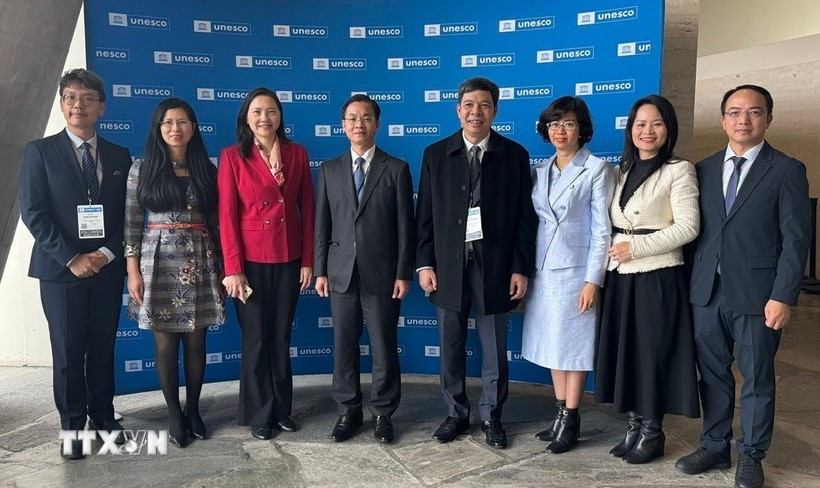
Paris (VNA) – The year 2025 marked a highly successful chapter in Vietnam’s cooperation with the United Nations Educational, Scientific and Cultural Organisation (UNESCO), highlighted by a series of important recognitions, initiatives and governance roles widely acknowledged by the international community, a diplomat has said.
Beyond heritage and culture, Vietnam has increasingly demonstrated its role as an active, responsible and proactive member contributing to UNESCO’s policy-shaping processes, thereby enhancing national prestige and promoting humanistic and peace-loving values on the global stage, Ambassador Nguyen Thi Van Anh, Permanent Representative of Vietnam to UNESCO, told Vietnam News Agency correspondents in Paris.
The ambassador said that throughout 2025 Vietnam consistently implemented the Party’s and State’s guidelines on multilateral diplomacy and cultural diplomacy in its engagement with the organisation. These efforts produced tangible results across culture, education, science, and information and communication.
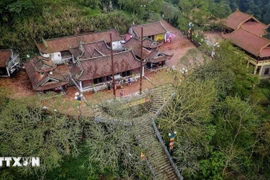
One of Vietnam’s most notable achievements was the July 12 decision by the World Heritage Committee to inscribe the Yen Tu–Vinh Nghiem–Con Son, Kiep Bac complex of monuments and landscapes as a World Heritage site. This became Vietnam’s ninth World Heritage property and the country’s first new inscription after an 11-year hiatus.

According to the ambassador, the recognition reflects international appreciation of the site’s outstanding universal value while honouring the profound humanistic and peace-oriented philosophy of Truc Lam Buddhism founded by King-Monk Tran Nhan Tong. The inscription also creates opportunities to strengthen heritage conservation, promote Vietnam’s image and people, and foster sustainable tourism development.
In addition to the new World Heritage title, Vietnam received five further UNESCO recognitions in 2025. The music collection of composer Hoang Van was inscribed on the Memory of the World Register in April; Ho Chi Minh City was designated a UNESCO Creative City in October; UNESCO adopted a resolution honouring and co-celebrating the 300th birth anniversary of scholar Le Quy Don in October; Hanoi was recognised as a UNESCO Learning City in December; and most recently, Dong Ho folk woodcut printing was inscribed on the List of Intangible Cultural Heritage in Need of Urgent Safeguarding.
These recognitions highlight the international community’s high regard for Vietnam’s long-standing cultural heritage, rich history and distinctive identity. They also help mobilise resources for preservation and promotion, strengthen the country’s soft power, support sustainable socio-economic development at the local level, and reaffirm Vietnam’s commitment to safeguarding and transmitting heritage to future generations.
Another major highlight in 2025 was a Vietnam-initiated proposal at UNESCO to launch an “International Decade of Culture for Sustainable Development.” Both the UNESCO Executive Board in October and the General Conference in November endorsed the draft resolution proposed by Vietnam, recommending that the UN General Assembly consider proclaiming the Decade for the 2027–2036 period.
The initiative seeks to elevate culture as a central pillar of sustainable development at both national and global levels. If approved by the UN General Assembly, it would become a global initiative bearing Vietnam’s imprint and represent a strategic contribution to UNESCO and the international community.
Alongside achievements in recognitions and initiatives, 2025 also witnessed Vietnam’s growing role within UNESCO’s key governing mechanisms. Vietnam was re-elected Vice-President of the 43rd session of the UNESCO General Conference in November and elected a member of the Intergovernmental Committee of the 2005 Convention on the Protection and Promotion of the Diversity of Cultural Expressions for the 2025–2029 term in June 2025.
As a result, Vietnam concurrently held positions in five major UNESCO mechanisms in 2025. In these capacities, the country actively and responsibly contributed to shaping UNESCO’s strategic orientations, promoting dialogue, cooperation and consensus amid global uncertainties. Vietnam’s constructive approach has been positively recognised by UNESCO leaders and member states.
Another milestone in Vietnam–UNESCO cooperation was the visit to Vietnam by UNESCO Director-General Audrey Azoulay in June 2025. The visit further promoted multifaceted cooperation and reaffirmed Vietnam as a model of effective collaboration between UNESCO and its member states. During the visit, the UNESCO chief attended the opening ceremony of the third Da Nang Asian Film Festival.
Looking ahead, Van Anh noted that 2026 will mark both the first year of implementing foreign affairs and cultural diplomacy tasks set by the 14th National Party Congress and the 50th anniversary of Vietnam’s accession to UNESCO (1976–2026). Building on the achievements of 2025, Vietnam will continue to deepen substantive cooperation with UNESCO, further reinforcing its role and standing in the new era of development./.