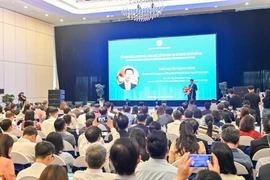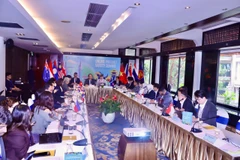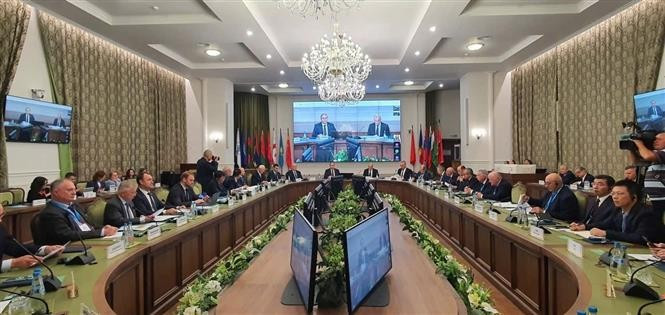
Hanoi (VNA) - Professor, Academician Chau Van Minh, President of the Vietnam Academy of Science and Technology (VAST), attended and delivered a speech at the 38th meeting of the International Association of Academies of Sciences (IAAS) Council held in Belarus from September 17-19.
In a report on the role of fundamental research in the development of strategic technologies in Vietnam, the VAST analysed the role of academic science in shaping cutting-edge technologies globally, as well as the influence of science and technology in the sustainable development process of each nation.
Using the metaphor of a "strategic technology tree," the VAST emphasised that basic research serves as the nourishing roots—the vital lifeline—for building technological self-reliance. Drawing from real-world examples of mRNA vaccines, semiconductor technology, artificial intelligence (AI), and new energy, it asserts that long-term investment in basic research is the foundation for defining strategic technologies in the prevailing trend towards globally autonomous science.
In bilateral discussions on the sidelines of the meeting, representatives from the Russian Academy of Sciences, Moscow State University, Kazakhstan Academy of Sciences, and the VAST shared practical experiences in the process of building and developing Vietnam’s leading national research institution. These included the establishment of a university under the academy, the integration of postgraduate training with specialised research institutes, and the support for bilateral research projects with member organisations.
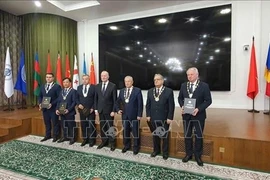
At the 38th IAAS Council meeting, the VAST President was awarded the IAAS Special Medal for outstanding contributions to scientific cooperation and development, alongside the leaders of the academies of sciences of Russia, Belarus, Armenia, China, and Uzbekistan.
VAST Vice President Prof., Academician Le Truong Giang was also granted the IAAS Academician title after being selected at the 37th meeting of the IAAS Council./.
Vietnam, Belarus bolster collaboration in science, technology
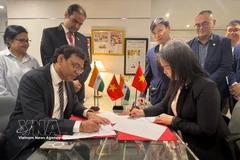
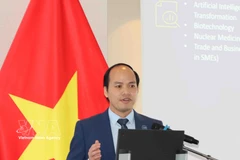
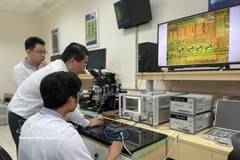
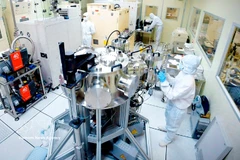
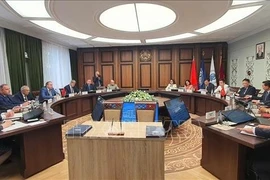
In addition to traditional fields such as materials science, semiconductors, laser, optics, biodiversity conservation, and water treatment, both sides agreed to expand into new areas such as space technology and Earth observation, biomedical science and nuclear medicine, and drones.