Vietnam’s aquaculture top position on world map

The growth in Vietnam's seafood export turnover in recent years has been created from the foundation of the aquatic farming, exploitation and processing industry.
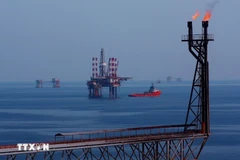
Vietnam’s aquaculture top position on world map ảnh 1Vietnam has the advantage of a long coastline and sufficient water surface area for developing both brackish and freshwater aquaculture. (Photo: vneconomy.vn)

HCM City (VNA) – The growth in Vietnam's seafood exportturnover in recent years has been created from the foundation of theaquatic farming, exploitation and processing industry.

Vietnam’saquaculture industry has not only served the sizable domestic market with apopulation of about 100 million but also gradually conquered the world market, said Truong Dinh Hoe, General Secretary of the VietnamAssociation of Seafood Exporters and Producers (VASEP).

Hoesaid that along with the growth of global seafood consumption demand, Vietnam'saquaculture product export turnover has maintained growth for many years andreached 11 billion USD in 2022, 12 times higher than that of 1998.

Notonly growing in output, Vietnamese aquacultural products are also considered a source ofprotein with stable quality and increasingly high nutritional value,contributing to ensuring food supply for people arround the world. Currently,Vietnam is the third largest seafood exporter in the world, after China andNorway.

Vietnam’sfisheries industry now has advantages. First, seafood consumption is increasing globally while natural aquatic resources are limitedand seafood supply must rely on aquaculture activities. Vietnam has the advantage of a long coastline and sufficientwater surface area for developing both brackish and freshwater aquaculture. Ofthe total world shrimp production of about 6 million tonnes per year, Vietnamcontributes about 1 million tonnes.

Thesecond advantage is that Vietnamese businesses can catch up with the world inprocessing technology, particularly deep processing to make value-addedproducts.

Thirdly,Vietnam has integrated widely and deeply into the global economy through signing andimplementing new-generation free trade agreements (FTAs) with countries andregions that are large consumption markets.

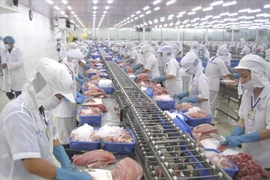
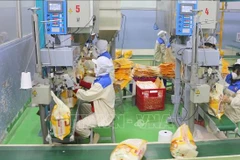
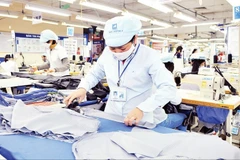
Vietnam’s aquaculture top position on world map ảnh 2Workers process shrimp for export in Ho Chi Minh City. (Photo: VNA)

However,Vietnam’s fisheries sector faces disadvantages such as small-scaleproduction, mostly household farming, and negative impacts of climate changethat result in the shrinking of freshwater aquaculture areas, Hoe said. 

Headded that Vietnam has strengths in processing technology and consumptionmarkets.

Theissue that its aquaculture sector needs to address now is how to optimizeproduction costs through minimizing input costs.

Long-termsolutions are also needed such as gradually increasing the rate of large-scaleproduction, applying high technology to improve productivity, and attractinginvestment in local animal feed and breed production to reduce its reliance onimported sources.

Hoesaid that Vietnamese aquacultural products are present in over 170 countriesand territories all over the world, so finding new markets is no longer apriority.

Inthe context of a decline in purchasing power in major markets, businesses andassociations need to step up trade promotion to effectively exploit thepotential of each market.

Regardingthe increasing trend of green production and green consumption, the VASEPrepresentative said that Vietnam's fisheries industry is "goinggreen" quite well.

Upto 70% of raw materials used to make products for export are raised at farms.Vietnam has more and more farms and farming areas that have receivedinternational certifications for responsibly farmed aquatic products, minimizednegative impacts on the environment, ecosystem, and community, and meeting labourregulations.

Outof 847 industrial-scale factories with food safety certificates, over 690factories received codes for exporting products to the EU. For the US market,Vietnamese products also meet Best Aquaculture Practices (BAP).

AsVietnam committed to net zero emissions by 2050, it's time for everyindustry and business to make moves including the use of energy-efficientequipment, renewable energy, and low-carbon packaging./.

VNA

See more

PM Pham Minh Chinh speaks at the meeting (Photo: VNA)

PM pushes five strategic breakthroughs to fuel digital economy

Addressing the first meeting of the National Steering Committee on Data linked virtually with all 34 cities and provinces nationwide, PM Pham Minh Chinh, who is also head of the committee, stressed that the Party’s policies and guidelines and the State’s laws have long articulated a strategic vision for data development. He cited Resolution No. 57-NQ/TW and the recently enacted Law on Data, both of which designate data as a “new means of production” and a strategic resource that must be transformed into high-value assets.

A customer conducts transactions at the Vietnam Joint Stock Commercial Bank for Industry and Trade (VietinBank). (Photo: VNA)

Central bank aims for 15% credit growth in 2026

In 2026, monetary policy will continue to be implemented in a proactive, flexible, timely and effective manner to help stabilise the macroeconomy, keep inflation under control, support economic growth and advance the restructuring of banks under compulsory transfer.

Vietnam is emerging as a preferred destination for many foreign enterprises (Photo: hanoimoi.vn)

Vietnam emerges as bright spot of growth, trusted and responsible partner

Despite a volatile global environment, Vietnam recorded solid gains in 2025. With flexible and proactive policies under the leadership of the Communist Party of Vietnam and the Government, all 15 key socio-economic targets were met or exceeded, while GDP expanded by about 8.02%, surpassing expectations.

An image of a Vietnamese game. CIS region has potential for gaming developers from Viet Nam. (Photo: Courtesy of cellphones.com.vn_

CIS: Opportunity for game developers in Vietnam

The CIS region, which includes Eastern Europe and Central Asia, has potential for gaming developers from Vietnam as this market displays user behaviour patterns that are highly favourable for mobile gaming growth, particularly around major holiday periods.

Banks, including MB Bank, have issued alerts about scams conducted via social media platforms such as Zalo and Facebook, where criminals impersonate acquaintances. (Photo: The Courtesy of MBBank)

Financial scams surge ahead of Tet

As the Lunar New Year (Tet) approaches, financial and banking scams in Vietnam are showing a sharp upward trend, prompting banks and law enforcement agencies to issue repeated warnings.

Hai Phong targets 4.3 billion USD in FDI in 2026 (Photo: VNA)

Hai Phong city targets 4.3 billion USD in FDI in 2026

Hai Phong’s investment appeal is underpinned by a rapidly expanding development space, including the Southern Coastal Economic Zone covering more than 20,000 hectares, a planned free trade zone, deep-water ports at Lach Huyen, and 12 industrial parks newly established in 2025.

The relocation of check-in counters aims to better meet the travel needs of residents and visitors. (Photo: VNA)

Vietjet shifts domestic check-in at Tan Son Nhat from January 13

During the recent New Year 2026 holiday peak, Vietjet added 380 flights, equivalent to nearly 78,000 additional seats, on many key domestic routes linking Hanoi and Ho Chi Minh City with destinations such as Vinh, Thanh Hoa, Hai Phong, Da Nang, Phu Quoc, Nha Trang and Da Lat.

Commercial banks are providing approximately 88% of total green credit outstanding in Vietnam. (Photo: nhandan.vn)

Capital sources expanded for sustainable growth

According to the State Bank of Vietnam (SBV), by the end of November 2025, outstanding green credit was estimated at around 750 trillion VND (28.55 billion USD), with an average growth rate exceeding that of overall credit in the economy.

Customers select goods at a supermarket. (Photo: VNA)

Retail market expands sharply, sustainability challenges persist

According to a report on recently released by the Ministry of Industry and Trade’s Agency for Domestic Market Surveillance and Development, the size of the market reached more than 7 quadrillion VND (about 266 billion USD) in 2025, up around 10% compared with 2024.

Oil rigs at the Bach Ho oil field. (Photo: VNA)

Resolution 79: State economy to lead growth

Resolution 79 is described as a “clear action declaration” by the Politburo, saying the state economy is not only responsible for maintaining macroeconomic stability, but must also become the force leading a new growth model that is green and sustainable.

Workers at Garment 10 Corporation produce apparel for export. (Photo: Nhan Dan)

Vietnam leverages export advantages within RCEP region

In 2025, seafood exports to China alone exceeded 2.2 billion USD, up about 33% compared to 2024. Shipments to Japan fetched nearly 1.7 billion USD, a year-on-year increase of 14.6%, while those to the Republic of Korea and Australia grew by 9.6% and 3.2%, respectively.

Certificates of membership in the Vietnam International Financial Centre in Da Nang are awarded at the conference on January 9. (Photo: VNA)

Da Nang continues targeted investment promotion approaches

According to Chairman of the Da Nang People’s Committee Pham Duc An, the city prioritises building sustainable economic ecosystems and focuses on key breakthrough sectors with strong spillover effects, including high technology and digital transformation, logistics, urban infrastructure, finance, processing and manufacturing industries, high-tech agriculture, and the pharmaceutical and medicinal herb industry.