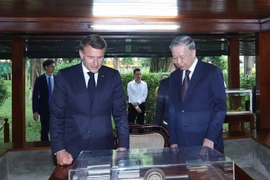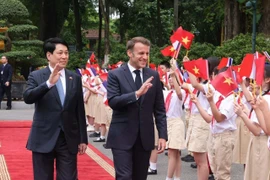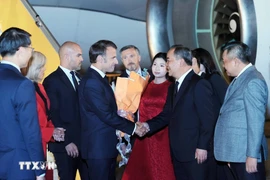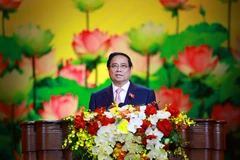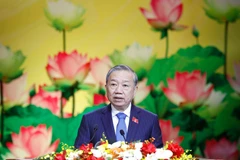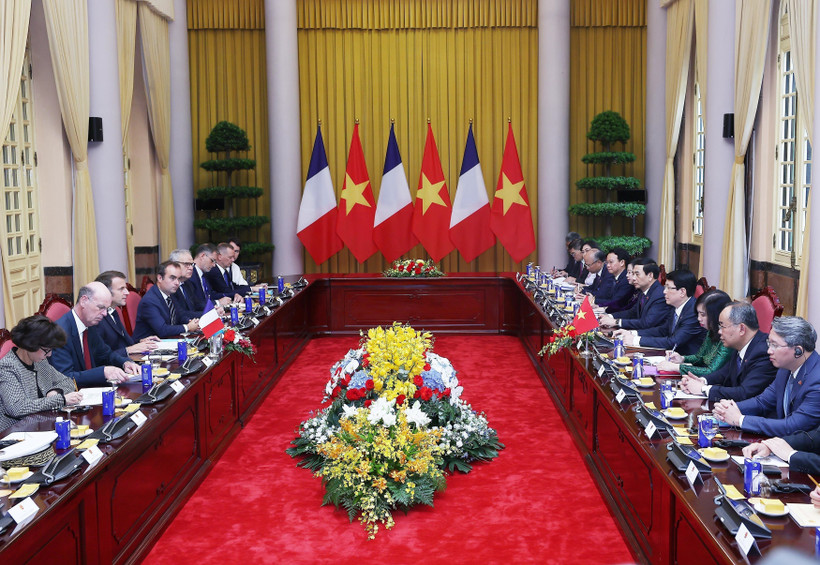
Hanoi (VNA) – France has always held an important position in Vietnam's foreign policy and is the first European Union country with which Vietnam has established a comprehensive strategic partnership – the highest level of diplomatic relations, State President Luong Cuong affirmed during his talks with French President Emmanuel Macron in Hanoi on May 26.
The state visit to Vietnam by the French President and his spouse affirms a clear commitment to advancing the Vietnam – France Comprehensive Strategic Partnership in a more substantive and effective manner, Cuong said.
He asserted that Vietnam always attaches great importance to developing multifaceted cooperation with France and supports its active role in international organisations such as the United Nations, the International Organisation of La Francophone, and UNESCO.
The Vietnamese State leader proposed the two countries continue to promote their shared strengths to jointly address global challenges and harmoniously manage emerging regional and international issues. Showing his delight at for the first time visiting Vietnam – a country that plays an important role in ASEAN and in France’s Indo-Pacific strategy, President Macron said he is impressed by Vietnam’s rapid and robust development as well as its remarkable socio-economic achievements in recent years.
Congratulating Vietnam on its growing status and role in the region and on the international stage, he affirmed that France wishes to further strengthen cooperation with Vietnam in traditional areas such as health care, education, and culture, while also expanding into new fields including infrastructure, urban transportation, aerospace, new energy, and historical memory, in a manner that is commensurate with the current comprehensive strategic partnership.
The two leaders exchanged views and reached consensus on major directions for future cooperation between the two countries. In terms of political and diplomatic relations, they agreed to continue strengthening delegation exchanges and contacts at all levels, especially high-level ones, through all channels; effectively implement existing collaboration mechanisms and consider the establishment of new ones; and maintain close coordination at international and regional forums.
They also agreed that the two countries should continue implementing signed agreements in the fields of defence and security, including cooperation in combating transnational crime.
President Cuong took this occasion to extend an invitation to high-ranking French leaders to attend the signing ceremony of the United Nations Convention against Cybercrime, to be held in Hanoi in October 2025.
In the areas of economy, trade, and investment, the two leaders agreed to promote trade and investment ties and to effectively implement the EU – Vietnam Free Trade Agreement (EVFTA). France pledged to support the early ratification of the EU – Vietnam Investment Protection Agreement (EVIPA), advocate for the European Commission to lift its "yellow card" warning on Vietnamese seafood, and create favourable conditions for Vietnam to increase aquatic product exports to the French and EU markets.
Both sides also reached a consensus on enhancing cooperation in science and technology, innovation, artificial intelligence, semiconductors, and digital transformation, especially in training high-quality human resources. They also committed to expanding joint scientific research, promoting technology transfer and mastery, and investing in the development of digital infrastructure.
The two leaders agreed to continue strengthening and promoting cooperation in traditional areas such as education – training, health care, justice, culture – tourism, agriculture, and climate change response.
The Vietnamese side called on France to continue its support in development cooperation through official development assistance (ODA) funding and preferential government loans for projects aimed at enhancing climate resilience and improving human resources quality in the energy sector. France was also suggested to continue assistance for Vietnam in carrying out specific projects within the framework of the Just Energy Transition Partnership (JETP).
President Cuong took the occasion to thank and ask for the French Government’s continuation of favourable conditions for the Vietnamese community so that they could stabilise their lives, better integrate into, and make practical contributions to the socio-economic development in the host country as well as the friendship between Vietnam and France. He also asked France to soon confirm the organisation of the 13th Vietnam – France Decentralised Cooperation Conference.
Exchanging notes on regional and international issues of mutual concerns, President Cuong affirmed that Vietnam maintains its steadfast "Four No's" defence policy in international relations. Both sides laid stress on the essential role of multilateralism, with the UN holding the central position.
President Macron affirmed his support for ASEAN's stance on the East Sea. The two sides emphasised that the 1982 UN Convention on the Law of the Sea (UNCLOS) serves as the comprehensive legal framework for all maritime and oceanic activities and cooperation. They reaffirmed their commitment to maintaining peace, stability, security, safety, and freedom of navigation and overflight in the region, resolving disputes by peaceful means based on international law, and supporting all efforts to achieve an effective and substantive Code of Conduct in the East Sea (COC) that complies with international law, particularly the 1982 UNCLOS.
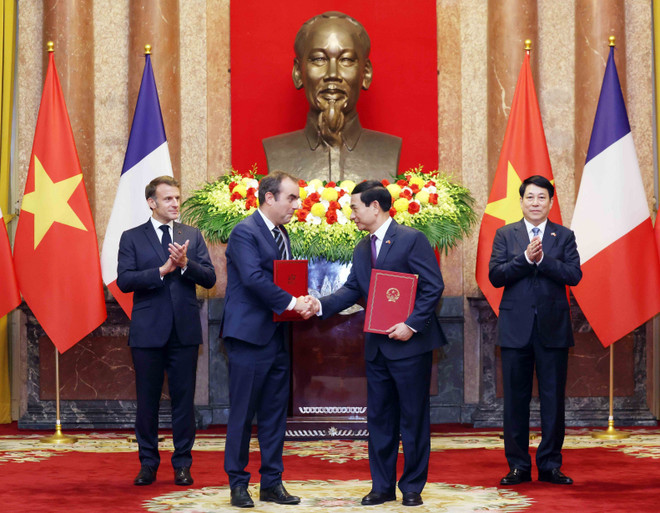
Following their talks, the two leaders witnessed the handover of several cooperation documents, covering the domains of defence, justice, archiving, nuclear energy, climate change adaptation, port, vaccine production technology, aviation, and many more./.