Hanoi (VNA) - The Consumer Price Index (CPI) in the first quarter of 2025 has increased by 3.22% compared to the same period last year, reflecting Vietnam's remarkable efforts to maintain macro-economic stability and control inflation amid a challenging global environment.
In March, CPI recorded a slight decrease of 0.03% compared to February, largely due to a decline in fuel and rice prices. However, compared to December 2024, the CPI still saw a rise of 1.3%. Year-on-year, March's CPI increased by 3.13%.
Domestic inflation control efforts
According to the National Statistics Office (NSO), despite the slight decrease in March, inflationary pressures remained under control. The core inflation rate (excluding fresh food, energy, and State-regulated prices) rose by 3.01% in Q1, lower than the general CPI increase, indicating the effectiveness of monetary policies in containing inflation from fundamental sources.
Nguyen Thu Oanh, head of the NSO’s Service and Price Statistics Department, explained that global commodity markets had been volatile, influenced by political, economic, and social factors in various countries. The ongoing strategic competition between major powers, particularly the new US tariff policies, has caused trade tensions and impacted global supply chains.
Moreover, geopolitical instability has also had significant effects. The Russia-Ukraine conflict continues to escalate, negatively affecting regional stability and the global economy. Political turmoil in the Middle East, the Red Sea, and Gaza persists. Many countries are maintaining tight monetary policies, and global demand remains weak, resulting in slow global economic growth. While inflation is gradually cooling, it has not yet reached the target levels set by several countries. Central banks have continued to monitor and adjust monetary policies to address inflationary pressures.
In this context, Vietnam has shown proactive and flexible management. Inflation in Vietnam has been kept at an appropriate level to support economic growth, with March 2025 CPI rising by 3.13% year-on-year, Oanh emphasised.
Oanh attributed the success to the decisive leadership of the Government and the Prime Minister. Domestically, the Government has been proactive and has closely guided ministries, sectors, and localities in implementing a range of measures to stimulate growth, maintain macroeconomic stability, and control inflation. Specific actions include ensuring smooth circulation and distribution of goods and services, reducing loan interest rates, and stabilising the foreign exchange market. Other actions include boosting public investment disbursements, implementing credit packages to support key sectors, reducing value-added tax for certain goods and services, cutting fuel taxes, and providing tax exemptions and extensions for businesses and citizens.
Thanks to these coordinated efforts, the prices of goods and services have generally remained stable, with inflation under control. In Q1, the CPI increased by 3.22% year-on-year, Oanh noted.
Core inflation lower than overall CPI
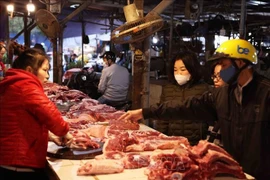
The NSO reported that the 3.22% rise was driven largely by the food and catering category, which expanded by 3.78%, contributing 1.27 percentage points to the overall CPI increase. Pork prices, which increased 12.49%, were the primary factor, contributing 0.42 percentage points, while rice prices were a smaller factor, increasing by 0.97%.

Additionally, the housing, electricity, water, gas, and construction materials group rose by 5.11%, contributing 0.96 percentage points to the overall CPI. Electricity prices climbed 5.11%, driven largely by end-of-year adjustments in 2024 and growing demand, contributing 0.17 percentage points to the overall increase.
Moreover, health and medical services surged 14.4%, contributing 0.78 percentage points, primarily due to the scheduled adjustments in healthcare service fees. The culture, entertainment, and tourism group saw a 2.16% uptick, contributing 0.1 percentage points.
Conversely, some groups contributed to lowering inflation, including transportation, which decreased by 2.4%, reducing the overall CPI by 0.23 percentage points, mainly due to a 9.73% drop in fuel prices compared to the previous year. Additionally, education services fell 0.61%, lowering the CPI by 0.04 percentage points due to local policies offering tuition fee exemptions and reductions. The post and telecommunications group fell 0.59%, pulling the overall CPI down by 0.02 percentage points, mainly due to lower prices of older-generation phones.
Given these factors, the core inflation rate in Q1 rose 3.01%, lower than the general CPI increase. The NSO attributed this difference to significant fluctuations in food prices, electricity, and healthcare services—factors that impacted the general CPI but were excluded from the core inflation calculation.
This demonstrated that core factor inflationary pressure is being managed relatively well, excluding temporary fluctuations in State-regulated prices, as well as food and energy, Oanh concluded./.