Vietnam's two-tier local administration model conforms to global trends: expert

Anh expressed his support for this policy, asserting that it is a necessary reform for Vietnam to capitalise on domestic and international opportunities for growth. Vietnam's “Doi Moi” (renewal) policy over the past four decades needs updates in a rapidly changing world with geopolitical instabilities, climate change, and advancements in artificial intelligence (AI).

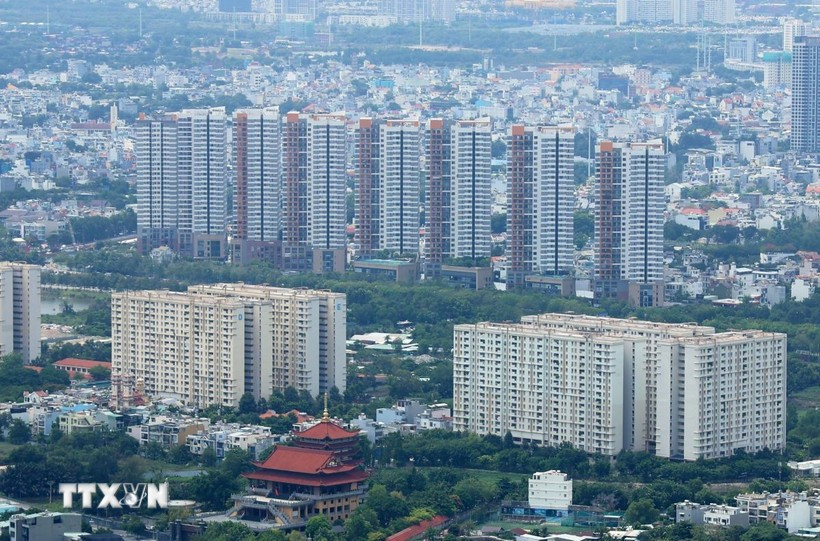
A corner of Ho Chi Minh City (Photo: VNA)

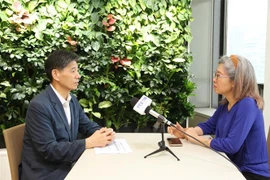
London (VNA) – Vietnam’s rollout of two-tier local administration model and restructuring of provincial administrative units is a sound policy that conforms to global trends. Dr. Luong Tuan Anh from the UK’s De Montfort University told the Vietnam News Agency (VNA)'s resident reporters in London.

Anh expressed his support for this policy, asserting that it is a necessary reform for Vietnam to capitalise on domestic and international opportunities for growth. Vietnam's “Doi Moi” (renewal) policy over the past four decades needs updates in a rapidly changing world with geopolitical instabilities, climate change, and advancements in artificial intelligence (AI).

Streamlining the administration apparatus could slash recurrent expenditures, which now consume nearly 56% of the national budget, compared to just 30% in the UK, thereby freeing up resources for development projects, he said.

The two-tier local administration model, he explained, would empower local authorities by granting them greater autonomy to tailor policies to their specific needs and capabilities.

The provincial administrative restructuring, while costly, promises substantial benefits, according to his recent research on merging Vietnamese provinces.

He pointed to the mergence of Ho Chi Minh City with Binh Duong and Ba Ria-Vung Tau provinces as a prime example. The move would create a dynamic economic hub, with Ho Chi Minh City serving as a financial centre, Binh Duong as an industrial powerhouse, and Ba Ria-Vung Tau as a tourism magnet. By erasing administrative boundaries, the new megacity would facilitate smoother transport and lure foreign investors, allowing them to work in Ho Chi Minh City, build factories in Binh Duong, and reside in Vung Tau.

Anh argued that such mergers would create driving forces, enabling each region to amplify its strengths and enhance its role within a unified province. “This creates momentum for better development opportunities”, he said.

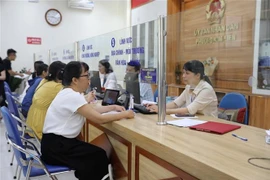
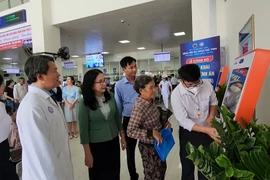
Drawing on the UK’s administrative reforms, he highlighted the benefits of digital governance, including online procedures that ensure data interoperability across ministries and public service providers. These systems offer real-time feedback on errors and allow applicants to track document processing, improving efficiency and transparency.

Vietnam should adopt similar principles of transparency, accountability, and scientific rigor to professionalise its public administration, Anh suggested./.

VNA
See more

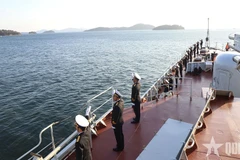
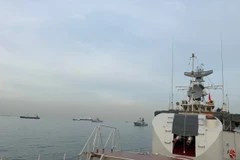
Frigate 015 – Tran Hung Dao and the delegation of the Vietnam People’s Navy (VPN) on December 14 leave Jinhae Naval Base. (Photo: qdnd.vn)

Frigate 015 – Tran Hung Dao concludes visit to RoK

During the visit, officers and sailors of the two navies toured Frigate 015 and the RoK Navy’s Munmu the Great destroyer, shared experience in training and long-duration deployments at sea, and took part in sports exchanges. The VPN delegation also hosted a banquet aboard Frigate 015 for senior officers and sailors of the host navy.

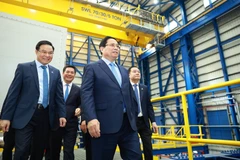
Prime Minister Pham Minh Chinh visits the operational system of the Nhon Trach 3 and 4 power plants (Photo: VNA)

Nhon Trach 3 and 4 thermal power plants reflect Vietnam’s determination, expertise: PM

The Nhon Trach 3 and 4 power thermal plants, invested by Petrovietnam Power Corporation, have a total investment of around 1.4 billion USD. With a combined capacity of 1,624 MW, the plants are expected to supply over 9 billion kWh annually once fully operational, adding substantial baseload power to the system, particularly in the southern region.

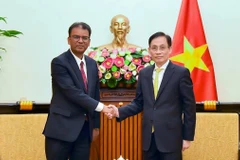
Minister of Foreign Affairs Le Hoai Trung receives Non-Resident Ambassador of Nepal to Vietnam Dhan Bahadur Oli in Hanoi on December 13, 2025. Photo courtesy of the Ministry of Foreign Affairs.

Vietnam, Nepal seek to promote deeper, substantive cooperation

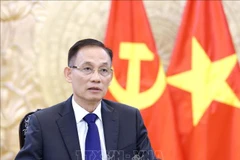
Nepalese leaders attach great importance to relations with Vietnam and wish to learn from its experience and development models in socio-economic development and international integration, said Non-Resident Ambassador of Nepal to Vietnam Dhan Bahadur Oli.

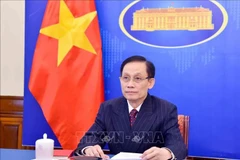
Vietnamese Minister of Foreign Affairs Le Hoai Trung (Photo: VNA)

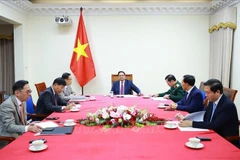
Vietnamese, Lao foreign ministers hold online talks

The two ministers agreed to maintain close coordination in the time ahead and to expand cooperation under the new framework and orientation, underscoring the significance of the two countries’ “great friendship, special solidarity, comprehensive cooperation, strategic cohesion”.

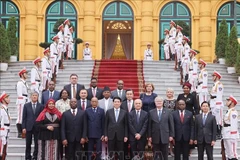
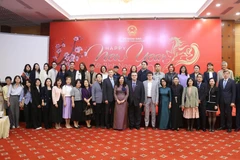
State President Luong Cuong (fourth from left, first row) and newly-appointed foreign ambassadors in Hanoi on December 12, 2025. (Photo: VNA)

State President receives newly-appointed foreign ambassadors

Receiving Egyptian Ambassador Hany Mostafa Mohamed Mostafa Hassan, President Cuong affirmed that Vietnam highly evaluates Egypt’s role, position, and contributions to regional peace and stability. He also congratulated the African country on its achievements in implementing the 2030 Vision.