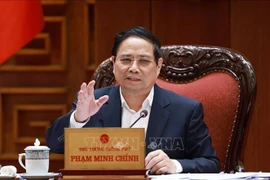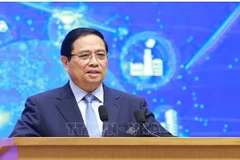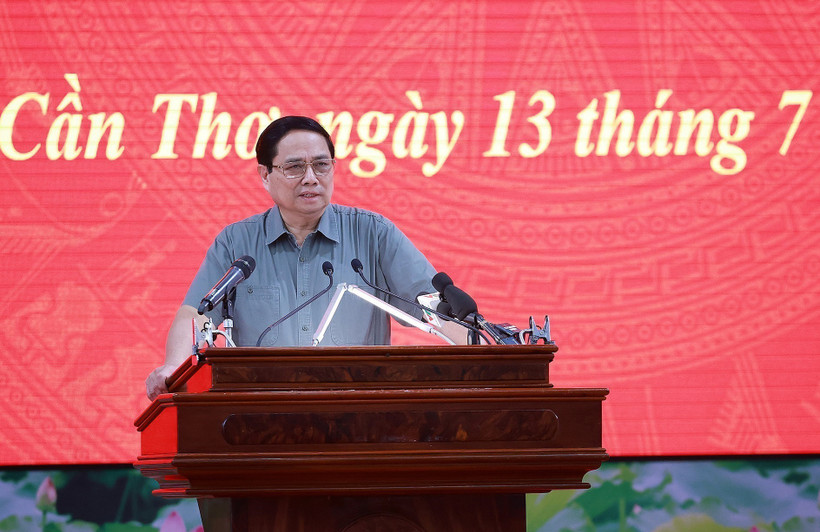
Can Tho (VNA) - Prime Minister Pham Minh Chinh has urged localities in the Mekong Delta region to implement the two-tier local government model swiftly and effectively, ensuring seamless, professional, and synchronised operations.
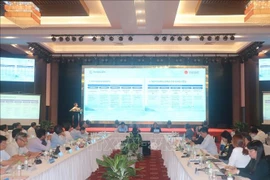
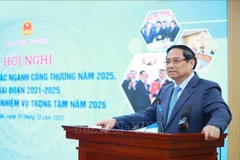
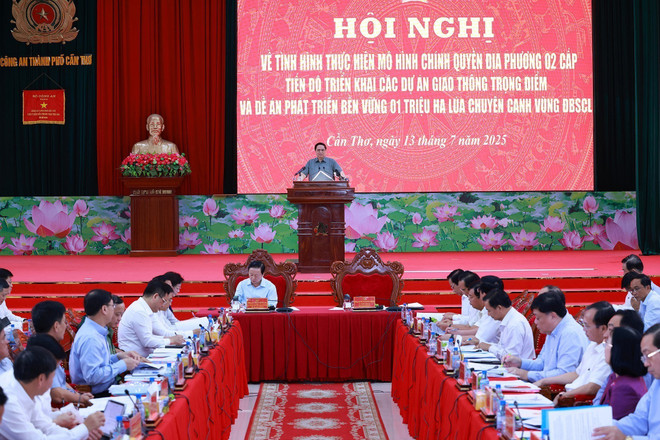
The PM chaired a conference on July 13 focused on the operation of the two-tier local government model, the progress of key transport infrastructure projects, and the implementation of the Mekong Delta's sustainable one-million-hectare low-emission and high-quality rice cultivation plan.
The conference assessed the implementation of 28 Government decrees on decentralisation and delegation of authority between the Government and local authorities in five Mekong Delta localities, namely Can Tho city, Vinh Long, Dong Thap, An Giang, and Ca Mau provinces, covering 476 communes and wards). The model has been rolled out methodically with strong public support.
Currently, the two-tier local governance model is functioning smoothly in these localities, with no major issues reported. Party building, local administration, mass organisations, staffing at commune level, and public administrative services have stabilised. Redundant personnel have received compensation in line with restructuring policies.
However, with the delegation and decentralisation of new responsibilities, staff of some specialised agencies have faced confusion in implementation, while commune-level authorities still lack qualified staff for certain functions. Shared administrative IT infrastructure has struggled with peak-time overload, forcing manual processing in some cases. Local leaders have proposed a comprehensive review and the development of integrated, nationwide digital platforms and seamless infrastructure from central to grassroots levels.
On transport infrastructure, 21 projects across road, waterway, and aviation sectors are underway in the region, including major expressways such as Chau Doc–Can Tho–Soc Trang, Cao Lanh–An Huu, and Can Tho–Ca Mau. Five of these expressways, totalling 206 km, are on track for completion in 2025. Other key projects include Rach Mieu 2 Bridge and upgrades to airports in Can Tho, Ca Mau, Rach Gia, and Phu Quoc.
Regarding the sustainable one-million-hectare high-quality, low-emission rice project, over 4,500 hectares across 101 pilot sites involving 620 cooperatives and 200 enterprises have been launched. However, progress remains slow relative to the 2030 goal, hindered by resource mobilisation issues, ODA-related procedures, unclear land mapping, and incomplete mechanisms for carbon credit issuance.
Concluding the meeting, PM Chinh praised the sound implementation of the two-tier governance model in the region, while stressing the need for more synchronised and professional operations. He highlighted notable infrastructure progress and urged continued efforts to resolve bottlenecks, boost investor confidence, and generate fresh momentum for development.
On the rice initiative, he emphasised its global significance as the first low-emission, high-quality rice-specialised region in the world, helping to ensure domestic and international food security, combat climate change, promote scientific innovation, digital transformation, regional and global value chain integration, and elevate Vietnam’s rice and national brand.
The PM called for greater unity, urgency and breakthrough efforts to exceed 2025 growth targets of 8% or higher, maintain macro-economic stability, ensure political and social order, and complete social housing initiatives, including eliminating all substandard houses nationwide by August 31, especially for policy beneficiaries by July 27.
He requested that all Party committees, local authorities, the Vietnam Fatherland Front, and socio-political organisations implement the two-tier local government model swiftly and effectively, following the principle of “completing each task thoroughly and decisively; ensuring seamless, professional, and synchronised operations” as directed by Party General Secretary To Lam.
He directed local authorities to implement two-tier governance model in line with Politburo Conclusion No. 177 (issued on July 11, 2025), and the Government’s related policies. This includes streamlining local staffing structures, preparing personnel and documents for Party congresses, maintaining uninterrupted administrative and public services, such as health care, semi-boarding schools in remote areas, and digital infrastructure in underdeveloped regions.
For key national projects, the PM directed an all-out approach, with the entire political system involved and local leaders regularly inspecting progress. All obstacles must be proactively removed, and mass organisations should support contractors on site to ensure no worker feels isolated. Local subcontractors should be engaged to help develop regional businesses, he stressed.
He tasked Deputy PM Tran Hong Ha with overseeing technical guidance and material pricing, resolving supply issues, and preparing for project completions timed with the 80th anniversary of the August Revolution (August 19) and National Day (September 2), as well as the national exhibition on 80-year journey of independence, freedom, and happiness.
He also directed the urgent and high-quality development of infrastructure for the 2027 APEC Leaders’ Week in Phu Quoc, including waste treatment, clean water supply, wastewater systems, transport links, green spaces and lighting, serving both immediate needs and long-term development.
Regarding the Can Tho Oncology Hospital project, he ordered the resolution of legal obstacles and immediate commencement, aiming for completion by 2026.
Agreeing with provincial leaders’ proposals, PM Chinh assigned the military to study the development of an inland waterway transport system in the Mekong Delta under special mechanisms./.