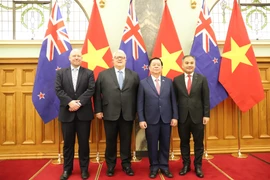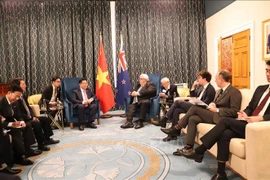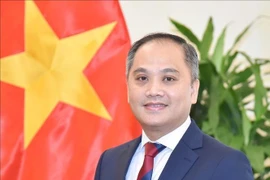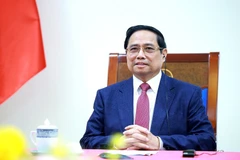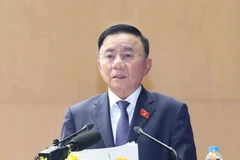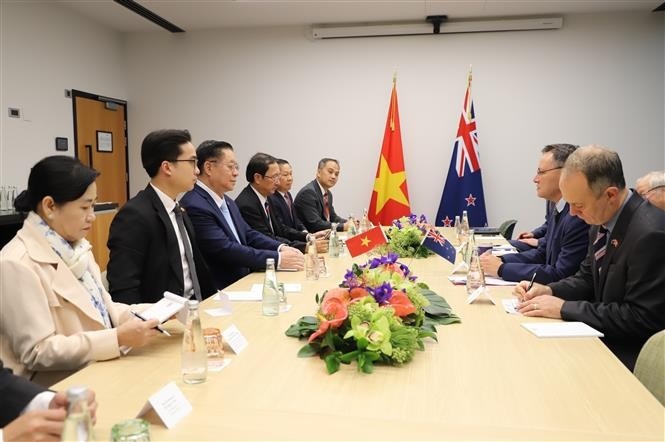
Auckland (VNA) – A delegation from the Communist Party of Vietnam, led by Politburo member, Secretary of the Party Central Committee, and Chairman of its Commission for Information, Education, and Mass Mobilisation Nguyen Trong Nghia, held meetings with New Zealand ministers and university leaders on September 23 and 24.
The delegation met with Minister for Universities Shane Reti and Minister of Climate Change, Energy, and Local Government Simon Watts, as well as leaders of Victoria University of Wellington and Auckland University of Technology.
Reti praised the growing ties in education and training between the two countries. He noted that since the start of this year, Prime Minister Christopher Luxon’s government has increased the number of scholarships for Vietnamese students to study at New Zealand universities, supporting Vietnam’s goal of becoming a high-income, developed country by 2045.
For his part, Watts highlighted the shared challenges both nations are facing from climate change and energy security. He expressed a desire to deepen cooperation, including information sharing, policy development, science and technology, and capacity building to deliver tangible outcomes.
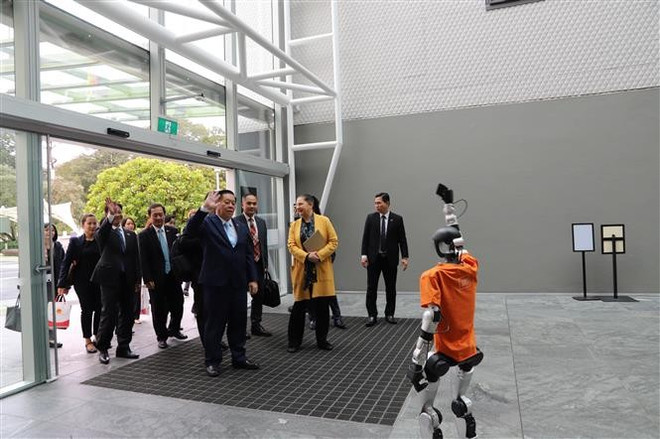
Leaders of the two universities said they had trained and provided scholarships for thousands of Vietnamese students and researchers over the years in areas such as business administration, education, basic sciences, IT, advanced technologies and health science. They voiced their commitment to expanding opportunities for Vietnamese students, particularly in technical and managerial fields, thereby contributing to the development of high-quality human resources for Vietnam in the new period.
Nghia thanked New Zealand for its valuable support over the past five decades, particularly in human resource training and socio-economic development projects. He called on the two sides to further advance their comprehensive strategic partnership, implement high-level agreements, and finalise the 2025 – 2030 action programme. This, he stressed, should include stronger political relations through high-level visits and exchanges across Party, State and Government channels, as well as closer people-to-people, locality-to-locality and business-to-business links.
The Party official emphasised that education and training remain a key pillar of the bilateral relations, and urged universities from both countries to design long-term, sustainable and practical cooperation plans. He suggested diversifying collaboration forms, including student and lecturer exchanges, joint training, and collaborative research. This should particularly focus on high-tech fields such as AI, semiconductors, biotechnology, health science, languages, and the development of a high-skilled workforce.
During the visit, Nghia also met staff of the Vietnamese Embassy and representatives of the Vietnamese community in New Zealand./.