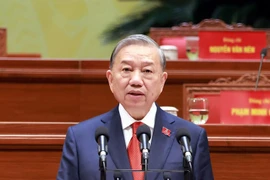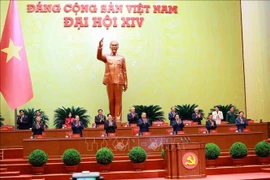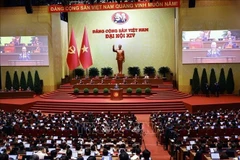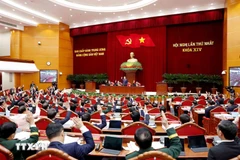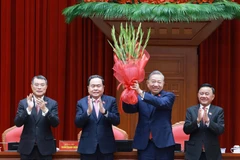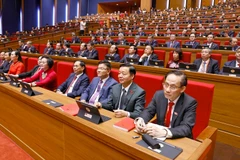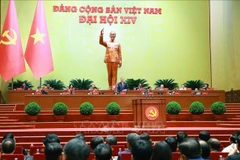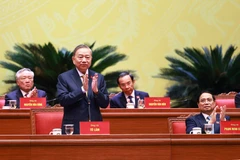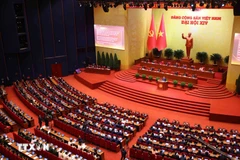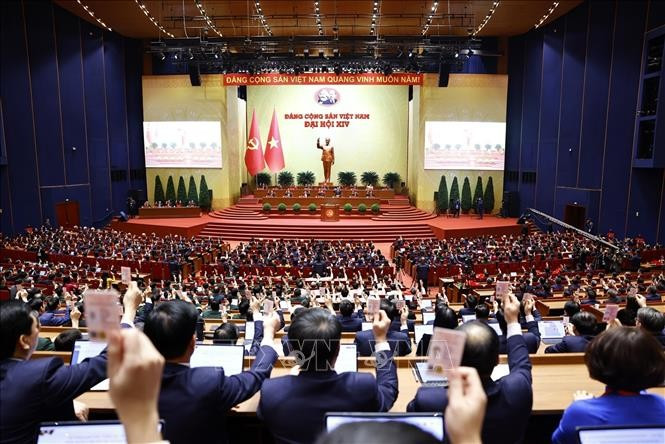
Hanoi (VNA) – At its closing session on the afternoon of January 23, the 14th National Party Congress unanimously adopted its Resolution, reaffirming core assessments of the implementation of the 13th Congress Resolution, the review of key theoretical and practical issues arising from 40 years of socialist-oriented renewal in Vietnam, and the 15-year enforcement of the Party Charter (2011–2025), as presented in documents submitted by the 13th Party Central Committee.
The 13th Congress term unfolded amid extraordinary headwinds, including the COVID-19 pandemic, supply-chain disruptions triggered by geopolitical tensions and conflicts, rising trade protectionism, and increasingly complex traditional and non-traditional security challenges. Against this backdrop, the Party, the people and the armed forces, united by determination, development aspirations and decisive action, successfully implemented the 13th Congress Resolution, enabling the country to secure major, comprehensive and breakthrough achievements, marked by multiple bright spots.
The Resolution reaffirms that the renewal process initiated and led by the Party is a historic choice, representing a comprehensive development in thinking, theoretical understanding and leadership guidelines of the Party in national development and defence. It is described as a great creative undertaking of historic significance, opening a new vision for Vietnam in its socialism building path, realised by the Vietnamese people themselves. The landmark achievements of four decades of renewal are the outcome of sustained, tireless efforts and the collective creativity of the Party, the people and the armed forces, underscoring the soundness and innovation of the Party’s renewal policy.
Looking ahead, the Resolution sets out a vision centred on firmly maintaining peace and stability; pursuing rapid and sustainable development while safeguarding national defence; comprehensively improving people's living standards; strengthening strategic autonomy, self-resilience and confidence; and advancing resolutely into a new era of national development. It targets Vietnam becoming a developing country with modern industry and upper-middle income by 2030 and a high-income developed nation by 2045, for a peaceful, independent, democratic, prosperous, civilised and happy Vietnam steadily advancing towards socialism.
For the 2026–2030 period, key targets include average annual GDP growth of at least 10%; per-capita GDP of about 8,500 USD by 2030; manufacturing and processing accounting for roughly 28% of GDP; the digital economy contributing around 30% of GDP; total factor productivity exceeding 55% of growth; annual labour productivity growth of about 8.5%; total asset accumulation of 35–36% of GDP; average total social investment of around 40% of GDP; social objectives feature an HDI of approximately 0.8; average life expectancy of around 75.5 years, including at least 68 healthy years; 35–40% of the workforce holding qualifications or certificates; and a sustained annual reduction of 1–1.5 percentage points in the multidimensional poverty rate. Vietnam also aims to rank among the world’s top 40 countries on the happiness index.
Environmental goals include maintaining forest coverage at about 42–43%; treating and reusing 65–70% of wastewater discharged into river basins; and cutting greenhouse gas emissions by 8–9%.
The Resolution outlines 12 development orientations for 2026–2030, calling for bold renewal in thinking and action, strategic breakthroughs, the creation of a new development ecosystem, and the principle of development for stability and stability for development, with people’s well-being at the centre. Priority is given to comprehensive and synchronised institutional improvement to underpin rapid and sustainable growth.
A new growth model will prioritise higher productivity, quality, efficiency, value added and competitiveness, driven primarily by science and technology, innovation and digital transformation. Emphasis is placed on fostering new, high-quality productive forces and modes of production, particularly in the data, digital, green and circular economies, alongside accelerated digital transformation, green and energy transition, structural adjustment and enhanced human capital.
The Resolution also stresses building an advanced Vietnamese culture imbued with national identity, grounded in national, cultural and family value systems and standards, while resolutely safeguarding national interests and firmly defending independence, sovereignty, unity and territorial integrity.
The five key tasks for the 14th National Congress terms focus on prioritising comprehensive institutional development to promptly and decisively remove bottlenecks and obstacles, promote innovation, and ensure coherence and harmony between growth and development; between the economy, society, and the environment and national defence, security, and foreign affairs; and between institutional reform and improvement and major, comprehensive transformations across all sectors. This approach is aligned with the three-tier government model and meets the requirements for rapid and sustainable national development in the new era.
The Congress reaffirmed its commitment to building a clean, strong and comprehensive Party and political system, coupled with coordinated reforms in leadership methods and enhanced capacity for self-renewal and self-improvement to strengthen the effectiveness and efficiency of Party leadership and governance. It called for the effective operation of the political system under the new organisational model, continued reform of personnel work, tighter power control within the Party and the State, and intensified efforts to combat corruption, wastefulness and negative practices.
It also underscored accelerating the development of a modern, internationally integrated socialist-oriented market economy suited to new productive forces. The State sector is to firmly play a leading role, while the private sector is recognised as one of the most important engines of growth. Economic restructuring, faster industrialisation and modernisation, and science and technology, innovation and digital transformation will underpin the new growth model, with priority given to the digital, green and circular economies and environmental sustainability.
Breakthroughs in science and technology, innovation and digital transformation are identified as essential to building new, modern productive forces, with priority accorded to strategic industries and technologies, notably semiconductors and artificial intelligence, alongside stronger training and utilisation of high-quality human resources.
Human resource development and cultural advancement are to be reinforced so that culture becomes a true spiritual foundation, endogenous strength and powerful driver of rapid and sustainable development. The Congress called for a modern national education system up to regional and global standards, increased investment in public health care, and effective social policies to ensure security, social welfare, safety and public well-being.
It reaffirmed the task of building a revolutionary, regular, elite and modern People’s Army and People’s Public Security forces to firmly safeguard independence, sovereignty, unity and territorial integrity, including seas and islands, while promoting proactive, creative and effective diplomacy.
The Congress identified three strategic breakthroughs for the new term. The first is a strong breakthrough in development institutions, enhancing policy-making and implementation capacity to unlock, mobilise and effectively utilise all resources as competitive advantages, reduce compliance costs for people and businesses, and further decentralise and devolve powers between central and local levels, strengthening local autonomy and accountability.
The second is comprehensive reform to restructure and improve the quality of human resources through transparent, fair and effective cadre work, while the third features coordinated breakthrough in socio-economic infrastructure, particularly multimodal transport, digital and green transition infrastructure, climate adaptation, and cultural, educational and sports facilities.
The Congress adopted the Political Report; the report reviewing key theoretical and practical issues of 40 years of renewal; the report on the 15-year implementation of the Party Charter and proposals submitted by the 13th Party Central Committee. It agreed not to amend the current Charter.
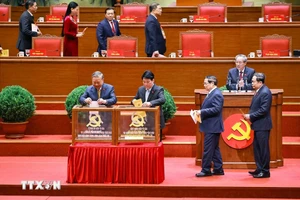
It also approved the review of the leadership and direction of the 13th Party Central Committee and the results of the election of the 14th Party Central Committee, comprising 200 members, tasking it and Party organisations at all levels with concretising and effectively implementing the orientations and policies set out in the documents of the 14th National Party Congress./.
VNA