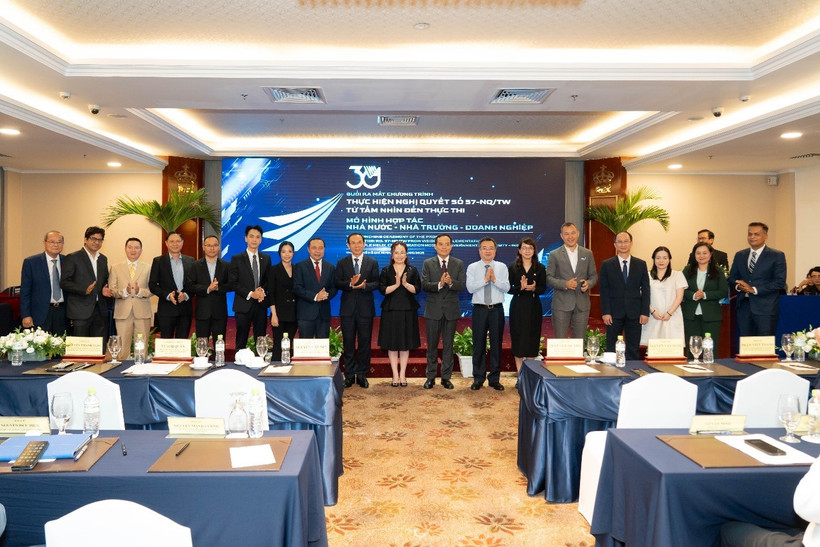
Hanoi (VNA) - TTC AgriS (Thanh Thanh Cong – Bien Hoa Joint Stock Company, AgriS, HOSE: SBT) has recently signed consecutive memoranda of understanding (MoUs) with Vietnam National University Ho Chi Minh City (VNU-HCM) and Nong Lam University Ho Chi Minh City (NLU) to initiate cooperation in training, research, and technology transfer.
The extensive partnership with two of Vietnam’s top universities underscores AgriS’s pioneering role in the “Three Pillars” alliance - Government, Academia, and Business - within the broader 5-party model shaping Vietnam’s agricultural future, alongside financial institutions and farmers. The company is actively aligned with national strategies focused on breakthroughs in private-sector growth and high-tech agriculture.
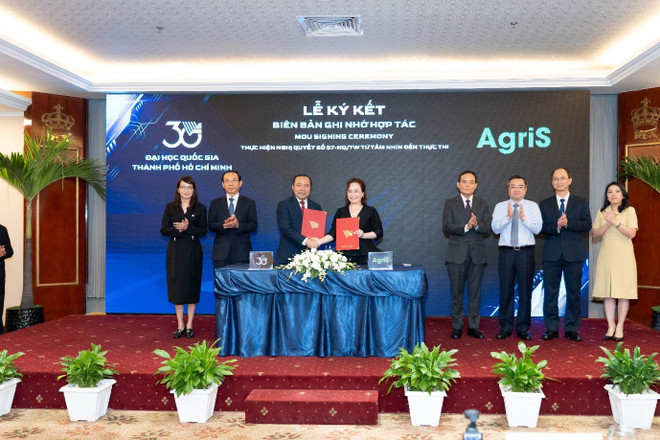
Strategic “Three Pillars” Partnership Drives High-Tech and Circular Agriculture
By engaging with two long-standing academic institutions in agriculture and science and technology, AgriS has created multi-dimensional cooperation opportunities aimed at advancing sustainable agriculture. The ultimate goal is to close the gap between theory and practical application in research and technology transfer.
The collaboration between AgriS and the universities focuses on several key areas: developing high-quality human resources; international exchange; contributing to national strategic programs in agriculture, science, technology, and digital transformation; developing R&D and technology transfer; and nurturing a startup ecosystem.
As a critical structure for developing sustainable agriculture in Vietnam, the close alliance among the "Three Pillars" - Government, Academia, and Business - is reflected in AgriS’s firm and action-oriented approach.
Ms. Dang Huynh Uc My, Chairlady of AgriS emphasized: “We believe agriculture is not just an economic sector but the foundation of a nation's survival. In this era of green transformation and global integration, the cooperation model between Government – Academia – Business, rooted in knowledge, supported by policy, and centered around people, will lay the groundwork for a truly innovative agricultural ecosystem. These are the three core pillars within the 5-party model defining our national agricultural development strategy.”
She also noted that, beyond these three pillars, AgriS is gradually integrating two additional forces: Farmers, the agents of innovation, and Financial partners, who support green growth.
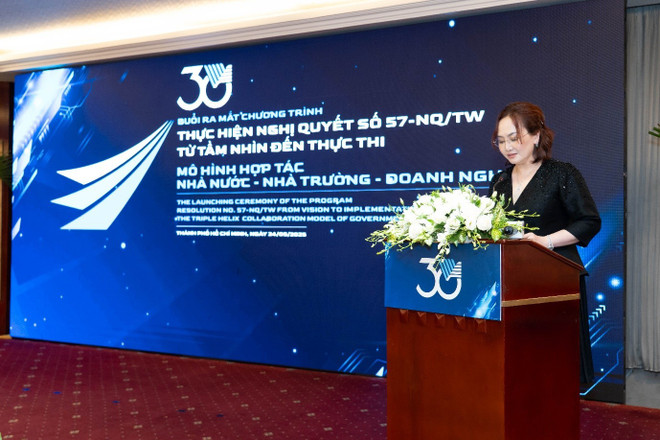
By sharing resources and creating an environment enriched in knowledge, capital, and experimental platforms, AgriS empowers students to lead innovation, laying the foundation for a competitive, circular agricultural industry. This effort aligns with the Government’s Resolution 57-NQ/TW on breakthroughs in science, technology, innovation, and digital transformation, as well as Resolution 68-NQ/TW of the Political Bureau on private sector development.
The Core Connector in a High-Tech, Sustainable Agricultural Ecosystem
Building on years of collaboration with academic and research institutions, AgriS continues to play the role of an “open platform” - a bridge for the growth of a high-tech circular agriculture ecosystem.
As a leading enterprise in sustainable, high-tech agriculture, AgriS is committed to partnering with universities and the Government to explore innovative initiatives in AgTech and FoodTech. The company pledges to co-create knowledge, invest long-term in the nation’s agricultural human resources, and serve as a hub for innovation by effectively applying research outcomes to real-world solutions.
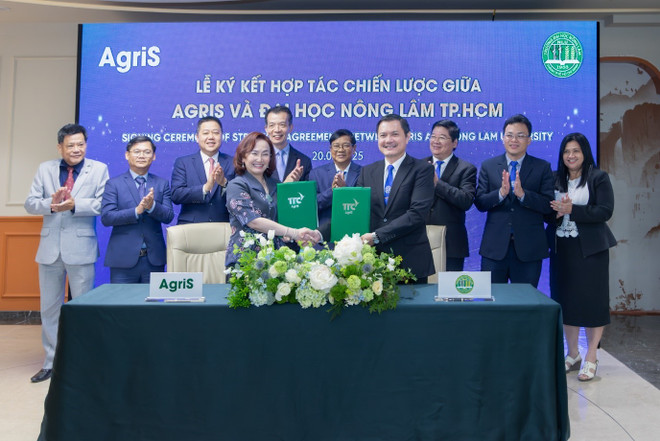
Specifically, AgriS will work with universities to establish specialized training centers and experimental models located at university campuses, raw material regions, and factories - providing students with direct exposure to high-tech agriculture practices. AgriS will also collaborate on building policy databases and piloting legal frameworks related to labor productivity, circular economy, and digital transformation in agriculture.
AgriS is especially focused on promoting entrepreneurship among students through funding support, innovation competitions, idea incubators, preferential credit programs, and partnerships with academic and financial institutions to build an agricultural startup ecosystem.
On the international exchange front, AgriS will cooperate in developing Joint Research Labs with academic partners to expand Vietnam’s scientific network with global leaders in agricultural science, technology, and digitalization. Additionally, through cooperation programs with experts and AgriS partners in Australia, Indonesia, Singapore, Thailand, and more, the company will support the development of an agriculture workforce equipped with strong expertise and innovation capacity to meet the demands of international agri-business.
Emphasising the Role of the Business Sector in Advancing a Sustainable Agricultural Ecosystem in Vietnam, Assoc. Prof. Dr. Vu Hai Quan, Member of the Party Central Committee, Secretary of the Party Committee, Chairman of the Council, and Director of VNU-HCM emphasized: “Three Pillars cooperation must operate under a shared principle: co-design, co-implement, and co-share. When businesses, universities, and government get along to solve major challenges and share risks, I believe we can achieve the goal of turning Vietnam into a high-income, developed country by 2045.”
Continuing to enhance the competitiveness of the agricultural workforce, AgriS is committed to being one of the first enterprises to act boldly, collaborating with academia and government agencies to achieve breakthroughs in agriculture - preserving Vietnamese identity while meeting international standards, with a vision toward Net Zero 2035./.