Hanoi (VNA) – Vietnam’s agro-forestry-fishery exports maintained strong growth momentum in the first two months of 2026, rising 17.1% year-on-year to an estimated 11.3 billion USD, according to the Ministry of Agriculture and Environment.
In February alone, export turnover was estimated at 4.71 billion USD, down 28.4% from the previous month but up 1.9% compared to the same period last year.
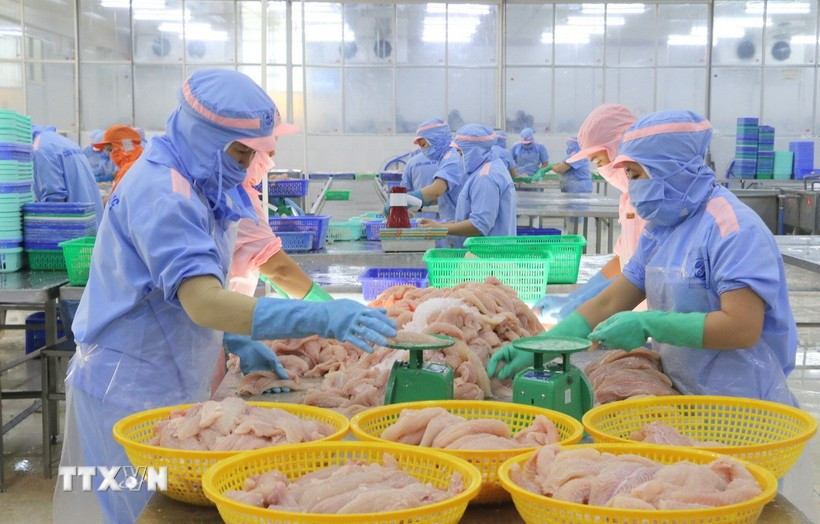
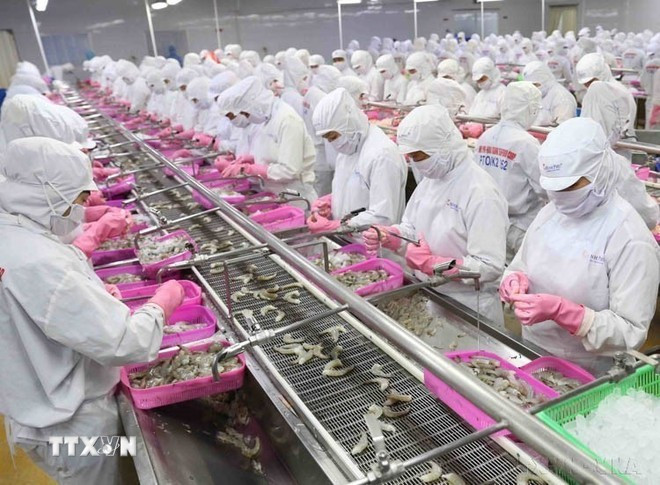
Of the total export value in the January–February period, agricultural products accounted for 6.09 billion USD, up 17.1% year-on-year. Seafood exports reached 1.76 billion USD, marking a sharp increase of 23.3%, while forestry products brought in 2.82 billion USD, up 7.4%.
Notably, livestock product exports surged 84.3% to 140.7 million USD. Exports of production inputs expanded 51.7%, and salt exports rose 69% compared to the same period last year.
Asia remained the largest export market for Vietnam’s agro-forestry-fishery products, making up 45.5% of total export value. The Americas ranked second with a 21% share, followed by Europe at 15.7%. Africa and Oceania accounted for 2.2% and 1.4%, respectively.
Compared to the same period last year, export value to Asia increased 27.7%, while shipments to the Americas rose 10.4% and to Europe 12%. Exports to Oceania surged 32.4%, and shipments to Africa declined 19.6%.
By individual market, China remained Vietnam’s largest importer, accounting for 22.9% of total agro-forestry-fishery export turnover. The US followed with 18.7%, and Japan came in third with 7.2%.
During the reviewed period, exports to China soared 55.9% year-on-year, while those to the US and Japan rose 9.2% and 9.8%, respectively.
The ministry said the positive growth results in the opening months of the year signal a market recovery, laying a favourable foundation for the sector to accelerate production, expand markets and strive to achieve its 2026 export target of 73–75 billion USD.
To sustain growth, the ministry will implement a range of coordinated measures, focusing on enhancing added value, promoting sustainable development and proactively adapting to increasingly stringent market requirements. In the context of complex geopolitical developments that may affect transport, payment and global trade flows, the sector will strengthen forecasting capacity and develop response scenarios to cope with international trade fluctuations.
On the production side, efforts will centre on tightening value chain management and strengthening linkages among production, preliminary processing, deep processing and distribution. Models associated with concentrated raw material areas, ensuring traceability and food safety, will be expanded to improve supply stability and product quality for export markets.
The ministry will also encourage enterprises to invest in technological innovation and deep processing linked to sustainable raw material zones and safe supply chains. Priority will be given to post-harvest preservation technologies and by-product processing in line with a circular economy model to maximise material utilisation, reduce losses and increase product value.
At the same time, authorities will enhance quality control capacity at processing and preservation facilities, guide enterprises in meeting technical standards and import requirements, and intensify trade promotion and brand building for Vietnamese agro-forestry-fishery products, while developing specialised, modern and sustainable logistics systems to improve competitiveness in global markets./.