Agriculture sector puts data at the heart of digital transformation

The Ministry of Agriculture and Environment is stepping up investment in digital infrastructure, shared platforms and integrated databases for agriculture and the environment, with a focus on centralisation, standardisation and security.

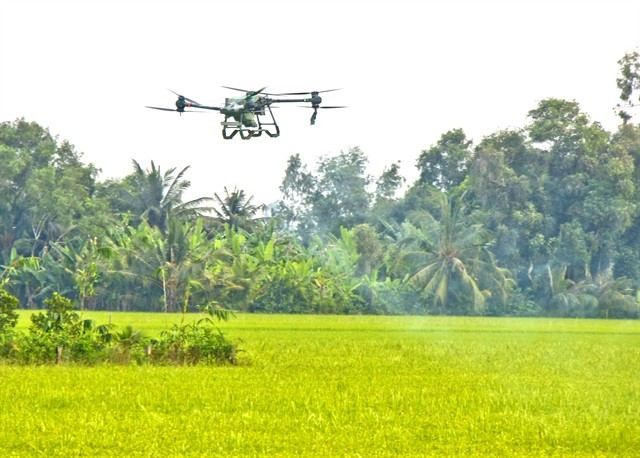
A drone is used to spray pesticides to care for the winter-spring rice crop in the Mekong Delta City of Can Tho (Photo: VNA)

Hanoi (VNS/VNA) – The Ministry of Agriculture and Environment is placing digital transformation and sector-wide data development at the heart of its long-term strategy, aligning its work with Politburo Resolution No. 57-NQ/TW on breakthroughs in science, technology, innovation and national digital transformation, alongside related resolutions of the National Assembly and the Government.

To that end, the ministry is stepping up investment in digital infrastructure, shared platforms and integrated databases for agriculture and the environment, with an emphasis on centralisation, standardisation and security.

A central objective is to strengthen data connectivity and interoperability both within the sector and with the National Data Centre.

Management, direction and policy implementation are gradually shifting towards a data-driven model, aimed at improving the effectiveness of State management, enhancing the quality of public services and better serving citizens and businesses.

Crucially, the ministry has stressed that building databases is not simply about having data but about ensuring data quality and usability.

“Without data, there can be no management or governance,” said Deputy Minister of Agriculture and Environment Vo Van Hung.

"Digital transformation is an inevitable task if the sector is to improve administrative effectiveness, serve the public and develop smart agriculture.

“Data must be the foundation, and outcomes the ultimate measure,” said Hung, adding that the sector was focusing on three main tasks.

The first is to transform management methods from experience-based and manual practices to digital, data-driven management.

The second is to complete shared sectoral databases that meet the criteria of being accurate, sufficient, clean and live, capable of reflecting realities in a timely manner.

The third is to gradually move from manual operations to automation, applying digital technologies to monitoring, forecasting and decision-making.

According to experts, when data is treated as a strategic resource and effectively exploited, the agriculture and environment sector can not only strengthen its governance capacity but also unlock new drivers of sustainable growth.

From agricultural market forecasting and land and water resource management to pollution control, disaster prevention and climate change adaptation, operations are expected to become increasingly accurate, timely and transparent.

This will provide a critical foundation for building a modern, smart and efficient agricultural sector suited to a new stage of development.

Under its digital transformation strategy, the sector aims to complete modern, green and shared data centres by 2030.

On that basis, the ministry plans to develop common digital platforms and applications from central to local levels, supporting comprehensive State management while meeting the growing demands of citizens and businesses.

By 2030, the target is for 100% of national and specialised databases in agriculture and the environment to be established, standardised and cleaned, forming a unified data ecosystem centrally managed and synchronised through the ministry’s data centres.

Key databases must fully meet the criteria of being accurate, sufficient, clean, live, unified and shared, creating a solid foundation for data-driven governance and decision-making.

According to the ministry’s Department of Digital Transformation, the sector currently operates 115 national and specialised databases, including 10 serving leadership and operational management, three directly serving citizens and businesses and 102 specialised databases in agriculture and the environment.

One national database has already been established, the National Land Database, while a National Climate Change Database is being proposed.

Several other datasets, though not formally designated as national, cover nationwide scopes, such as those on water resources, geospatial data, the environment, meteorology and hydrology, plant varieties, fisheries, dyke management and poverty reduction.

In practice, database development has already delivered important initial results.

The sector has completed both the National Land Database and the National Fisheries Database, while also rolling out technical conditions to connect and synchronise data with the National Population Database and the National Data Centre.

A basic framework of technical regulations for national and specialised databases has also been issued, providing standardised guidelines for building, refining and sharing data with ministries, agencies and local authorities nationwide./.

VNA

See more

The banh chung making session at the Nguyen Du Lao-Vietnamese bilingual school (Photo: VNA)

A touch of Vietnamese Tet in Laos, Mozambique

In Maputo, members of the Vietnamese community in Mozambique have gathered for the “Spring of the Homeland”, a reunion that brought overseas Vietnamese into each other’s company to share laughter, stories, and heartfelt Tet wishes.

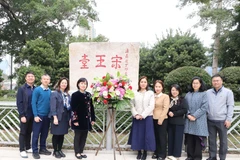
Officials and staff of the Consulate General of Vietnam in Hong Kong (China), led by Consul General Le Duc Hanh, together with representatives of some Vietnamese agencies and businesses operating in Hong Kong, lay flowers at the Sung Wong Toi monument. (Photo: VNA)

Vietnamese Consulate General in Hong Kong commemorates Party founding anniversary

Participants revisited the historical background and significance of the Party’s establishment. Historical records describe the event as a major turning point that unified predecessor communist organisations into a single, cohesive party tasked with leading the Vietnamese revolution to overthrow colonial rule and achieve national independence, freedom and happiness.

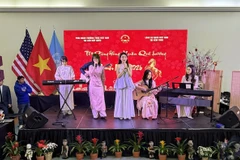
The youth band of Vietnam’s representative office in New York in a performance at the Tet gathering. (Photo: VNA)

OV communities celebrate Lunar New Year

Vietnamese communities in the US and Germany marked the Lunar New Year - the Year of the Horse with warm and vibrant community celebrations, helping preserve national traditions while strengthening bonds between overseas Vietnamese and their host societies.

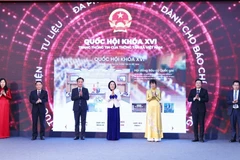
Delegates perform the inauguration ceremony for the VNA information portal on the election of deputies to the 16th National Assembly and People’s Councils at all levels for the 2026–2031 term at its launch in Hanoi on February 3. (Photo: VNA)

VNA launches website on election of deputies to 16th National Assembly, People’s Councils

VNA General Director Vu Viet Trang said that, in fulfilling its mandate as the national news agency, the VNA is intensifying its key information streams to translate the Resolution of the 14th National Party Congress into action. Among related major information streams, the election represents a particularly important political event, taking place immediately after the 14th National Party Congress and serving as a concrete step in realising its resolution.

The three suspects at the police station (Photo: VNA)

Three prosecuted for illegal trading of over 8.4 billion email accounts

Recently, the Criminal Police Division of the Tuyen Quang provincial Department of Public Security uncovered an organised group exploiting cyberspace to illegally infiltrate others’ email accounts for illicit gain. The suspects allegedly contacted foreign counterparts via Telegram to buy and sell leaked email information, including usernames and passwords obtained through cyberattacks.

Spring Fair 2026: Hanoi adds six bus routes to serve residents and visitors

Spring Fair 2026: Hanoi adds six bus routes to serve residents and visitors

Under the plan implemented by the Hanoi Traffic Management and Operations Centre, the enhanced services comprise two existing routes (No. 43 and E10) and four supplementary routes, with a total of 34 buses operating 362 trips per day. The routes connect the VEC in four directions, from the city centre and the eastern, western, southern and northern areas of Hanoi.

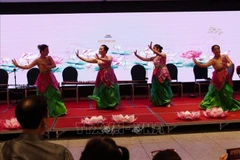
A lotus dance performance by artists from the VietAus Cultural Exchange Organisation - VACEO delighted international guests. (Photo: VNA)

Vietnamese community in Sydney gathers in joyful Tet reunion

The Vietnamese Consulate General in Sydney welcomed the overseas Vietnamese (OV) community to its “Community Tet – Spring from the Homeland” event on February 1, an intimate cultural reunion that fostered emotional and communal links with their beloved homeland.

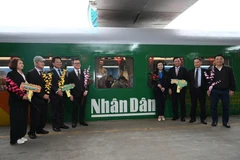
The Happiness Train”, officially launched on February 2 at the Hanoi Railway Station, aims to promote the country’s image and tourism to domestic and international travellers. (Photo: VNA)

“Happiness Train” promotes Vietnam’s image, people and tourism

The programme will continue on New Year’s Eve, when another “Happiness Train” will depart, turning the journey into a festive space of reunion, sharing and good wishes. Passengers on board on Lunar New Year’s Eve (February 17) will also receive lucky money from the organisers.