Bac Ninh develops agricultural economy linked with processing, product consumption

From now to 2030, the northern province of Bac Ninh will focus on developing its agricultural economy in depth, with strong links to processing and the consumption of farm produce.

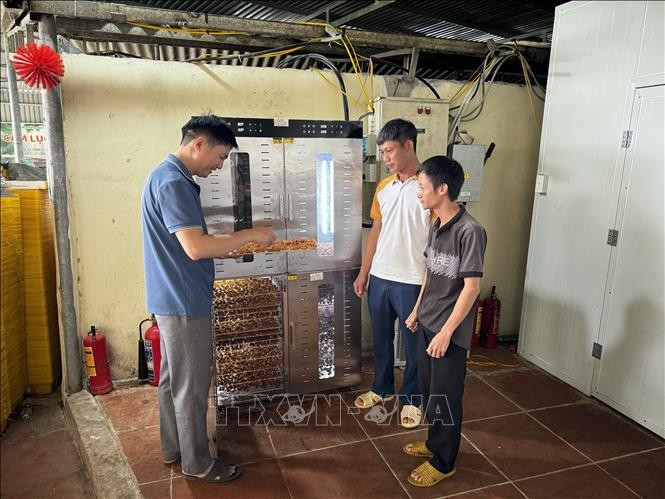
A cooperative in Bac Ninh province invests in a high-capacity fruit dryer for its production activities. (Photo: VNA)

Hanoi (VNA) - From now to 2030, the northern province of Bac Ninh will focus on developing its agricultural economy in depth, with strong links to processing and the consumption of farm produce, according to Director of the provincial Department of Agriculture and Environment Duong Thanh Tung.

The provincial agricultural sector is reviewing and advising on the development of support policies for the next phase, with priority given to a comprehensive policy package for the development of agriculture, forestry and fisheries for 2026 – 2030. The aim is to remove bottlenecks in land, credit and investment attraction in agriculture, while promoting green, circular and smart agriculture. At the same time, the sector is advising on plans to develop key local crops and livestock, such as fruit trees, pig and poultry farming, and economic forestry.

In the coming period, Bac Ninh will focus on planning and restructuring its crop and livestock systems based on the strengths of each locality and ecological region. In suburban areas, the province encourages the development of high-tech agriculture linked with urban consumption markets and exports.

In plains and mountainous areas, it will promote concentrated, specialised, high-quality agricultural production models; develop OCOP products; form value chains from production to consumption; and attract enterprises to invest in high-tech agricultural processing zones and modern slaughtering facilities.

The province also plans to develop its fruit-growing areas into a nationally important fruit production zone. Bac Ninh will attract investment to build an agricultural irradiation centre to support the export of farm produce, especially to demanding markets such as the US. Additionally, the province will plan an agricultural-processing industrial park and a research and manufacturing centre for high-tech agricultural machinery to increase the share of deep processing, reduce costs and improve product value.

Tung added that from now to 2030, Bac Ninh will focus on agricultural production that meets VietGAP, GlobalGAP, organic and circular standards, along with branding and traceability to serve domestic markets and move toward export. The province is shifting from volume-based agricultural production to a multi-value agricultural economy, linking agricultural development with new-style rural building, community tourism and ecotourism to create added value and promote sustainable agricultural growth.

Bac Ninh is also investing in agricultural infrastructure for large-scale, concentrated production, especially in irrigation and dyke systems, to better respond to increasingly unpredictable weather patterns. The province, meanwhile, continues promoting mechanisation in all stages of production.

The local favourable geography and mild climate give it strong potential for diverse, high-value agricultural production. Since 2020, the province has reorganised its production areas, invested in infrastructure and converted over 10,000 hectares of low-yield rice into fruit and vegetable crops with higher economic efficiency.

As a result, Bac Ninh has developed many large-scale, specialised agricultural production zones, including nearly 54,000 hectares of fruit trees, the fourth-largest area in Vietnam, while having over 770 products rated three stars or higher under the One Commune, One Product (OCOP) programme.

More than 1,600 local agricultural establishments now apply high technology. The value of high-tech products is 17 – 30% higher than traditional cultivation.

Over 60% of farming and aquaculture output is produced under good agricultural practices. Income per hectare of cultivated land has reached 138 million VND (5,231 USD) per year, an increase of 28 million VND per hectare compared with 2020./.
VNA

See more

The vessel carrying the 2 millionth TEU arrives at Hai Phong Port. (Photo:VNA)

Hai Phong Port reaches 2-million-TEU milestone

Handling the 2 millionth TEU in 2025 not only demonstrates Hai Phong Port’s operational capacity and the collective efforts of its workforce, but also highlights its increasingly important role in regional and global supply chains, the confidence of shipping lines, logistics firms and the business community, and the effectiveness of policies to improve the investment climate and strengthen maritime infrastructure and services.

Melons labelled with traceability codes on display at the Song Van agricultural produce store in Ninh Binh city, Ninh Binh province. (Photo: VNA)

Tracing origins hindered by fragmented data systems

As the Government accelerates the digital economy, establishing a unified national traceability system has become a crucial move to end data fragmentation and disconnection among ministries, sectors and localities.

Hyundai unveils its new Avante Hybrid model in Seoul, the Republic of Korea, on August 13, 2020. (Photo: Yonhap/VNA)

Tax cuts poised to ignite Vietnam’s hybrid vehicle boom from 2026

Experts forecast that 2026-2030 will mark a period of strong growth for hybrid vehicles in Vietnam, a trend that will invigorate the automotive sector while supporting national objectives on emissions reduction, sustainable development and the broader transition to green mobility.

Illustrative image (Photo: VNA)

Vietnam targets 1 billion USD in banana exports

Bananas have been identified as a priority product under the Project for the Development of Key Fruit Crops to 2025, with a vision to 2030, approved in October 2022. Under the plan, banana acreage is projected to reach 165,000–175,000ha by 2030, with output of 2.6–3 million tonnes.

Deputy Minister of Foreign Affairs Nguyen Minh Hang (Photo: VNA)

Event connects Vietnamese businesses with African countries

Deputy Foreign Minister Nguyen Minh Hang held that to develop Vietnam – Africa ties more strongly and substantively, it is necessary to promote the engagement of businesses, and that the Government will create favourable conditions for them to enhance fruitful cooperation.

Deputy Prime Minister Ho Duc Phoc (R) and Independent Non-executive Chairman of AIA Mark Tucker at their meeting in Hanoi on December 12. (Photo: VNA)

AIA Group envisions long-term investment, cooperation in Vietnam

Over 25 years of operation in Vietnam, AIA has achieved positive results. Its premium revenue ranks among the top five life insurers, reaching nearly 14.83 trillion VND (563.71 million USD) in 2024 and an estimated 15.73 trillion VND in 2025, equivalent to around 10% of the market share.

A view of the 2025 Japan business roundtable in HCM City on December 12. (Photo: VNA)

Ho Chi Minh City courts Japanese investment with growth blueprint

Ha underscored the pivotal contributions of Japanese firms, which have long supported local socio-economic progress through major infrastructure projects, industrial zones and workforce training courses. To date, Japanese companies have invested more than 15 billion USD in over 2,200 projects, reflecting sustained confidence and commitment to the market.

Deputy Prime Minister Bui Thanh Son receives Kounlaphanh Vongnathy, Vice President of Phongsupthavy Group, in Hanoi on December 12, 2025. (Photo: VNA)

Lao group urged to deepen energy ties with Vietnam

Deputy Prime Minister Bui Thanh Son has commended Phongsupthavy Group as one of Laos’ leading investors supplying electricity to Vietnam, noting its pledge to ramp up power exports and actively contribute to the implementation of energy cooperation agreements endorsed by senior leaders of the two Parties and States.