Bau Truc – Perfect place for tourists to explore quintessence of Cham pottery
Bau Truc pottery village in the south central province of Ninh Thuan is viewed as a perfect destination for visitors to explore the quintessence of Cham pottery making and their unique culture.
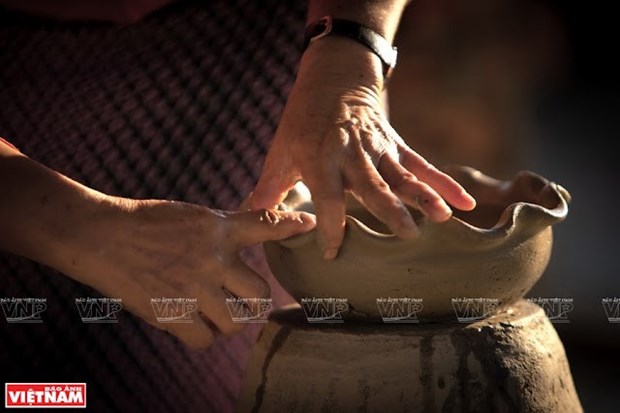 A Bau Truc potter turns clay into unique pottery items. (Photo: VNA)
Bau Truc is one of the oldest pottery villages in Southeast Asia. Over 90 percent of some 500 families in Bau Truc village are making pottery. For the Cham ethnic minority people, ceramics are not only used as daily utensils, but more importantly, they are an intermedia for them to connect with gods.
Local potters believe that their craft was founded more than a thousand years ago by Poklong Chanh, a man who refused to become a mandarin in order to stay at his village teaching housewives how to take clay and shape and fire it into utensils and decorative items.
To show their gratitude toward the forefather of their craft, Bau Truc villagers built a temple dedicated to Poklong Chanh and pray for him during Kate, the Cham’s biggest festival held annually in the seventh lunar month.
Truong Thi Gach, an 80-year-old potter who has been making ceramics her entire life, said her mother learnt the craft from her grandmother and then passed it down to Gach when she was 10. Gach is now teaching the craft to her children. In Bau Truc, only women make pottery while the men help in the firing process by collecting firewood and straw.
According to Gach, Bau Truc pottery is distinctive from any other type in the world because it is handmade at all stages. While other pottery is made from a rotating wheel, Bau Truc is not. Bau Truc potters use their feet to move around the clay mixture while using their hands to shape the pottery. Every single pottery item in Bau Truc is made by hand without using any molds.
The pottery making process involves many stages. Gach said that the first and most important of which is selecting the clay which is the secret behind the uniqueness of Bau Truc pottery.
She said the clay used to make Bau Truc pottery must be taken from the soil near the village river. The clay is then dried, and soaked in water to become soft. After that, it is mixed with sand and water, and then kneaded until it turns into a flexible and smooth mixture. That is when it can be used for shaping.
Bau Truc pottery is also fired in a different way. The firing process, which only uses wood and straw, takes from five to eight hours depending on the size of the product.
According to Cham tradition, a potter must choose a good date for firing the pottery and before starting the firing process, he must conduct an offering ritual dedicated to the gods and forefathers of the craft, praying for their support for turning out beautiful items.
Bau Truc products characterize the life, culture and beliefs of locals. They range from simple home utensils such as a jar, pot, pan or kettle, to objects of worship, statues, reliefs and decorative patterns. The patterns on Bau Truc pottery ware mostly portray natural scenery and show the Cham’s beliefs.
Today, old Bau Truc village is a popular cultural and tourist attraction in Ninh Thuan. In 2008, the village set up its pottery cooperative which has become a place to showcase the art of Bau Truc pottery making. Visitors to the cooperative can select beautiful pottery items from thousands of products on display while at the same time, exploring how they are made.
For researchers, the Cham and their original cultural heritages remain mysterious and their pottery making is an example./.





You should also see

Energy industry needs nearly 5 trillion VND of investment in 2021-2030
The total investment capital demand for the whole energy sector in the 2021-2030 period is between 4.13-4.8 trillion VND (163.01-189.46 million USD), according to a plan to implement the National Power Planning in the 2021-2030 period with a vision to 2050.


See more
 Culture - Sports
Google Arts & Culture exhibition spotlights Trang An Landscape Complex
An online exhibition featuring the Trang An Landscape Complex in Vietnam’s northern Ninh Binh province was launched on Google Arts & Culture on April 18 by the complex's management board with the support of Google Arts & Culture and UNESCO World Heritage Centre.
 Videos
Ninh Binh listed among world’s top 10 free-crowd wonders
The northern province of Ninh Binh has been named among the list of the top 10 free-crowd wonders of the world, as compiled by media outlet the Daily Mail of the UK.
 Destinations
Mui Ne among top 5 upscale destinations in Asia-Pacific
In March, Booking.com, a leading travel app from the Netherlands, released a list of unique destinations in the Asia-Pacific region offering remarkable experiences and luxury. Mui Ne in Phan Thiet city, Binh Thuan province, secured a spot in the top 5.
 Destinations
Hue named Vietnam's most affordable destination
Hue emerges as the most affordable destination for travellers in Vietnam in April and May, according to the online travel platform Agoda.
 Videos
Ancient 12th-century road discovered beneath My Son Sanctuary
An ancient road dating back to the 12th century has freshly been discovered in an excavation on architectural ruins at the east side of Tower K within the My Son Sanctuary in the central province of Quang Nam.
