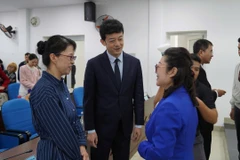
Nestlé Vietnam donates 10,000 bricks made of coffee grounds to a school in Dong Nai province. The circular economy enables the company to make every kilo of coffee grounds count. (Photo: suckhoedoisong.vn)
 Pham Minh Thien, general director of Thanh Binh Company Ltd, revealed that hiscompany's production process had been designed so that waste in one stagebecomes fodder for another.
He said his company had bought land in the Tan Hong region to grow a particularstrain of rice, which can easily do without fertilisers, pesticides, and cropcare. As such, the strain causes a minimal impact on the environment.
At harvest time, its straw is reused as a medium to grow mushrooms whereasits rice husk as a biomass fuel for export. Its rice bran is processed toproduce bran oil and animal feed. The residue from this oil-making processis reclaimed to feed poultry.
"The global demand for these by-products isconsiderable. For instance, bran oil has become much sought after by Japanesetraders," said Thien.
The circular economy embraced by Thanh Bình Company Ltd has proved to behighly beneficial to its stakeholders, not only economically but alsoenvironmentally.
As a result of the sustainable farming practices, the soilcultivated by the company, which was contaminated previously by chemicalsubstances, has been gradually improving in quality.
Nestlé Vietnam Company Ltd is another name that has managed to incorporatethe circular economy into its production.
The company has put coffee grounds to good use by turning them intobiomass, which is used to fuel its boilers. The ash left after thecombustion will serve as a raw material for the production of bricks.
Coffee sludge is processed into microbial fertilisers to enrich the soil,whereas the steam from the boilers goes to the cooling towers for furtherreuse. Even the wastewater is not wasted: it will be recycled into A-standardclean water to close the production loop.
Tran Thi Hong Minh, head of the Central Institute for Economic Management,asserted that the circular economy would serve businesses well byenabling the efficient use of resources andfacilitating their deeper involvement in the global supply chains.
She said the circular economy is no longer an option but an imperative forbusinesses because global customers have become more eco-consciousand willing to shift toward a more sustainable buying behaviour.
Vu Kim Hanh, chairman of the Association of Vietnamese High-quality Products,opined that the Government needs to take active steps to lay thegroundwork for a broad-based transition to the circular economy.
The to-do list should comprise a long-term scheme for the transition andthe entry into force of a sufficient number of legal documents thatregulate the notion.
She also said the feasibility of the circular economy in the country wouldhinge on technological, institutional, infrastructural, and human resourcesfactors.
Nguyen The Chinh, director of the Environmental Economic Policy Institute,underlined several obstacles in the way of businesses trying to embrace thetransition.
The first obstacle involves advanced technology, which is not alwaysreadily accessible to a large number of businesses. Without advanced technologyat their disposal, many businesses get stuck in their traditional linearway of production.
The second obstacle centres around the rigidity of domestic consumption habits.For instance, a wide range of consumers back home keep usingplastic bags for their convenience and show a reluctance to shift gears,posing a setback for recyclable bags./.
The circular economy embraced by Thanh Bình Company Ltd has proved to behighly beneficial to its stakeholders, not only economically but alsoenvironmentally.
As a result of the sustainable farming practices, the soilcultivated by the company, which was contaminated previously by chemicalsubstances, has been gradually improving in quality.
Nestlé Vietnam Company Ltd is another name that has managed to incorporatethe circular economy into its production.
The company has put coffee grounds to good use by turning them intobiomass, which is used to fuel its boilers. The ash left after thecombustion will serve as a raw material for the production of bricks.
Coffee sludge is processed into microbial fertilisers to enrich the soil,whereas the steam from the boilers goes to the cooling towers for furtherreuse. Even the wastewater is not wasted: it will be recycled into A-standardclean water to close the production loop.
Tran Thi Hong Minh, head of the Central Institute for Economic Management,asserted that the circular economy would serve businesses well byenabling the efficient use of resources andfacilitating their deeper involvement in the global supply chains.
She said the circular economy is no longer an option but an imperative forbusinesses because global customers have become more eco-consciousand willing to shift toward a more sustainable buying behaviour.
Vu Kim Hanh, chairman of the Association of Vietnamese High-quality Products,opined that the Government needs to take active steps to lay thegroundwork for a broad-based transition to the circular economy.
The to-do list should comprise a long-term scheme for the transition andthe entry into force of a sufficient number of legal documents thatregulate the notion.
She also said the feasibility of the circular economy in the country wouldhinge on technological, institutional, infrastructural, and human resourcesfactors.
Nguyen The Chinh, director of the Environmental Economic Policy Institute,underlined several obstacles in the way of businesses trying to embrace thetransition.
The first obstacle involves advanced technology, which is not alwaysreadily accessible to a large number of businesses. Without advanced technologyat their disposal, many businesses get stuck in their traditional linearway of production.
The second obstacle centres around the rigidity of domestic consumption habits.For instance, a wide range of consumers back home keep usingplastic bags for their convenience and show a reluctance to shift gears,posing a setback for recyclable bags./.
VNA