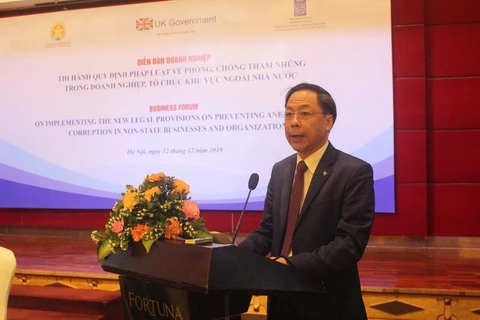
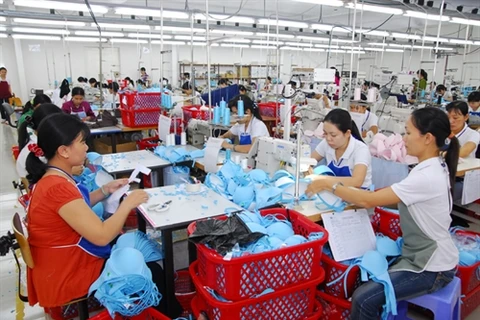
The private sector has become one of the important driving forces for the national economy (Photo: VNA)
 Hanoi (VNA) – Clear mechanisms and policies play a specially important role as a launching platform for the private economic sector to make breakthroughs and greatly contribute to the national economic development.
Resolution 10/NQ-TW of the Party Central Committee on developing the private economy into an important driving force of the socialist-oriented market economy reflected the strong renovation of the Party regarding this issue, paving the way for the private economy to become a dynamic and creative economic sector.
To realise the resolution, the National Assembly issued and instructed the implementation of several important laws such as the Law on Competition and the Law on Support for Small- and Medium-sized Enterprises. The legislature also issued a law amending some articles of the Investment Law in which conditional businesses lines were cut down from 267 to 243 from July 2017.
The Government, ministries, sectors and localities have issued many guiding documents and implementing a wide range of action programmes, thus creating a favourable and clear business environment for the private economy to grow.
Talking with private businesses, Prime Minister Nguyen Xuan Phuc pledged to continue providing a space, resources and opportunities for the private sector to develop more easily.
The Government leader’s commitment has been concretised with a series of important policies such as Resolution 19/NQ-CP on major tasks and solutions to improve the business environment and enhancing national competitiveness in 2017, with orientation to 2020; Resolution 35/NQ-CP on business support and development by 2020; Resolution 98/NQ-CP promulgating the Government’s action programme to realise the Party Central Committee’s Resolution 10/NQ-TW.
[Private economic sector – important driver of economy]
In addition, an array of business environment improvement measures have been launched by the Government and the Prime Minister such as reforming administrative procedures, reducing production and business costs, accessing markets, reorganize inspection activities, and simplifying and reducing business conditions.
Many legal documents have been issued to guide the implementation of laws related to business and management activities of the private sector.
Resolution 98 delivers a message of building “a government of action” that focuses on removing institutional obstacles to help businesses reduce costs, improve operational efficiency, and raise competitiveness. On that spirit, the resolution called on ministries, sectors and localities to engage in performing the task of “creating a favourable business and investment environment for the development of the private sector and support it in renovating and modernising technologies, developing human resources, and improving labour productivity”.
The action programme also urged People’s Committees of provinces and cities to organise periodical open dialogue at least twice a year with the business community and press agencies to promptly remove difficulties and obstacles facing enterprises.
In its Resolution 35, the Government has launched a series of measures to create a favourable business and investment environment, support firms in accessing credit, production and business premises, and markets as well as those to help enterprises cut production costs, thus contributing to increasing national competitiveness, promoting the development of the private sector, and forming several potential, large-scale economic groups.
A noteworthy thing in the implementation of the Government’s reform programmes is the activeness and proactiveness of the concerned ministries and agencies.
In 2018, the ministries and agencies reviewed and submitted 28 legal documents, cut more than 3,300 out of nearly 6,200 business conditions, or 54.5 percent, exceeding 8,1 percent compared to that required by the Government. Those with the largest number of simplified business conditions included the Ministry of Industry and Trade, the Ministry of Health, and the Ministry of Transport.
In 2019, improving the business investment environment continued to be one of focuses of the Government. On January 1, 2019, the Government issued Resolution 02/NQ-CP on continuing to implement key tasks and solutions to improve the business environment and enhance national competitiveness in 2019, with orientation to 2021.
One and a half years since the Law on Support for Small- and Medium-sized Enterprises (SMEs) took effect, decrees and circulars guiding the implementation of the law have basically been fully promulgated. In order to urgently bring a number of policies stipulated in the law to life, the Ministry of Planning and Investment and the Ministry of Finance have been actively finalizing a draft Government Decree on supplementing a number of professions and sectors eligible for investment incentives prescribed in the Law on Support for Small- and Medium-sized Enterprises and the National Assembly's Resolution on corporate income tax incentives for SMEs.
Many localities have developed plans and projects to support small and medium-sized businesses with specific policies to meet their real SMEs development requirements.
The efforts of the Government, ministries, agencies and localities in building a transparent business environment have created a foundation for the strong development of the private sector in recent years.
The sector has become one of the important driving forces for the national economy as it creates about 42 percent of the country’s gross domestic product (GDP), contributes 30 percent of State budget revenue, and attracts 85 percent of labour force./.
VNA