CPV’s policy drives Vietnam’s transformation, global integration

After 40 years of adopting Doi moi (renewal) process, under the leadership of the Communist Party of Vietnam, Vietnam has made remarkable transformations, with its international position and prestige steadily rising.

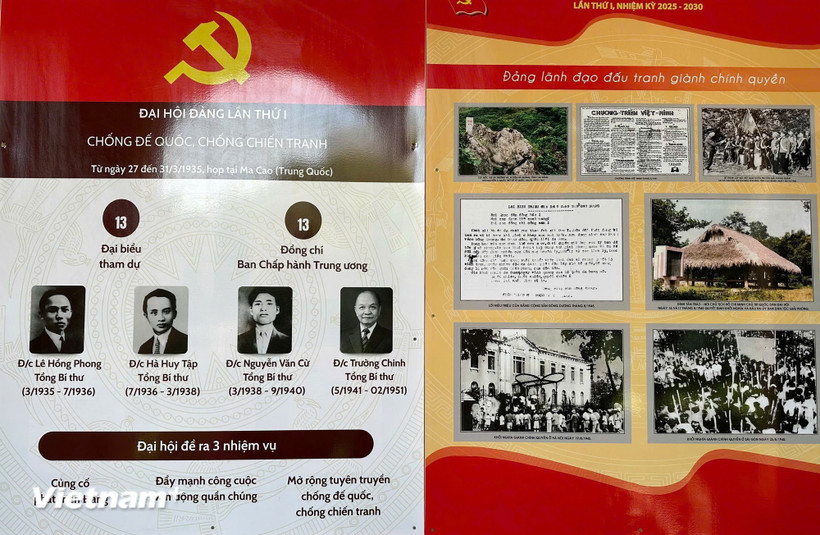
The exhibition on the first National Congress of the Communist Party of Vietnam at the Ho Chi Minh Museum, Ho Chi Minh City branch. (Source: VietnamPlus)

Hanoi (VNA) – Over nearly 96 years since its founding, particularly during 40 years of renewal, the Communist Party of Vietnam (CPV) has led the nation through a historic journey marked by the will, mettle, and intellect of the Vietnamese people.

From difficult beginnings to achievements of historic significance, Vietnam has risen vigorously, deepened international integration, and steadily enhanced its global standing.

Achievements reflecting Party–people unity

A report reviewing theoretical and practical issues from four decades of Doi Moi (renewal), issued by the 13th Party Central Committee, noted that before reform, Vietnam was a poor country heavily devastated by war and facing a severe socio-economic crisis in the late 1970s and early 1980s.

During roughly a decade following national reunification (1975–1985), per capita income ranged between 125 USD and 200 USD per year, placing Vietnam among the world’s poorest countries, while inflation soared to 774.7% in December 1986.

Facing those challenges, the Party recognised renewal as a matter of vital importance. It objectively assessed realities, drew lessons from practice, and placed firm trust in the people’s strength.

At the 6th National Party Congress in 1986, the CPV launched the renewal policy, marking a turning point in Vietnam’s transition toward socialism and ushering in a period of comprehensive reforms.

The reform process began with economic changes, shifting from a centrally planned and subsidy-based system to a market-oriented mechanism. Over time, this evolved into a modern market economy with extensive international integration, operating under market principles while maintaining a socialist orientation toward the goal of a “prosperous people, strong nation, democracy, justice and civilisation.”

As a result, the economy has maintained steady growth, expanded in scale and improved in structure. Living standards have risen significantly, with higher incomes and declining poverty rates.
vnanet-pano.jpg
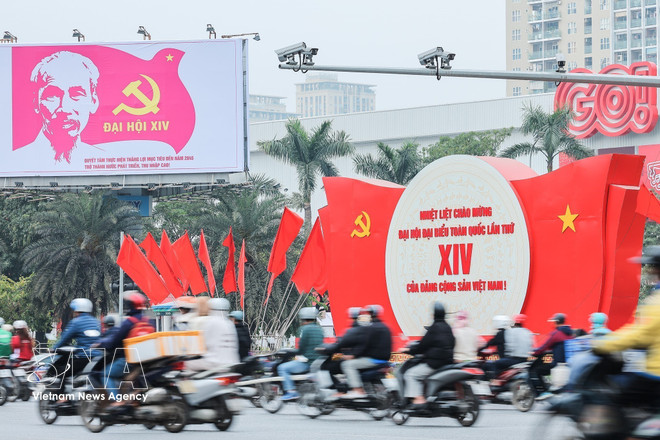
A festive atmosphere welcoming the 14th National Congress of the Communist Party of Vietnam spreads across Hanoi’s streets, reflected in propaganda banners and billboards. (Photo: VNA)

Progress has also been recorded in education, healthcare, science and technology, culture and social welfare, while greater attention has been given to social equity and security.

Vietnam’s international standing has also grown steadily. The country has become a trusted partner and a responsible member of the international community.

Vietnam currently maintains diplomatic relations with 194 countries and has established a variety of comprehensive strategic partnerships with major powers, including all five permanent members of the UN Security Council.

It is also an active member of the Association of Southeast Asian Nations (ASEAN) and more than 70 regional and international organisations, maintains relations with 230 countries and territories, and participates in 17 effective free trade agreements linking major economies.

These achievements demonstrate the soundness of the Party’s renewal policy and provide a solid foundation for further national development.

Moving towards new development era

Building on the achievements of the past 40 years of renewal, the 14th National Party Congress is expected to mark an important milestone, opening a new stage of national development.

According to congress’s draft documents, Vietnam aims to become a developing country with a modern industry and upper-middle-income by 2030, and a developed socialist country with high income by 2045.

The congress’s draft political report emphasises strengthening national defence and security while promoting foreign affairs and international integration as key and regular tasks, according to Minister of Foreign Affairs Le Hoai Trung.

It also highlights the principle of independence and self-reliance alongside peace, friendship, cooperation and development in foreign relations, he added.
vnanet-to-lam.jpg
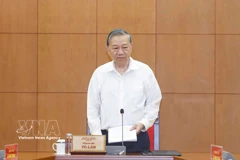
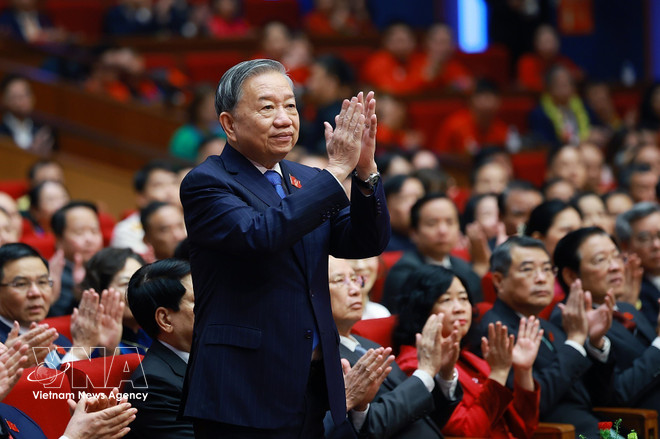
Party General Secretary To Lam attends the 11th National Patriotic Emulation Congress (Photo: VNA)

According to Party General Secretary To Lam, the Party’s mission is to lead the country into a new era of development and prosperity in which a socialist Vietnam with rich people, a strong nation, and a democratic, equitable and civilised society is successfully built, standing shoulder to shoulder with powers across five continents. In that era, all people have a prosperous and happy life and are supported to develop their own wealth while Vietnam contributes to regional and global peace, stability, and development, for the happiness of humanity and global civilisation.

“With confidence in the strength of the Party and the solidarity of the entire nation, it could be affirmed that the entire Party, people and army will unite to surmount all difficulties and challenges, securing fast and sustainable development for the country in the new era as well as a glorious and bright future for the Vietnamese people,” he stated./.
VNA

See more

National Assembly Chairman Tran Thanh Man speaks at the general debate of the 152nd Assembly of the Inter-Parliamentary Union in Istanbul on April 16, 2026. (Photo: VNA)

Deputy FM highlights parliamentary diplomacy gains from IPU-152, European trips

Regarding bilateral engagements in Italy and Türkiye, the deputy minister said the trips marked a meaningful step in implementing Vietnam’s foreign policy following the 14th National Party Congress, helping deepen relations with European and Middle Eastern partners while mobilising external resources for national development.

Party General Secretary and President of Vietnam To Lam, Party General Secretary and President of China Xi Jinping and their spouses attend a tea reception during the former's state visit to China from April 14 to 17, 2026. (Photo: VNA)

Vietnam, China elevate strategic connectivity in new phase of development

With railway cooperation expected to emerge as a new highlight of bilateral strategic cooperation, China expressed readiness to collaborate with Vietnam on financing, technology, training, and industrial capacity in the railway sector while encouraging capable enterprises to participate in railway construction.

Chairman of the Vietnamese National Assembly Chairman Tran Thanh Man (left) meets with Speaker of the Grand National Assembly of Türkiye Numan Kurtulmus in Istanbul on April 17. (Photo: VNA)

Top legislators of Vietnam, Türkiye meet on sidelines of IPU-152 in Istanbul

The top Vietnamese legislator expressed his admiration for Türkiye’s cultural identity and its friendly, hospitable people, while highly valuing the European country’s growing role and position at multilateral forums and in regional mediation efforts. He affirmed that Vietnam attaches importance to strengthening ties with Türkiye.

Officials sign cooperation documents in the presence of Party General Secretary and President of Vietnam To Lam, and his Chinese counterpart Xi Jinping on April 15, 2026. (Photo: VNA)

Vietnam, China sign 32 cooperation documents

The documents include a cooperation plan between the Communist Party of Vietnam (CPV) and the Communist Party of China (CPC) for the 2026–2030 period; a memorandum of understanding (MoU) on cooperation between the Organisation Commission of the CPV Central Committee and its Chinese counterpart; and a cooperation agreement between the Ministry of Foreign Affairs of Vietnam and the International Liaison Department of the CPC Central Committee.

The meeting between Chairman of the Vietnamese National Assembly Tran Thanh Man and Speaker of the Federation Council of Russia’s Federal Assembly Valentina Matviyenko in Istanbul, Türkiye, on April 17 (Photo: VNA)

Parliamentary leaders hail development of Vietnam – Russia ties

The top legislator of Vietnam proposed that both sides deepen political and diplomatic connections, as well as parliamentary cooperation, through delegation exchanges, high-level meetings through various channels, and the successful organisation of a visit to Vietnam by the Speaker of Russia’s Federation Council and a trip to Russia by the NA Chairman to co-chair the 5th session of the Inter-Parliamentary Cooperation Committee in 2026.

Wei Wei, a researcher on Vietnam and head of the Vietnamese-language service at the China Media Group, grants an interview to the Vietnam News Agency. (Photo: VNA)

Expert highlights new trends in Vietnam – China relations

A Chinese expert has paid attention to General Secretary and President To Lam's visit to the Xiong'an New Area, meeting with youth representatives of both countries together with his Chinese counterpart Xi Jinping, and experience of high-speed rail travel.

General Secretary of the Communist Party of Vietnam (CPV) Central Committee and State President To Lam and his spouse, together with a high-level Vietnamese delegation, leave Nanning on April 17, successfully concluding their state visit to China from April 14–17 (Photo: VNA)

General Secretary, State President To Lam concludes state visit to China

The trip also included meetings with Vietnamese diplomatic staff and the Vietnamese community in China, exchanges with relatives of Chinese generals, experts and others who had supported Vietnam-China friendship, attendance at a Vietnam - China friendship art programme, a visit to the historic Nanning Yucai School, and participation in activities launching a Vietnam–China Border People’s Festival 2026.