Party chief pushes Military Technical Academy toward global-standard research excellence

The Military Technical Academy aims to rank among the top science and technology universities in Vietnam by 2030, with several fields reaching regional and international standards, and to enter the world’s top 700 universities. By 2045, it targets a place in the global top 500.

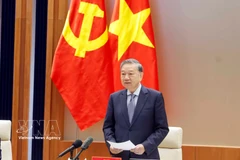
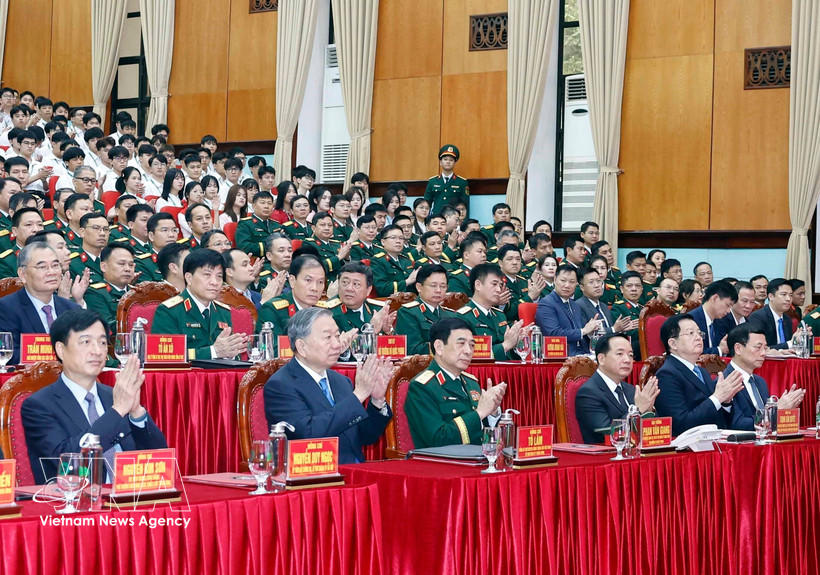
Party General Secretary To Lam (front, second, left) attends a meeting with the Military Technical Academy on March 17. (Photo: VNA)

Hanoi (VNA) – Party General Secretary To Lam on March 17 called on the Military Technical Academy (MTA) to strongly promote the spirit of “unity, resilience; innovation, creativity; intelligence, development” as it advances toward becoming a leading research university in science and technology.

During a working visit to the academy, the Party chief, who is also Secretary of the Central Military Commission, emphasised the institution’s pivotal role in training high-quality human resources, advancing military science and technology, and contributing to the modernisation of the army.

Against a backdrop of increasingly complex and unpredictable global and regional developments, along with the rapid pace of the Fourth Industrial Revolution, the Party chief stressed that breakthroughs in science, technology, innovation and digital transformation are reshaping all sectors, particularly defence industry development and modern weapons production.

He underscored that the Resolution of the 14th National Party Congress has set the goal of building a revolutionary, regular, elite and modern people’s army during the 2025–2030 period. In this context, the academy must stay firmly aligned with the Party’s guidelines and the State’s policies on military and defence tasks, while adopting new mindset on national defence and safeguarding the Fatherland.

The Party chief called for the effective implementation of key orientations, including steadfast adherence to the Party’s military line and the building of a politically strong army; intensified modernisation of the military and expand international integration and defence diplomacy; and proactive prevention of risks such as conflict, as well as degradation in political ideology, morality and lifestyle.

He also stressed the importance of building a strong and clean Party organisation within the academy, with cadres and Party members demonstrating firm political will and the capacity to successfully fulfil all assigned tasks.
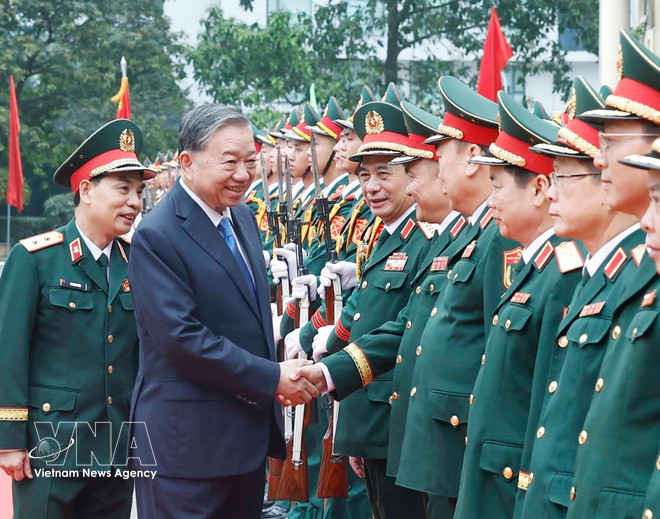
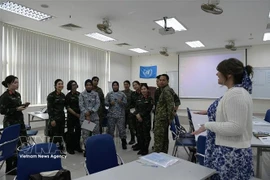
Party General Secretary To Lam meets with officials of the Military Technical Academy on March 17. (Photo: VNA)

Party General Secretary To Lam meets with officials of the Military Technical Academy on March 17. (Photo: VNA)

The MTA must take the lead in implementing resolutions of the Party Central Committee and the Central Military Commission on breakthroughs in education and training, while vigorously modernising curricula to be practical, integrated, and closely aligned with real-world demands and technological advances, he said, stressing that the academy should also step up international integration, guided by the principle that learners are at the centre, the institution is the foundation, and teachers are the driving force.

The academy should also invest in research and development of advanced weapons and technical equipment, accelerate digital transformation, and build strong research groups and centres of excellence.

Developing a contingent of leading scientists and experts in key fields will be critical to transforming the academy into a top national research institution and innovation hub, he said.

The Party chief stressed the need to strengthen political, ideological, ethical and lifestyle education, build political mettle, and promote the values of the “Uncle Ho’s Soldiers,” while inspiring dedication and innovation among officials, Party members and the public, especially young people.

He also called for greater efforts to attract, nurture and effectively utilise talent, and to build a contingent of officials capable of meeting the demands of the new context, alongside the continued effective implementation of the Party Central Committee's resolutions on Party and political system building and rectification, and the Politburo's regulations on revolutionary ethics of officials and Party members in the new period, in combination with the ongoing drive to study and follow Ho Chi Minh’s thought, morality and style.

Greater attention and direction should be paid to developing the academy into a leading centre for education, scientific research, technology and innovation, capable of mastering key national defence and dual-use technologies of regional and global standards, he said, asking for favourable conditions for the academy to mobilise additional financial resources, invest in modern laboratories and infrastructure, and attract top domestic and international scientists.

As the academy prepares to mark the 60th anniversary of its traditional day (October 28, 1966–2026), the Party leader expressed confidence that it will continue to unlock its full potential and creativity, embodying the spirit of unity, resilience; innovation, creativity; intelligence, development.

Looking ahead, the academy aims to rank among the top science and technology universities in Vietnam by 2030, with several fields reaching regional and international standards, and to enter the world’s top 700 universities. By 2045, it targets a place in the global top 500./.
VNA

See more

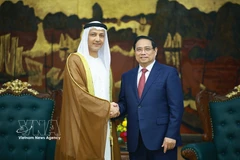
Prime Minister Pham Minh Chinh receives UAE Ambassador to Vietnam Bader Abdullah Almatrooshi in Hanoi on March 17, 2026. Photo: VNA

PM pushes forward energy cooperation with UAE after high-level talks

Vietnam–UAE relations have continued to grow, with the UAE now Vietnam’s largest trading partner in the Middle East and a potential investor. For Vietnam, the UAE is not only an important economic partner but also a sincere and reliable friend sharing common values of peace, cooperation, and prosperity.

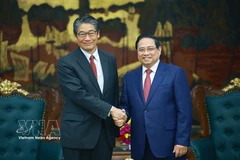
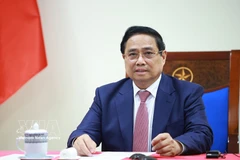
Prime Minister Pham Minh Chinh (right) receives Japanese Ambassador to Vietnam Ito Naoki on March 17. (Photo: VNA)

Prime Minister calls on Japan to support Vietnam’s energy security

The PM proposed that the ambassador raise voice to help facilitate Vietnam’s access, through appropriate forms, to part of the 80 million barrels of oil that Japan is considering releasing from its reserves to mitigate the impact of Middle East tensions on fuel prices.

Le Hoai Nam, head of the liaison board of the Vietnamese community in South Africa (Photo: VNA)

Vietnamese community in South Africa confident in 16th NA’s leadership

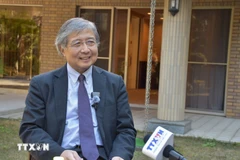
Regarding the fact that this year’s election of deputies to the NA and People’s Councils at all levels for the 2026–2031 tenure is held two months earlier than usual, a representative of the Vietnamese community in South Africa said that as Vietnam enters a new stage of development with many major goals, organising the election earlier is a proactive and strategic move.

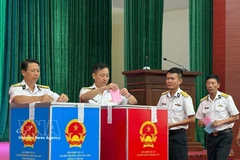
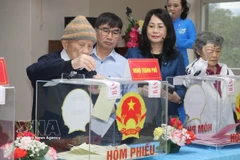
The atmosphere during voting for deputies to the 16th National Assembly and People’s Councils for the 2026–2031 term at Polling Station No. 20, Brigade 957, Naval Region 4, in Khanh Hoa. (Photo: VNA)

Final results of 16th NA election expected on March 22

Local authorities are currently compiling and verifying election data before submitting their reports to the council, which will meet on on March 22 to review the figures and announce the official election results, Tran Thanh Man, Chairman of the NA and President of the Vietnam National Election Council, said.

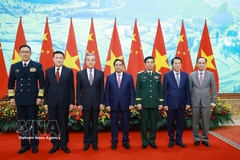
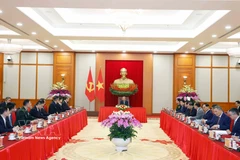
Prime Minister Pham Minh Chinh (centre) and the Vietnamese and Chinese ministers of foreign affairs, national defence and public security at the meeting in Hanoi on March 16. (Photo: VNA)

Vietnam places top priority on ties with China: PM

PM Pham Minh Chinh asked the foreign affairs, defence and public security ministries of both countries to play a more proactive role in unceasingly strengthening political trust and mutual understanding between the two Parties, countries and peoples, and in making full use of existing cooperation mechanisms, particularly the 3+3 strategic dialogue.

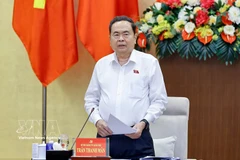
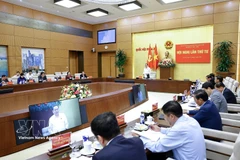
Chairman of the National Assembly (NA) Tran Thanh Man speaks at the fourth meeting of the NA Party Committee for the 2025–2030 term in Hanoi on March 16. (Photo: VNA)

Institutional, legal reform key strategic breakthrough for development: NA Chairman

Chairing the fourth meeting of the NA Party Committee for the 2025–2030 term in Hanoi on March 16, NA Chairman Tran Thanh Man, who is also Secretary of the NA Party Committee, said the legislature must play a pivotal role in building and perfecting development institutions as Vietnam enters a new stage of strong, comprehensive and sustainable development.

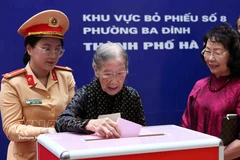
Doan Thi Thuan, a 101-year-old voter, casts her ballot at Polling Station No. 8 in Ba Dinh ward, Hanoi, on March 15. (Photo: VNA)

General election marks renewal in building modern Vietnamese state

The decision to hold the election two months earlier than usual represents not merely a technical adjustment but a historic and well-considered step, reflecting long-term vision in building, consolidating and operating the state apparatus, said Tran Thang, an aeronautical engineer and commentator in the US.

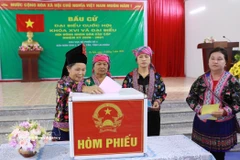
Voters in Nam Sao 2 village, Pa Tan commune of Lai Chau cast their ballots on March 15 (Photo: VNA)

Mexican lawmaker confident in Vietnamese legislature’s enhanced role

Ana Karina Rojo Pimentel, a congresswoman from the Labour Party (PT) of Mexico and Chairwoman of the Mexican Chamber of Deputies’ Welfare Committee, said the new representatives will help further strengthen the legislature’s role in policymaking and national development orientation.

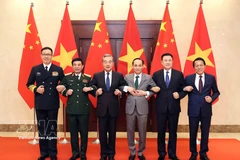
Vietnamese and Chinese ministers pose for a photo at the first ministerial-level Strategic Dialogue among their foreign affairs, defence and public security ministries. (Photo: VNA)

Vietnam, China hold first ministerial-level 3+3 strategic dialogue

The 3+3 Strategic Dialogue mechanism is important for implementing high-level common perceptions and promoting the role of key agencies in advancing Vietnam–China relations as well as sectoral cooperation in various fields, thereby enhancing political trust and contributing to peace, stability and development in the region and the world.

Vice President of the Vietnam – Malaysia Business Association Nguyen Thi Thanh Van. (Photo: VNA)

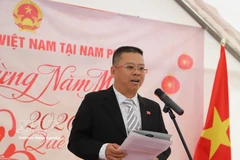
Vietnamese business leader in Malaysia hopes for streamlined, effective governance

Voters and the business community demand above all a unified, forward-looking legal framework, which resolves near-term frictions while anchoring sustained progress. NA and People's Council deputies must sustain their role as an effective bridge between constituents and authorities, converting grassroots input into meaningful policies.

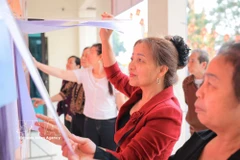
People read information about candidates at polling station No. 6 in Hanoi. (Photo: VNA)

Early election seen as strategic step to implement Party's goals: expert

Dr. Nguyen Quoc Hung, Vice President of the Union of Vietnamese Organisations in Russia, underscored the significance of advancing the election schedule by two months to promptly consolidate personnel work following the CPV’s 14th National Congress, describing the move as a timely and strategic decision that helps translate the congress’s objectives into action without delay.