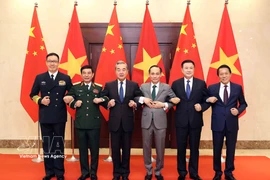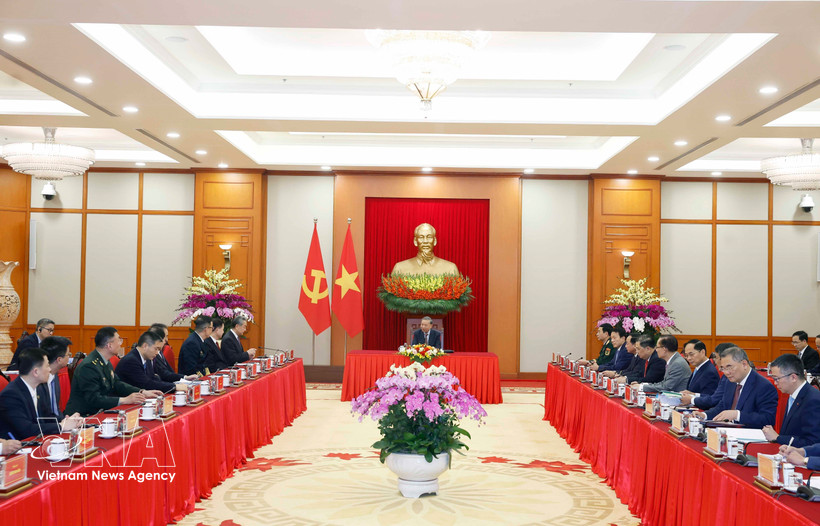
Hanoi (VNA) – General Secretary of the Communist Party of Vietnam (CPV) To Lam received in Hanoi on March 16 China's Minister of Foreign Affairs Wang Yi, Minister of National Defence Dong Jun, and Minister of Public Security Wang Xiaohong, who are in Vietnam for the first ministerial-level strategic dialogue on foreign affairs, national defence and public security, known as the “3+3" dialogue.
General Secretary Lam conveyed his regards and best wishes to Xi Jinping, General Secretary of the Communist Party of China (CPC) and Chinese President, and thanked the CPC Central Committee and Xi for their strong support for the 14th National Congress of the CPV.
He congratulated China on its recent important achievements and the successful convening of the fourth session of the 14th National People’s Congress, expressing confidence that China will effectively implement its 15th five-year plan for national socio-economic development with a focus on high-quality growth.
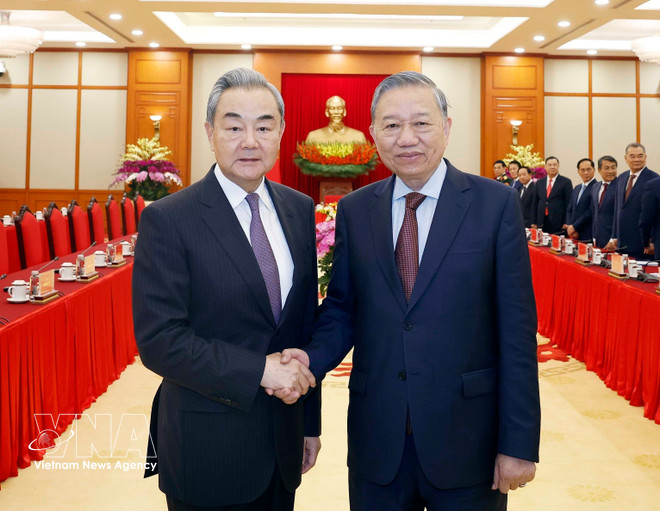
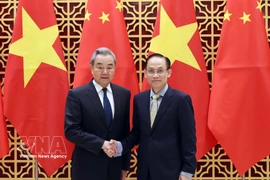
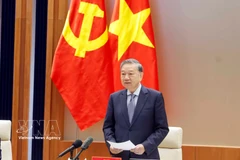
Party General Secretary To Lam (right) and Chinese Minister of Foreign Affairs Wang Yi at the meeting on March 16 (Photo: VNA)
He welcomed the Chinese ministers’ joint visit and the inaugural “3+3” dialogue mechanism, stressing its importance in strengthening political trust, enhancing strategic cohesion, and promoting the stable development of Vietnam–China relations. He said the new mechanism also reflects the two countries’ responsibility in maintaining peace, stability and development in the region and the world.
The Chinese ministers, for their part, conveyed greetings from Xi to the Vietnamese Party leader, and congratulations from the Party and State of China to the Vietnamese Party and State on the successful organisation of the 14th Party Congress of CPV and the 16th National Assembly election, and extended congratulations to To Lam on his re-election as General Secretary.
They expressed confidence that under the leadership of the CPV, Vietnam will effectively implement the resolution of the 14 National Party Congress, successfully achieve the country’s two centenary goals marking the founding of the CPV and the nation, secure even greater achievements, and firmly advance into a new development era.
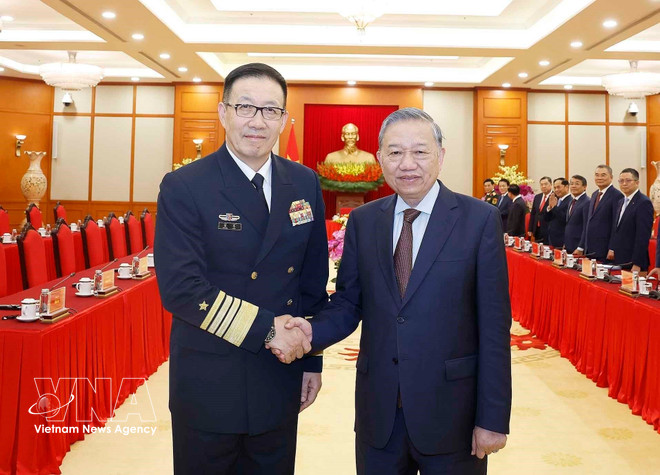
Sharing key outcomes of the 14th National Party Congress, the Vietnamese Party leader reaffirmed Vietnam’s strategic orientation of strengthening national defence and security while promoting foreign affairs and international integration as core and long-term tasks.
Amid complex global developments, he said Vietnam consistently pursues its foreign policy of independence, self-reliance, multilateralisation and diversification of external relations, as well as its defence policy of “four no’s”.
Vietnam also maintains a consistent stance of respecting international law and the United Nations Charter, he said, emphasising that disputes and differences must be settled through peaceful measures on the basis of international law.
General Secretary Lam reaffirmed that developing relations with China remains a top priority and a strategic choice in Vietnam’s foreign policy. He noted that the two Parties and have established a comprehensive system of frameworks and guiding principles, creating a strong political foundation for the Vietnam–China relationship to continue developing in line with agreed orientations.
He noted that high-level common perceptions, commitments and cooperation agreements have been thoroughly implemented by ministries and sectors of the two sides in a serious and effective manner, with important contributions from the diplomatic, defence and public security sectors of the two countries.
Looking ahead, he emphasised that the two sides should further enhance strategic cohesion to ensure cooperation produces concrete results that benefit both nations. He expressed readiness to maintain close exchanges with Xi to guide the positive development of bilateral relations in the new tenure.
He called on the diplomatic, defence and public security sectors of Vietnam and China to take the lead in strengthening coordination and effectively implementing high-level common perceptions, while developing the Vietnam–China “3+3” strategic dialogue into a model cooperation mechanism.
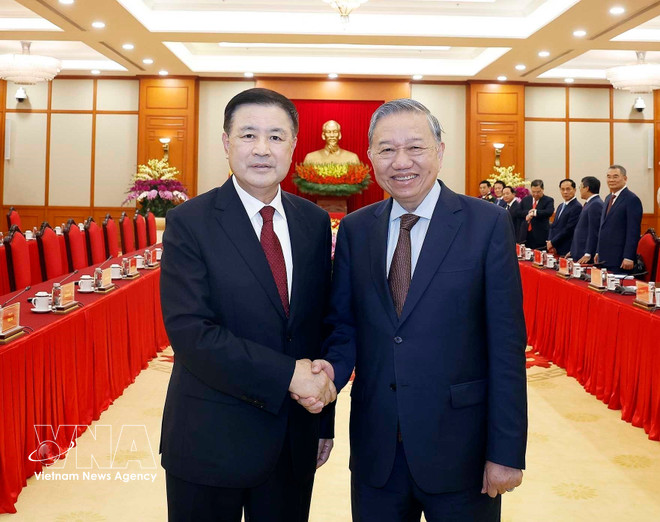
He also urged the two countries’ foreign ministries to coordinate in planning and organising all-level exchanges, and to work with relevant ministries, sectors and localities to promote more substantive cooperation, particularly in railway connectivity, while facilitating economic and trade ties and people-to-people exchanges between the two nations.
The defence ministries of Vietnam and China should continue effectively implementing existing exchange and cooperation mechanisms while striving to achieve breakthroughs in key areas of collaboration, commensurate with the level of strategic connectivity and trust between the two countries, he said.
The public security ministries were also urged to strengthen law enforcement coordination, enhance cooperation in crime prevention and combat, and share experience in safeguarding political security.
The Vietnamese Party leader called on the two sides to properly manage and handle differences at sea in line with high-level common perceptions, and persist in resolving disputes through peaceful measures in accordance with international law, including the 1982 UN Convention on the Law of the Sea, contributing to building trust and maintaining peace and stability in the region.
Expressing appreciation for and strong agreement with the important guidance and orientations of General Secretary Lam, the Chinese ministers reported key outcomes of the first Vietnam–China “3+3” strategic dialogue. They affirmed that China consistently regards Vietnam as a priority in its neighbourhood diplomacy and an important direction in its overall foreign policy, while expressing readiness to share experience and support Vietnam in implementing its new development goals.
The Chinese ministers affirmed that they will closely coordinate with their Vietnamese counterparts, adhere to high-level common perceptions, and strengthen exchanges of theoretical and practical experience in Party building and state governance.
They also pledged to deepen cooperation in defence, security, law enforcement, crime prevention and joint exercises; while elevating substantive collaboration in key areas such as trade, investment, science and technology, and artificial intelligence; and strengthen the social foundation of bilateral ties by promoting cooperation in tourism, education - training, and people-to-people exchanges.
The two sides will also better manage and resolve differences in line with the new level of bilateral relations, high-level common perception and international law, they said./.