Da Nang (VNA) – As the central city of Da Nang aims to be one of Vietnam’s three leading semiconductor and microchip hubs by 2030, home to a high-quality manpower training network linked with a comprehensive semiconductor ecosystem, concerted efforts are being made to realise that goal.
The target is in line with the national semiconductor industry development strategy until 2030, with a vision to 2050.
Investment in semiconductor packaging, testing infrastructure
The VSAP LAB Joint Stock Company recently started work on a laboratory for the production of advanced packaging technologies (fab-lab) at the Concentrated Information Technology (IT) Zone of Da Nang Software Park 2.
This project, a pioneering model in Vietnam, plays a strategic role in advancing core technologies, in accordance with the Politburo's Resolution No. 57-NQ/TW and the national semiconductor industry development strategy by 2030, with a vision to 2050. It is also a strategic step in Da Nang's semiconductor and artificial intelligence development plan.
With a total investment of 1.8 trillion VND (68.8 million USD) and spanning 2,288 sq.m., the fab-lab project is set to begin operations in the fourth quarter of 2026. It will have a designed capacity of 10 million products annually, catering to both domestic and international markets.
Nguyen Bao Anh, CEO of the VSAP LAB JSC, said the global semiconductor industry is shifting strongly but there remain bottlenecks related to the supply – demand balance. Those bottlenecks do not lie in the stages of chip design or manufacturing but in advanced packaging – a key step determining the efficiency, size, reliability, and production cost of semiconductors.
This fab-lab will be the first facility in Vietnam capable of developing and producing advanced packaging technologies on a trial basis such as RDL Fan-out, 2.5D, and 3D packaging—fundamental for AI chips, high-performance data centre chips, automotive chips, and next-generation electronic devices.
The fab-lab model being developed in Da Nang represents a flexible public-private partnership, becoming the first in Vietnam to fully integrate research, production, testing, human resources training, and technology transfer in the field of advanced semiconductor packaging technologies.
Luong Nguyen Minh Triet, Chairman of the Da Nang People’s Committee, said science – technology development, innovation, and digital transformation are identified as the city’s top priority for 2025–2030.
As VSAP LAB is expected to become an exemplary fab-lab model, municipal authorities pledge to provide favourable infrastructure, administrative, and manpower conditions for the project to be carried out on schedule, safely, and efficiently, he noted.
VSAP LAB will serve as the core for developing a semiconductor innovation cluster, helping realise Da Nang's ambition to become a national high-tech hub, he added.
Human resources development, talent attraction
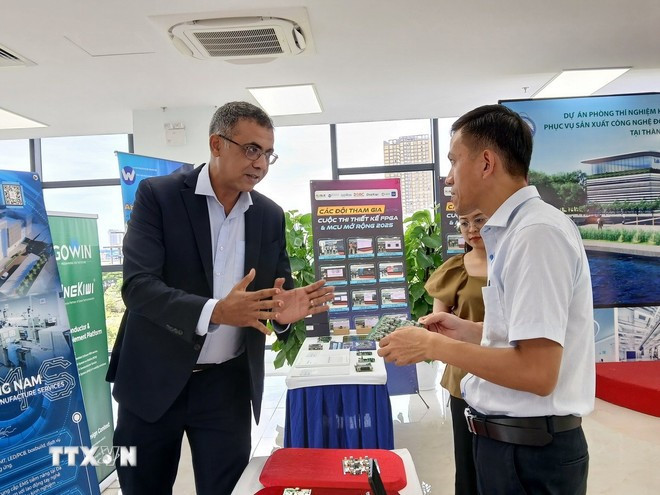
Representatives of enterprises and universities share information and discuss cooperation in training semiconductor human resources. (Photo: VNA)
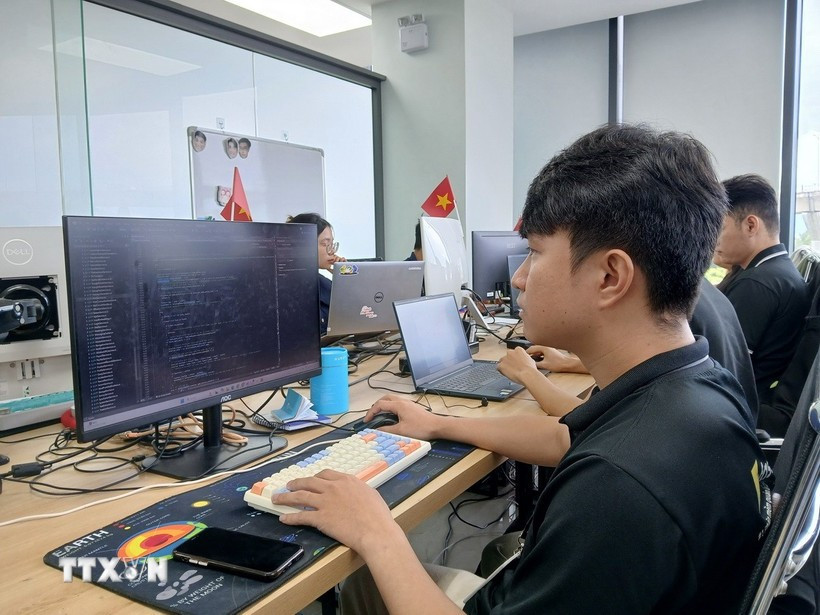
Da Nang aims for its digital economy, by 2030, to make up at least 35–40% of the total GRDP and attract a minimum of 5,000 high-quality semiconductor professionals, including 1,500 design engineers and 3,500 testing and packaging ones. The force will not only meet local demand but also serve other Vietnamese localities and some international markets having partnerships with this city.
To train and supply a skilled semiconductor workforce, universities in Da Nang are focusing on training in chip design, testing, physical design, and chip architecture design, while strengthening cooperation with global semiconductor organisations and businesses. The National Innovation Centre will also develop a shared database to support training across the universities offering semiconductor programmes.
In addition, the city is offering several incentives to learners and experts. Many outstanding policies with total funding of about 873 billion VND (33.2 million USD) have been issued, including benefits, income, and accommodation for professionals and scientists directly involved in research, training, and connection of semiconductor development programmes.
Phil Hoang, a semiconductor expert at the US-based technology expert organisation TreSemi, perceived that Da Nang has taken right steps to prepare human resources for the semiconductor industry. It has launched concrete projects that gather State agencies, businesses, universities, experts, and potential partners to set up training orientations and manufacture globally competitive chips.
He underlined TreSemi’s support for Da Nang to hold in-depth training courses to create top-tier engineers.
Developing high-quality human resources to meet businesses’ demand is also believed to generate an opportunity for the city to have sufficient international-standard manpower to welcome a new investment wave.
Currently, Da Nang hosts around 10 active semiconductor design companies, including Synopsys, Uniquify, Savarti, Renesas, Synapse, FPT Semiconductor, and Viettel CNC, employing roughly 550 engineers./.