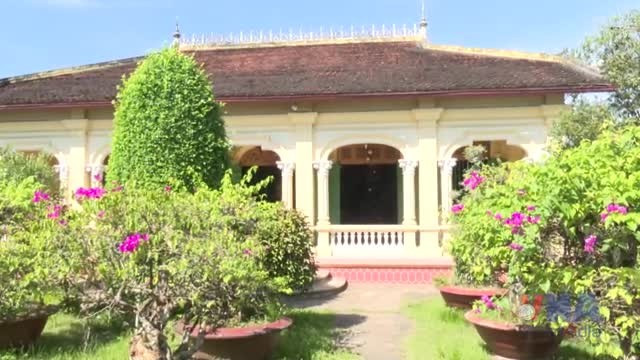
Dong Thap (VNA) – The century-old houses in Cai Be and Long Khanh communes and Cai Lay ward of Dong Thap province feature distinctive architecture imbued with the rustic charm of southern Vietnam, making them a magnet for both domestic and international visitors.
Dong Thap currently preserves more than 48 ancient 'nha ruong' (traditional southern wooden houses) over a century old. Spacious and intricately crafted, these houses are considered works of art that embody the cultural and spiritual essence of the early settlers who shaped the southern frontier centuries ago.
When speaking of ancient houses in the province, visitors often recall the Dong Hoa Hiep ancient village in Cai Be commune. The village is home to seven houses built in the traditional southern style, featuring five compartments and three rear wings shaped like the Chinese character “Dinh” (丁). Their elaborately carved wooden details have earned the site recognition as a valuable cultural heritage complex and a foundation for eco-tourism development in the Mekong Delta.
Nguyen Thanh Tuan, Vice Chairman of the Cai Be commune People’s Committee, said the village attracts visitors eager to experience classical southern architecture reflected in its lacquered boards and finely carved wooden panels. Nestled among lush fruit gardens, the ancient houses create a rustic yet poetic setting that draws around 100,000 visitors each year, more than 75% of them foreigners.
Among the highlights is the house of Phan Van Duc in Cai Be commune, built in 1850 on a 19,000 sq.m estate surrounded by fruit trees. It harmoniously combines southern Vietnamese and French architectural styles and houses rare antiques, including mother-of-pearl inlaid altars, cabinets, and a royal decree issued by King Tu Duc (1848–1883).
Another architectural treasure is the house of Le Quang Xoat, also in Cai Be, built in the early 18th century. Covering more than 700 sq.m, the house follows the Hue 'nha ruong' style but retains strong southern characteristics. Constructed entirely of precious wood with yin-yang tiled roofs, it sits within a 9,215 sq.m fruit garden.
Despite several restorations across six generations, it has preserved its original folk architecture. Particularly remarkable is a Van Ngua (wooden bed) made of marble that stays cool in summer and warm in winter. The house was recognised as a provincial-level historical and cultural relic site in 2014 and received support from the Japan International Cooperation Agency (JICA) to develop community-based tourism.
Beyond Dong Hoa Hiep, visitors can explore the 130-year-old house of the Nguyen Hoang Viet family in Long Khanh commune, built in 1890 by skilled craftsmen from Hue. Made entirely from rare woods such as cam xe (Pyinkado) and huong (Padauk), the house features a three-compartment layout with 32 large pillars and a yin-yang tiled roof. Every detail, from beams to pillars, was handcrafted without the use of nails or modern machinery. Inside, the family preserves heirlooms such as mother-of-pearl inlaid altars, bronze incense burners, and intricately carved wooden furniture.
Nguyen Long Tuan, a visitor from Ho Chi Minh City, said he was fascinated by the harmonious blend of Western and Vietnamese styles that creates an ancient yet lively atmosphere, while maintaining the traditional values of Vietnamese architecture through time.
According to Vo Pham Tan, Deputy Director of the Dong Thap Department of Culture, Sports and Tourism, the artistic value of these ancient houses -harmoniously integrated with fruit gardens and waterways - has become a hallmark of local tourism. He added that the province is working with homeowners to restore and preserve these sites, aiming to turn them into a model for sustainable river-based eco-tourism in the Mekong Delta./.