HCM City powers up as industrial giant post-merger

The municipal Department of Industry and Trade rolled out a five-pillar strategy to steer development. Priorities include synchronised industrial, logistics, and energy infrastructure, with specialised zones, technology parks, and large-scale integrated logistics zones powered by green energy.

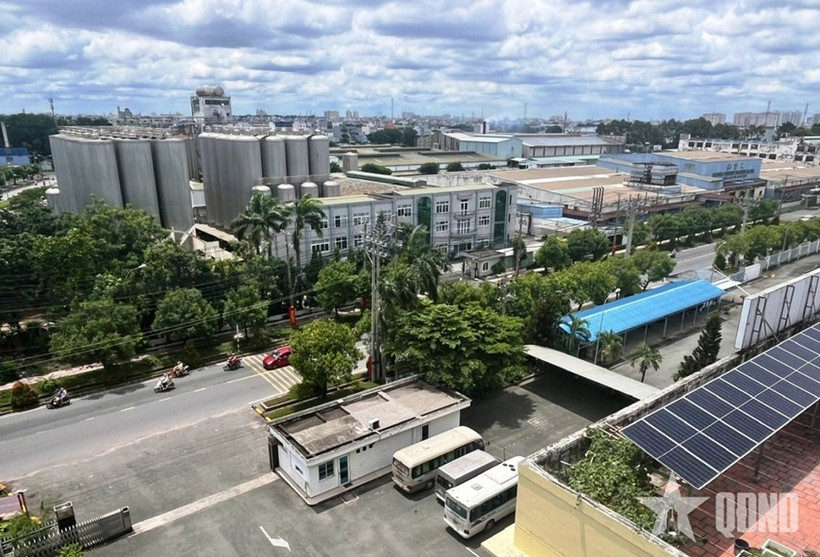
A view of Tan Binh Industrial Park in Ho Chi Minh City (Photo: qdnd.vn)

Hanoi (VNA) – Vietnam’s southern economic engine is shifting into high gear, fueled by a landmark merger with neighboring industrial hubs Binh Duong and Ba Ria-Vung Tau. The expanded Ho Chi Minh City is on a journey to become a regional manufacturing powerhouse, leveraging a potent mix of innovation, production muscle, and strategic logistics to drive growth.

Mega project signals bold ambitions

At the heart of this transformation is THACO Group’s 786-ha mechanical industrial park with a total investment of 75 trillion VND (2.87 billion USD) in the former Binh Duong province, set to break ground in August 2025. The high-tech complex, slated for operation by September 2026, aims to integrate suppliers into a streamlined production chain, bolstering Vietnam’s supporting industries. It is projected to create 30,000 jobs, including 10,000 for skilled technicians.

“This will be a national-scale mechanical hub, a magnet for domestic and foreign firms,” said Do Minh Tam, General Director of THACO Industries. The new-generation park will feature cutting-edge infrastructure, including automated systems, digital platforms, and artificial intelligence.

The project is a cornerstone of HCM City’s post-merger industrial push, capitalising on Binh Duong’s manufacturing prowess, Ba Ria-Vung Tau’s energy and port logistics, and the city’s innovation hub. In 2024, the region contributed 930 trillion VND to national industrial output, accounting for over 25% of Vietnam’s total.

The city now oversees 66 industrial and export-processing zones spanning 27,000 ha, with plans to scale up to 105 zones covering 49,000 ha by 2050, according to deputy head of the HCM City Export Processing and Industrial Zones Authority (HEPZA) Tran Viet Ha.

Strategic planning, smart technologies

With a population now nearing 14 million, the merged metropolis is Vietnam’s economic, industrial and commercial hub. Its officials are continuing to double down on a modern, green, and sustainable industrial model, focusing on advanced manufacturing, digital transformation, and supporting industries through targeted policies for 2021-2025.

But challenges abound. Soaring logistics costs, a scarcity of clean industrial land, outdated technologies, and global trade headwinds are squeezing progress. The merger’s regulatory overlap has frustrated investors, while a shortage of skilled labour threatens to cap growth. Economists are pushing for a “one-stop shop” mechanism to fast-track approvals for big-ticket projects.

At a recent seminar, Dr. Tran Du Lich, Chairman of the Advisory Council for implementing Resolution 98, warned that that sticking to low-cost labour and traditional industrial models risks locking the city into a middle-income trap. He called for a pivot to high-value sectors via green tech, digitalisation, and an industrial-service-seaport corridor linking Binh Duong to the Cai Mep-Thi Vai deep-water port.

A hi-tech vocational training network focused on automation, industrial design, digital control, smart logistics, and clean energy is also critical, experts said.

The municipal Department of Industry and Trade rolled out a five-pillar strategy to steer development. Priorities include synchronised industrial, logistics, and energy infrastructure, with specialised zones, technology parks, and large-scale integrated logistics zones powered by green energy.

Technological upgrades, automation, and digitalisation are central to producing high-tech goods for smart urban and sustainable economic models. To supercharge supporting industries, the city is considering incentives for investments in new materials, strategic components and localised production. Workforce development is another priority, alongside a push for green industries and a circular economy./.

VNA
See more

The fruit and vegetable sector is also set to hit a record, with exports projected at around 8.5 billion USD in 2025. (Photo: VNA)

Agro-forestry-fishery exports poised to hit record high in 2025

Agro-forestry-aquatic exports totalled 64.01 billion USD in the first 11 months of 2025. If performance in the final month matches that of recent months, the figure could approach 70 billion USD, far exceeding the 65-billion-USD target set for the year.

A view of Dinh Vu port in Hai Phong city. (Photo: VNA)

Circular on domestic maritime transport permits for foreign vessels issued

Under the circular, which will take effect from February 1 next year, the Minister of Construction will grant the permits for cases such as transporting oversized or overweight cargo or other types of goods using specialised vessels; clearing congested cargo, passengers, and luggage at ports when Vietnamese ships are unable to handle them; and conducting disaster relief, disease control, or emergency humanitarian aid.

At a tax office in Hanoi (Photo: VNA)

Decree regulates corporate income tax incentives

A CIT rate of 15% applies to enterprises with a total revenue in the preceding year of not more than 3 billion VND (114,000 USD), while a CIT rate of 17% applies to enterprises with a total revenue in the preceding year of over 3 billion VND but not more than 50 billion VND.

Ho Chi Minh City’s downtown area and the Thu Thiem peninsula, where the International Financial Centre is being developed. (Photo: VNA)

GOE Alliance commits to partnering with HCM City IFC

The GOE Alliance was officially launched at the Autumn Economic Forum in November 2025, bringing together technology firms, financial institutions, policy experts and international partners, including Viettel Digital Services, Dragon Capital, Tether, Ava Labs, Sky Mavis, Republic and Onchain Academy. The alliance aims to pilot on-chain economic models within a policy-oriented legal framework.

Vietnam's foreign trade is projected to hit a record of over 900 billion USD in 2025, positioning the country among the top 15 global trade powers. - Illustrative image (Photo: dantri.vn)

Vietnam joins elite group of 15 largest trading countries

The country recorded its first trade surplus in 2012 and has maintained a continuous streak of surplus for 10 years since 2016. The surplus grew steadily, hitting 19.9 billion USD in 2020, a record of 28.3 billion USD in 2023, and 24.9 billion USD in 2024.

Officials visit a booth at the festival. (Photo: VNA)

Vietnam OCOP Festival 2025 opens in Hanoi

The festival functions as a space to bring together regional OCOP excellence, a forum connecting OCOP stakeholders with distributors, investors, experts and consumers, and a platform to spread pride in indigenous culture, local knowledge, and the aspiration for legitimate prosperity.

Prime Minister Pham Minh Chinh (third from right) and officials launch the Ministry of Construction’s new information technology systems at the conference on December 21. (Photo: VNA)

Modern, comprehensive infrastructure – a need for fast, sustainable development: PM

The Party and State continue to define infrastructure development as one of the three strategic breakthroughs, with priority given to building comprehensive and modern infrastructure, particularly transport facilities, technological infrastructure, and green – digital transition infrastructure, to help realise the national target of double-digit growth, the PM said.