Journey to return rescued wildlife to the wild

Beyond wildlife rehabilitation, Bu Gia Map National Park has become an important centre for environmental education, helping raise public awareness of biodiversity conservation through guided visits, rescue-centre experiences, school outreach programmes and digital communication campaigns.

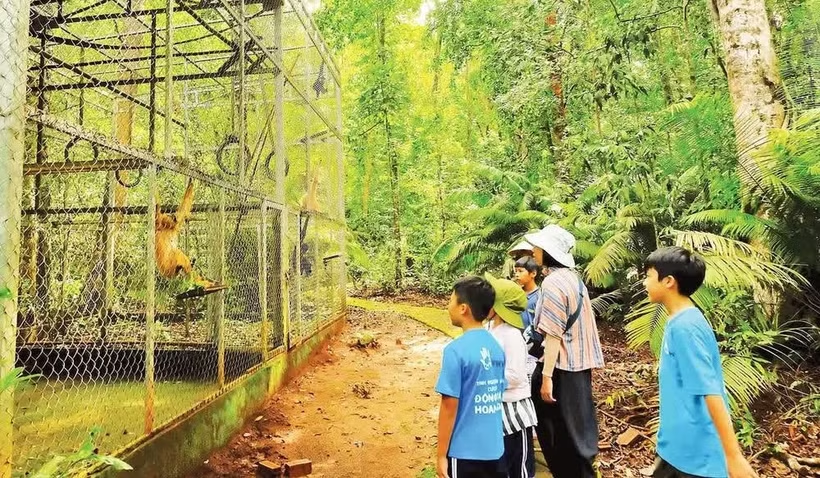
Young volunteers help care for rescued wildlife at Bu Gia Map National Park. (Photo: Nhan Dan)

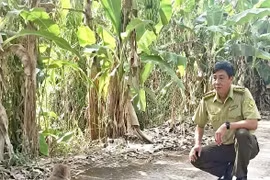
Dong Nai (VNA) – Deep within the ancient forests of Bu Gia Map National Park in the southern province of Dong Nai, conservationists quietly work each day to rescue injured and trafficked wildlife, restore their natural instincts, and prepare them for life back in the wild.

Covering about 26,000 hectares at the end of the Truong Son mountain range, the park is one of Vietnam's important protected forests, home to more than 1,000 plant species and hundreds of mammal, bird and reptile species, including many that are globally threatened.

For years, the park's communication, ecotourism and wildlife rescue centre has received and rehabilitated numerous wild animals before releasing them into their natural habitats. Among the rescued species are several endangered primates and mammals, including yellow-cheeked gibbons, black-shanked douc langurs, pygmy slow lorises, otters and binturongs.

Tran Van Truong, deputy director of the centre, said the facility is currently caring for 65 individual animals representing 23 rare species. One of its most notable achievements has been successfully breeding three yellow-cheeked gibbons in captivity and releasing an entire gibbon family back into the wild.

He said growing public awareness of wildlife conservation has encouraged more people to voluntarily hand over wild animals to authorities or rescue centres instead of keeping or trading them illegally. He added that rescued animals underwent rehabilitation to regain their natural survival skills before being released into the forest, where they were closely monitored. Animals that failed to adapt were brought back to the centre for further care until they could survive independently.

However, Truong noted that the centre was struggling with overcrowding as the number of rescued animals continued to increase.

Beyond wildlife rehabilitation, Bu Gia Map National Park has become an important centre for environmental education, helping raise public awareness of biodiversity conservation through guided visits, rescue-centre experiences, school outreach programmes and digital communication campaigns.

The park also welcomes volunteers, particularly pupils and university students, who assist professional staff in caring for rescued animals. These hands-on activities help young people better understand biodiversity, foster a love of nature and strengthen their sense of environmental responsibility.

This summer, Pham Nam Phuong and two other families from Ho Chi Minh City joined the centre as volunteer caregivers. Phuong said the programme provided children with a meaningful hands-on learning experience while helping them better understand the importance of biodiversity conservation and develop a stronger sense of responsibility for protecting nature.

Each day, young volunteers help prepare food, clean enclosures, monitor the animals' health, record observations and create environments that encourage the recovery of natural behaviours. They also assist in educating visitors about wildlife conservation.

Fourteen-year-old Pham Minh Khiem from Ho Chi Minh City, who has volunteered at the centre three times, said he had initially felt lonely but soon grew attached to the place. Through the programme, he had prepared food, cared for rescued wildlife and closely observed different species, gradually learning to recognise the calls of mammals and birds. He added that he also spent time teaching computer skills, mathematics and English to local children.

Despite its achievements, the rescue centre continues to face significant challenges. Limited funding and the growing number of rescued animals have left existing facilities unable to meet demand. Staff members often take on additional work, including welding and constructing new enclosures, while seeking financial support from donors and the wider community.

According to the centre, greater investment in infrastructure, equipment, funding and human resources would significantly improve wildlife rescue and rehabilitation efforts, allowing more rescued animals to regain their natural behaviours and return safely to their forest habitats./.
VNA

See more

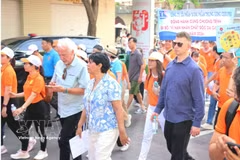
Representatives from various consulates, the Vietnam Association of Victims of Agent Orange/dioxin, and a large number of people from Ho Chi Minh City participated in the solidarity walk "For Victims of Agent Orange" (Photo: VNA)

More than 5,000 join walk in support of AO victims

Speaking at the event, Major General, Associate Professor, Dr Nguyen Hong Son, Chairman of the VAVA chapter in Ho Chi Minh City, said the programme is not only a commemorative event but also an opportunity to call on agencies at all levels, businesses, organisations and individuals to continue supporting AO victims in overcoming hardship and building their better lives.

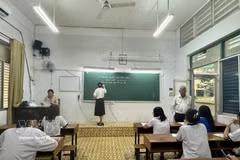
Students in Ho Chi Minh City take the 2025 National High School Graduation Examination. (Illustrative photo: VNA)

Ho Chi Minh City lays groundwork for English as second language in schools

Ho Chi Minh City is building on nearly three decades of experience in English-language education as it prepares to gradually make English a second language in schools, with a focus on improving teaching quality, investing in educational infrastructure and creating an English-speaking learning environment.

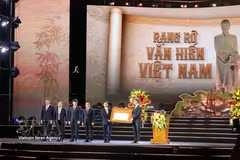
A view of the national ceremony commemorating the 300th birth anniversary of cultural luminary Le Quy Don (1726–2026) at the memorial site dedicated to the renowned scholar in the northern province of Hung Yen on the evening of July 31, 2026. (Photo: VNA)

National ceremony marks 300th birth anniversary of cultural luminary Le Quy Don

In recognition of Le Quy Don's exceptional contributions, UNESCO adopted a resolution to jointly commemorate the 300th anniversary of his birth, acknowledging that his intellectual legacy, commitment to practical learning and humanistic values transcend national borders and form part of humanity's shared cultural heritage.

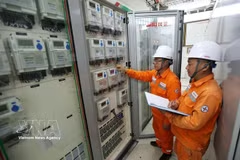
Inspecting the electrical switching system before maintenance at the 110kV WHA Industrial Park substation, Trung Loc commune, Nghe An province. (Photo: VNA)

Powering growth: Ensuring reliable energy supply to keep investment flowing

Across Ha Tinh and Nghe An, maintenance teams conduct inspections day and night, using thermal cameras and drones to detect potential faults without interrupting electricity supply. Their work helps ensure stable power supply for businesses as the region accelerates development in line with the Government's economic growth targets.

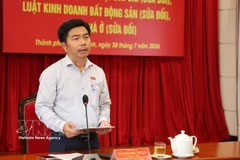
Deputy head of the Ho Chi Minh City’s National Assembly (NA) deputies delegation Vo Hoang Ngan speaks at the conference (Photo: VNA)

Land Law revision: A step toward more effective governance

Experts and regulators are pushing to fine-tune rules on land acquisition, compensation, valuation, decentralisation and the capture of land-generated added value, aiming for a harmonious balance of interests among stakeholders.

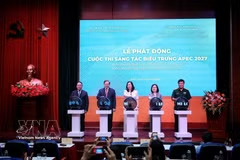
Delegates launch a nationwide competition to design the official logo and visual identity for APEC Vietnam 2027 on July 31 (Photo: VNA)

Contest launched to design APEC 2027 logo, visual identity

Speaking at the launch ceremony, Deputy Minister of Foreign Affairs Le Thi Thu Hang, head of the Communications and Culture Subcommittee under the National Committee for APEC 2027, described the contest as one of the first key preparations for APEC 2027, marking the start of efforts to build the event’s branding and communications for one of the largest and most significant multilateral diplomatic events Vietnam will host in the coming years.

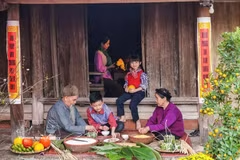
Family members gather to make banh chung – an indispensable part of the Lunar New Year (Tet) celebration. (Photo: VNA)

National value system needs unified implementation to drive development: official

The national value system sets the country's development goals and aspirations; the cultural value system fosters an environment in which these values are embraced, practised and promoted; the family value system serves as the primary foundation for character formation; while the standards of the Vietnamese people serve both as the driving force behind these values and as the ultimate goal of development.

Since July 1, free travel has been available on all 134 subsidised and non-subsidised bus routes across Ho Chi Minh City. (Photo: VNA)

Ho Chi Minh City: Free bus fares drive increase in bus, metro ridership

According to Deputy Director of the Ho Chi Minh City Public Transport Management Centre Le Hoan, the bus network operated nearly 478,000 trips in July, serving more than 8.48 million passengers. Weekly growth accelerated throughout the month, rising from 33% in the first week to 45% in the fourth week.

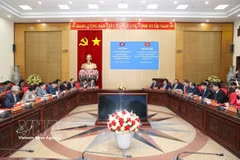
An overview of the working session between the Standing Board of the Ninh Binh provincial Party Committee and Lao delegation led by Sisay Luedethmounsone, Politburo member, Secretary of the Central Committee of the Lao People's Revolutionary Party (LPRP) and head of its Organisation Commission (Photo: VNA)

Lao Party’s Organisation Commission delegation visits Ninh Binh

The two sides exchanged experience in Party building and organisation, cadre management, renewing Party leadership methods, building a streamlined and effective political system, promoting digital transformation in Party building, and improving the organisational structure of advisory and support agencies at the commune level.