Ho Chi Minh City (VNA) – The 14th Party Central Committee’s third plenum has laid out major orientations for amending the Land Law and related laws, demanding a fundamental reset in how land is governed.
Experts and regulators are pushing to fine-tune rules on land acquisition, compensation, valuation, decentralisation and the capture of land-generated added value, aiming for a harmonious balance of interests among stakeholders.
From “land management” to “land governance”
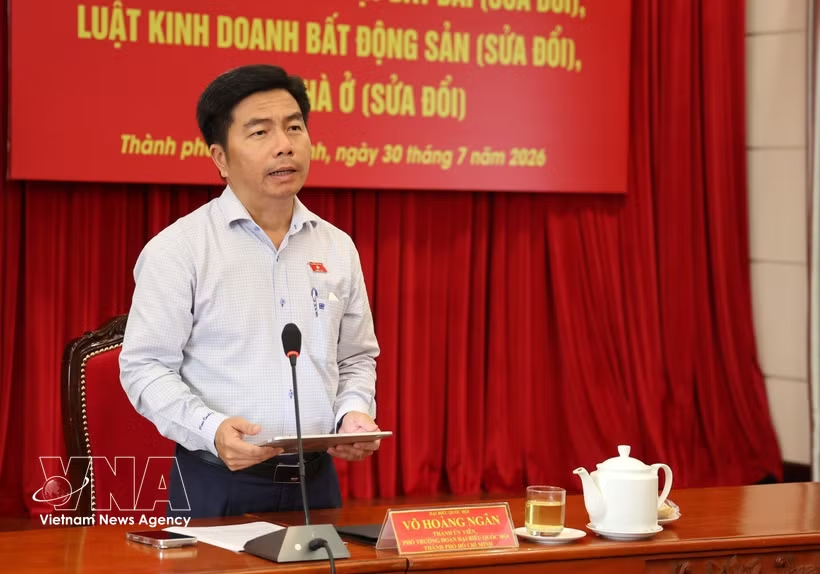
At a July 30 conference gathering input on the draft revised Land Law, Law on Real Estate Business and Law on Housing, deputy head of the Ho Chi Minh City’s National Assembly (NA) deputies delegation Vo Hoang Ngan said the three bills carry sweeping impact on socio-economic development. investment and trade.
Ngan said the amendments should closely track the plenum’s core demand, particularly the shift from “management” mindset to “governance". That starts with building a concentrated, unified and interoperable land database. Right now, data is fragmented across sectors, driving up administrative costs and delays for citizens and businesses.
The Land Law, he added, must be rewritten in lockstep with the housing and real estate business laws to cut overlaps in land use, its planning, and valuation.
Nguyen Thi Bich Thuy, Deputy Director of the Ho Chi Minh City Department of Agriculture and Environment, said said more than a year of enforcing the 2024 Land Law and the NA’s Resolution 254/2025/QH15, which stipulates mechanisms to tackle enforcement bottlenecks, has cleared challenges triggered by the rollout of a two-tier local administration model. Several long-stalled projects have also seen their institutional and policy logjams broken.
She said the draft law is designed to dislodge enforcement bottlenecks that have built up in recent years, accelerate decentralisation and the handover of authority to localities alongside tougher accountability, modernise land governance, and fuel the digital transformation.
Clarifying how to allocate land-generated added value
Alongside the major orientations, many opinions focused on mechanisms for land acquisition, compensation, capture of land-generated added value and transit-oriented urban development.
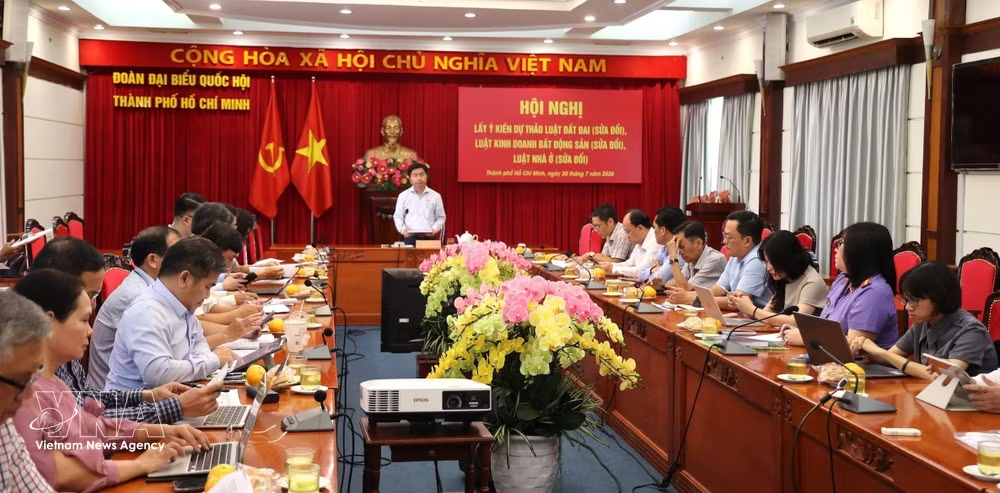
Nguyen Ngoc Hien, Deputy General Director of Tan Thuan Industrial Development Co., Ltd. (IPC), spotlighted the NA’s Resolution 260/2025/QH15, which introduces a mechanism for transit-oriented urban development, allowing functional zoning of land around metro stations and depots, as well as housing, commercial and service facilities on such land.
Thuy noted that the draft law adds a suite of regulations on land acquisition, compensation, support and resettlement. These include widening the cases where land can be taken for socio-economic development in the national and public interest, introducing flexible mechanisms for the timing of land acquisition and resettlement in special projects, and codifying the principle that displaced households must get housing and living conditions at least as good as their old ones.
The bill also creates mechanisms for leftover land fragments that no longer meet use conditions and introduces measures to curb profiteering from compensation policies, she added./.