Efforts made to turn heritage into driver of Vietnam’s cultural industries

Experts believe that with coordinated reforms in institutions, technology, human resources and infrastructure, Vietnam can transform its cultural heritage into a powerful engine for innovation, economic growth and national soft power in the new era.

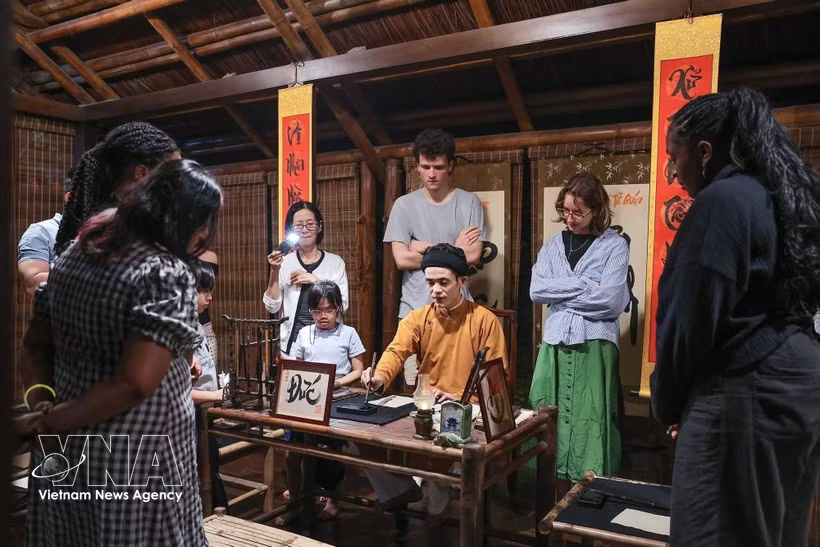
Tourists watch a calligraphy master demonstrate the art in a heritage setting during the Temple of Literature's night tour. (Photo: VNA)

Hanoi (VNA) – Vietnam is seeking to transform its rich cultural heritage into a strategic resource for the digital economy and cultural industries, as the country steps up implementation of the Politburo’s Resolution No. 80-NQ/TW on the development of Vietnamese culture.

The shift aims to unlock new sources of growth, strengthen national soft power and create fresh momentum for development.

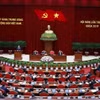
Six months after the resolution was issued, ministries, sectors and localities have moved swiftly to develop action plans and introduce new policy mechanisms. At the second meeting of the Central Steering Committee for the Development of Vietnamese Culture, Party General Secretary and State President To Lam acknowledged these early efforts but stressed that significant gaps remain between policy goals and tangible outcomes. He identified four gaps and outlined three major transformations to guide cultural development in the years ahead.

The four shortcomings include the limited appeal of Vietnamese cultural values in the digital environment, the slow conversion of heritage into digital resources and intellectual property, insufficient capacity to create competitive cultural products, and an underdeveloped institutional framework for cultural industries. The three major shifts are viewing culture as a pillar of national development, promoting culture in both physical and digital spaces, and moving beyond preservation towards innovation and value creation.

Associate Professor, Dr. Do Hong Quan, President of the Vietnam Union of Literature and Arts Associations, said that the Party and State leader’s candid and pragmatic assessment after six months of implementing the resolution highlighted a persistent gap between policy and tangible outcomes, as well as between action programmes and their real-world impact. Public spending on culture currently accounts for only around 1.5% of the State budget, falling short of the resolution’s minimum target of 2%.

Vietnam possesses more than 40,000 historical and cultural sites, nearly 70,000 items of intangible cultural heritage and 38 UNESCO-recognised heritage elements. However, much of this valuable resource has yet to be digitised, standardised or integrated into shared databases. Nor has it been effectively protected and commercialised as intellectual property or developed into digital knowledge and creative products serving education, cultural industries and artificial intelligence applications.

Professor Dr. Tu Thi Loan, President of the Thang Long Institute of Cultural Studies, said Vietnam’s greatest challenge lies not in the lack of heritage or creativity but in the absence of a complete ecosystem capable of transforming heritage into data, data into knowledge, knowledge into intellectual property, and intellectual property into marketable products and services. She stressed the need for a national cultural data infrastructure, a transparent legal framework governing heritage data, and stronger collaboration between the cultural, technology and business sectors.

She also called for more attractive financial policies, investment funds and intellectual property protection to encourage long-term investment in creative industries. A more integrated ecosystem linking artists, enterprises, technology, finance, education and international markets, she said, will enable cultural assets to become valuable economic resources.

Currently, cultural industries contribute around 4% of Vietnam’s GDP. Under Resolution 80, the sector is expected to account for 7% by 2030 and 9% by 2045. Experts believe that with coordinated reforms in institutions, technology, human resources and infrastructure, Vietnam can transform its cultural heritage into a powerful engine for innovation, economic growth and national soft power in the new era./.

VNA
See more

Artists of Italy's Teatro Lirico Giuseppe Verdi di Trieste perform the opera La Traviata. (Photo published by VNA)

Over 100 Italian artists bring opera masterpiece La Traviata to Vietnam

First staged at Venice's Teatro La Fenice in 1853, La Traviata was adapted from Alexandre Dumas fils' La Dame aux Camélias (Camille). More than 170 years on, it remains one of the most enduring works in the operatic repertoire and is regularly performed at leading theatres worldwide.

Hanoi launches tourism-focused art programme

Hanoi launches tourism-focused art programme

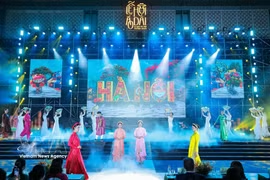
The “Chuyen Ha Noi – Mot ngay rat Ha Noi” (Hanoi stories – A truly Hanoi day) programme is scheduled to be staged regularly at 8 p.m. every Friday at the theatre, located at 31–33 Luong Van Can street, Hoan Kiem ward. It is expected to become one of the city’s signature cultural attractions for both domestic and international visitors.

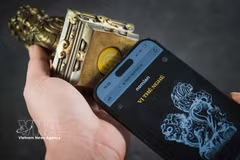
A digital book is embedded in the bronze nghe statues at the Temple of Literature in Hanoi. (Photo: VNA)

Vietnam’s folk culture to go digital

Digitising Vietnam’s folk culture, including oral literature, beliefs, customs, festivals and art passed down through generations, has become an urgent lever for national cultural development in the new era.

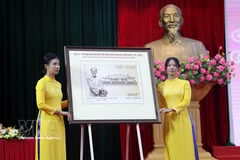
The special commemorative postage stamp marking the 300th birth anniversary of renowned Vietnamese cultural figure Le Quy Don (1726–2026) (Photo: VNA)

Commemorative stamp issued to mark Le Quy Don's 300th birth anniversary

Speaking at the event, Deputy Minister of Science and Technology Pham Duc Long described Le Quy Don as one of Vietnam's most distinguished cultural figures of the 18th century. A celebrated scholar, poet, historian, thinker, educator and diplomat, Le Quy Don left behind an extensive body of work whose enduring value continues to enrich the nation's cultural, scientific and educational heritage.

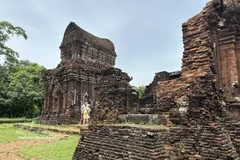
The My Son temple complex served as the foremost religious and spiritual centre of successive ancient Champa dynasties for nearly nine centuries, from the 4th to the 13th century, featuring an extensive ensemble of Hindu temples and towers. (Photo: VNA)

My Son inscriptions set sights on UNESCO documentary heritage status

Located in Thu Bon commune, Da Nang city, My Son is renowned for its architectural heritage, but it also preserves an exceptional archive engraved on stone. These inscriptions have enabled scholars to unravel the history of the sanctuary and trace the rise and development of the ancient Champa kingdom over many centuries.

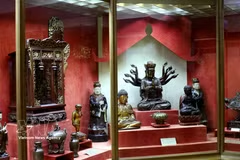
Vietnamese cultural artefacts on display at the State Museum of Oriental Art in Russia. (Photo: VNA)

Moscow museum bridges Vietnam-Russia cultural exchange

Among its rich collections, the Vietnamese gallery at the State Museum of Oriental Art in Moscow stands out as a vivid testament to the country's history, culture and craftsmanship, helping promote Vietnam's cultural identity to Russian and international visitors.

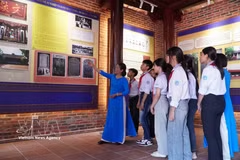
Students and teachers explore the legacy of scholar Le Quy Don (Photo: VNA)

Exhibition showcases legacy of scholar Le Quy Don

Speaking at the opening ceremony, Nguyen Hang Nga, Director of the Vietnam Exhibition Centre for Culture and Arts, said the exhibition gives visitors deeper insight into cultural figure and scholar Le Quy Don's vast scholarly contributions through photographs, historical documents, woodblock reproductions, stone inscriptions, books and other valuable archival materials.

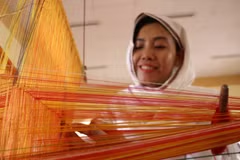
My Nghiep weaving village in Khanh Hoa province strives to keep tradition alive. (Photo: VNA)

Resolution paves way for Vietnam to unleash soft power

The implementation of Resolution No. 06 alongside the cultural diplomacy strategy sends a clear message: by combining its rich cultural heritage with proactive diplomacy, innovation and digital transformation, Vietnam would strengthen its competitiveness on the global stage.

Visitors sample Hue's traditional specialties during the Hue Traditional Cuisine Week 2024. (Photo: VNA)

Hue city named among Asia's top destinations for traditional cuisine

Hue stood out for its imperial cuisine, a culinary tradition rooted in the city's history as the capital of the Nguyen Dynasty. Renowned for its refined flavours, meticulous preparation and artistic presentation, Hue's cuisine reflects centuries of royal and cultural traditions.

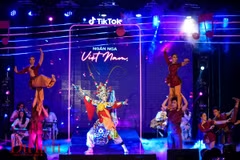
TikTok joins hands to launch the “Ngan Nga Vietnam" campaign, helping promote Vietnamese cultural identity and tourism on digital platforms (Photo: Ho Chi Minh City's Department of Tourism)

Creating Vietnamese cultural identity, sovereignty in digital space

Party General Secretary and State President To Lam has stressed the need to address bottlenecks hindering the transformation of culture into an endogenous resource, soft power and a driver of national development, as the appeal and reach of positive cultural values in the digital environment have yet to keep pace with the rapid growth of digital platforms and content.

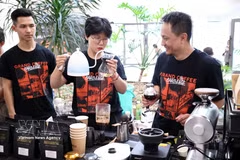
A barista demonstrates coffee brewing for visitors at the event. (Photo: VNA)

Central Vietnam's specialties inspire innovative coffee beverages

Businesses and coffee artisans in Da Nang city are reimagining the central region's signature specialties through creative coffee beverages, offering visitors distinctive flavours while adding value to OCOP (One Commune One Product) items and strengthening links between agriculture, culture, tourism and commerce.

Over 100 young overseas Vietnamese from 32 countries and territories join the Vietnam Summer Camp 2026. (Photo: VNA)

Vietnam Summer Camp 2026 wrapped up

Held from July 12 to 25 across eight cities and provinces, Vietnam Summer Camp 2026 offered a rich array of experiences. Participants explored historical landmarks, visited iconic cultural heritage sites such as the imperial city of Hue, Hoi An ancient town, and the My Son Sanctuary, and engaged in charitable activities valued at over 300 million VND (11,400 USD), including the installation of a "Youth Bookshelf."

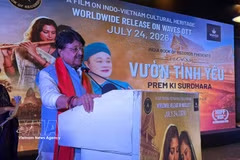
India's Madhya Pradesh Cabinet Minister Kailash Vijayvargiya speaks at the event. (Photo: VNA)

Film inspired by Vietnamese Quan Ho folk singing released globally

Produced by the India Book of Records (IBR) based on an idea by Prof. Dr. Chu Bao Que, "Love Garden" weaves Quan Ho folk singing into a bridge connecting past and present. The storyline follows a young Indian woman from Madhya Pradesh state who travels to the heartland of Quan Ho in northern Vietnam and performance stages in Hanoi to trace memories of her late mother.