Hanoi (VNA) – Party General Secretary and State President To Lam has stressed the need to address bottlenecks hindering the transformation of culture into an endogenous resource, soft power and a driver of national development, as the appeal and reach of positive cultural values in the digital environment have yet to keep pace with the rapid growth of digital platforms and content.
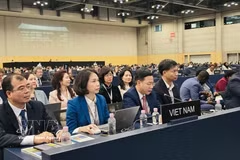
Addressing the second meeting of the Central Steering Committee for the Development of Vietnamese Culture on July 13, the leader identified this as one of four major gaps that have emerged during the implementation of Resolution No. 80-NQ/TW.
He noted that as the digital space increasingly shapes social perceptions, tastes and lifestyles, the gap poses a challenge to the ability to transform the nation's cultural capital into soft power and the capacity to shape values.
“If this gap is not addressed soon, exogenous values will increasingly gain the upper hand, undermining the appeal of national culture and creating new challenges to preserving cultural identity, strengthening public trust and passing on the national cultural values,” he said.
According to the 2026 Global Digital Report, Vietnam had around 85.6 million internet users at the end of 2025, equivalent to 84.2% of the population, while the number of social media user identities stood at approximately 79 million.
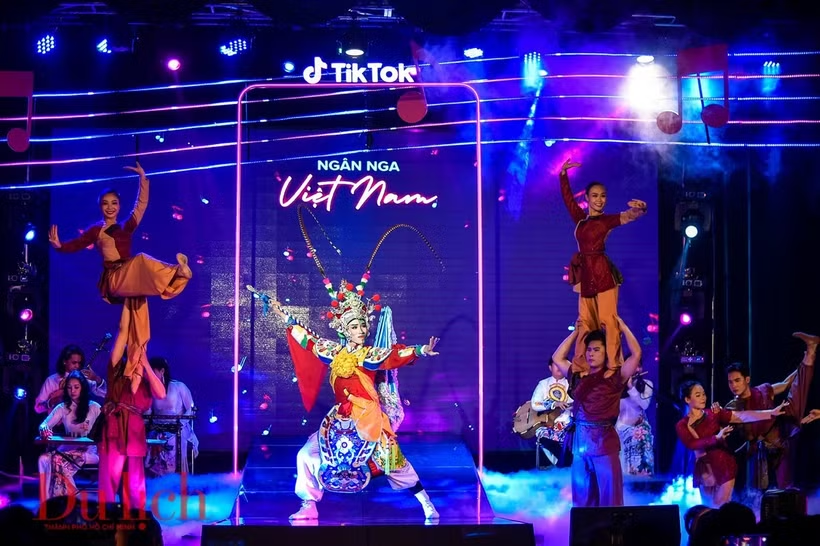
Today, every smartphone or internet-connected computer is both a gateway for receiving culture and a channel for transmitting information to millions of others. A folk song, a traditional dish or a scenic destination can become known around the world within minutes of being posted online.
However, opportunity does not automatically translate into influence. In the digital environment, content must compete fiercely for public attention, with algorithms playing a decisive role in determining what is seen and shared.
Dr. Nguyen Huy Phong from the Central Theoretical Council attributed the gap to the rapid development of science, technology and artificial intelligence (AI), which is increasingly shaping online behavior, as well as Vietnam’s rapid Internet growth since the country went online in 1997.
Cultural products created and promoted in cyberspace, however, remain limited and monotonous. This is partly due to the foreign-oriented mindset among some young people, which has led to traditional values being overlooked, and partly because insufficient attention has been paid to building a cultural ecosystem in the digital environment, from developing strategies to establishing a legal framework to encourage the creation and promotion of new works.
There is also a gap in the shift from traditional management to smart governance in the digital environment, while there is still a shortage of human resources with both a strong understanding of culture and solid technological expertise, experts said.
They noted that the current gap stems largely from limited capacity to turn cultural values into distinctive digital products. In some places, digital transformation is still equated with photographing artefacts, digitising documents or putting archival materials online.
Vietnam’s rich cultural resources have yet to be fully translated into modern cultural products, intellectual property and market value due to gaps in institutions, policy, human resources and the digital ecosystem. To turn culture into an endogenous resource, soft power and a source of national competitiveness, Vietnam needs to build a more coherent ecosystem that can transform cultural values into data, knowledge, creative works and products embraced by the public.
Prof. Dr. Tu Thi Loan, Director of the Thang Long Institute for Cultural Research, noted that digital transformation in the cultural sector differs fundamentally from that in economic and technical fields. Its objective is not merely economic efficiency or automation, but also the preservation and promotion of cultural identity, historical and traditional depth, and creative forms of expression.
Another challenge lies in storytelling. Many official cultural products still rely on one-way communication. Although they provide comprehensive information, they often lack characters, situations and emotions, making them less engaging.
The creative ecosystem also remains fragmented. Those with cultural expertise may not necessarily be proficient in technology, while technology specialists may lack knowledge of history and aesthetics. Artists, media companies, museums, schools and management agencies still lack sustainable mechanisms for cooperation, leaving many valuable resources untapped.
In many agencies and organisations, social media is still treated merely as a secondary channel for reposting content originally produced for print or television, rather than as a creative space with its own language. Evaluation also tends to focus on the number of news stories and articles rather than their actual reach and social impact.
Furthermore, much cultural content is distributed through cross-border platforms, meaning that even a single change in a platform's policy or algorithm can immediately affect its ability to reach audiences.
Experts said that to narrow the gap, it is necessary to create content that can be found, understood, appreciated, shared and used as a source of further creativity. Cultural data must be standardised and identified while ensuring copyright protection, connectivity and reusability.
The State should focus resources on foundational projects and products of high ideological and artistic value, while expanding public-private cooperation with businesses, artists and independent creators. Evaluation should shift from counting outputs to measuring recognition, interaction and social impact.
Ministries, sectors and localities should allocate human resources with both a strong understanding of traditional culture and solid technological expertise, while focusing on training young talents with passion, creativity and aspirations for development, to create new cultural values and contribute to shaping Vietnam’s cultural identity and sovereignty in cyberspace, they added.
Production must go hand in hand with distribution strategies, insiders said, noting that positive content cannot simply be posted online and left for audiences to find.
Data should be used to identify target audiences and select the right timing, formats and platforms, while communities should be actively built and major platforms engaged in campaigns to promote Vietnamese culture. Investment is also needed in domestic data repositories, search tools and distribution channels, as self-reliance is not merely a communications issue but also an integral part of digital cultural sovereignty, experts stressed.
In his remarks at the meeting, General Secretary and President Lam called for three major shifts in cultural development - viewing culture as a spiritual foundation of society, a pillar of development and a new driver of growth; expanding cultural development into both physical and digital spaces; and combining preservation with creativity. He also identified four key priorities - improving institutions, strengthening cultural sovereignty in the digital spaces, transforming cultural heritage into knowledge and creative products, and developing cultural industries into a new driver of growth and national competitiveness./.