Virtual museums bring Lam Dong's heritage into digital age

Beyond preservation, digitalisation is opening new opportunities for smart tourism, thereby expanding public access to heritage and enhancing research activities.

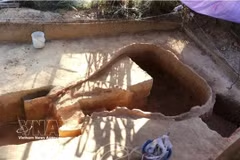
The Lam Dong Museum’s Binh Thuan branch digitises more than 400 representative original artifacts, with the digitisation effort still ongoing. (Photo: VNA)

Lam Dong (VNA) – Lam Dong province is stepping up efforts to digitise its cultural heritage through digital databases, 3D artefact scanning, virtual museums and online exhibition platforms, thus preserving valuable cultural assets while expanding public access and advancing smart tourism.

From June 15 - 18, the Lam Dong Museum joined forces with Phan Thiet University to carry out a provincial research project on the digitalisation of the province's tangible and intangible cultural heritage.

The initiative saw 200 representative artefacts digitally captured in 3D, alongside the creation of virtual reality exhibition spaces at three locations: the Lam Dong Museum's Binh Thuan branch, the Cham Cultural Exhibition Centre in Bac Binh commune, and the Cham Royal Heritage Collection in Hong Thai commune.

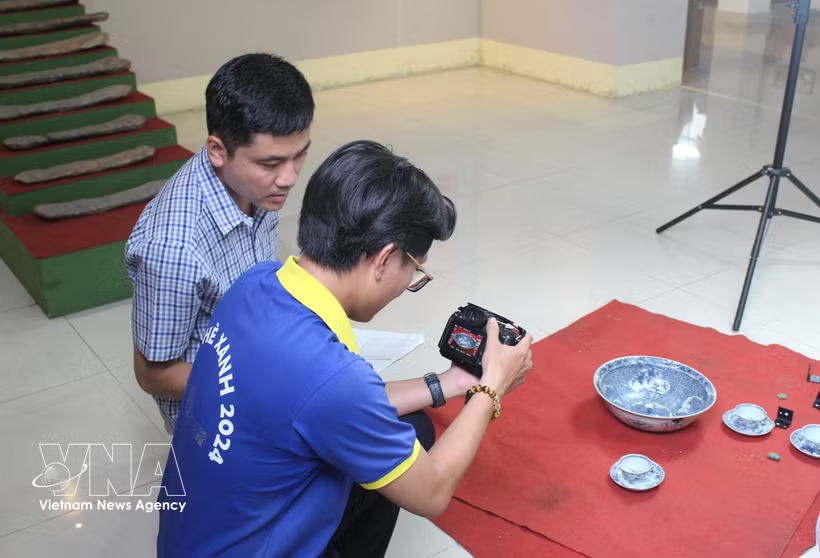
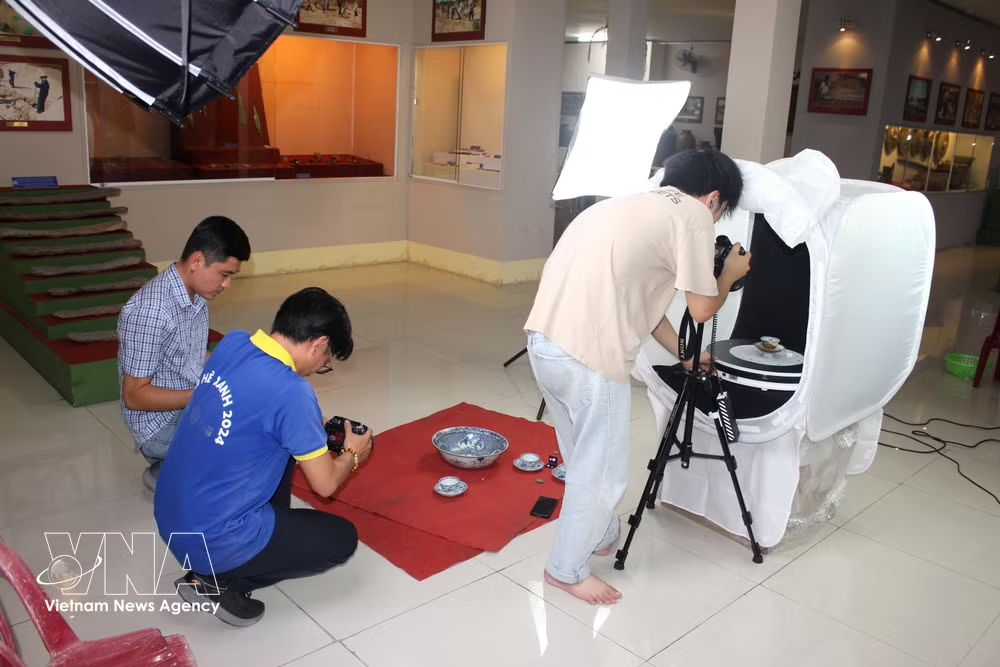
Giang Sy Chung, a lecturer at Phan Thiet University, said the team employed 360-degree virtual reality technology to recreate entire exhibition spaces. Laser scanning and multi-angle photography were combined to generate highly detailed 3D models, enabling users to examine artefacts from every perspective in a digital setting.

He noted that the process required particular care because many of the objects are centuries old, while others have undergone restoration and could be vulnerable during handling and scanning.

The Lam Dong Museum's Binh Thuan branch houses nearly 60,000 artefacts, including around 30,000 originals. As part of its digital transformation strategy, the museum has digitised two-dimensional image records, standardised data for a digital heritage database, introduced QR codes for exhibition areas and key artefacts, and created QR codes for 16 historical and scenic sites across the province.
vnanet-potal-lam-dong-day-manh-so-hoa-di-san-mo-rong-khong-gian-tiep-can-van-hoa-8834591-1.jpg
Digitisation to establish a shared digital database that integrates archival resources, enhancing inventory, documentation and collection management. (Photo: VNA)

Heritage information has also been integrated into the culture sector's digital heritage and museum management system.

Doan Van Thuan, Deputy Director of the Lam Dong Museum, said the institution has progressed beyond simple digitisation and is now developing a fully integrated digital museum with immersive online visitor experiences.

He said digital replicas help safeguard the scientific information associated with artefacts while reducing the risk of deterioration and loss over time. A shared digital database will also strengthen links between museums and heritage sites, supporting inventories, research, education and cultural heritage management.

The initiative has become increasingly important following the formation of new Lam Dong province through the merger of the former provinces of Lam Dong, Binh Thuan and Dak Nong. The enlarged province now oversees a much broader range of heritage assets, making modern, technology-driven management solutions essential.

Beyond preservation, digitalisation is opening new opportunities for smart tourism, thereby expanding public access to heritage and enhancing research activities.

More than 400 artefacts in eastern Lam Dong have already been digitised, while the Cham Cultural Exhibition Centre has completed 3D scanning of over 50 artefacts and continues to expand the project.

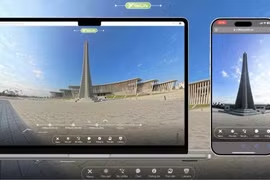
Visitors have responded positively to the new digital experiences, which complement conventional museum tours. Through the virtual museum platform at https://3d.baotanglamdong.com.vn, users can explore exhibition galleries, heritage sites and museum facilities online through an interactive interface.

Nong Hoang Yen Dan, an 11th grader from Phan Thiet ward, said the platform allows users to discover exhibitions and artefacts from anywhere with an internet connection. The experience is vivid and feels almost like visiting the museum in person, she said.

Looking ahead, the Lam Dong Museum will launch a 50-billion-VND (1.9-million-USD) project during 2026–2028 to digitise its entire collection while developing a comprehensive 3D visitor platform and a modern multimedia presentation hall.

By combining traditional exhibitions with digital technologies, the museum aims not only to preserve valuable artefacts for future generations but also to extend the reach of cultural heritage beyond physical museum walls, making it more accessible to audiences both in Vietnam and overseas./.
VNA

See more

Xuan Son comes on in the second half and contributes to Vietnam’s second goal, with his shot forcing a Cambodian defender into an own goal to put Vietnam 2-1 ahead (Photo: VNA)

Vietnam's 22-match unbeaten run draws praise from RoK media

Under the tournament format, the semifinals and final will be played over two legs. Vietnam will travel to Malaysia for the first leg on August 16 before hosting the second leg on August 19. Should Vietnam overcome Malaysia, they will meet the winner of the other semifinal between Thailand and Singapore in the final.

A performance at the Vietnam–Korea Festival 2026 in Da Nang city (Photo: VNA)

Vietnam–Korea Festival 2026 kicks off in Da Nang

Now in its fifth edition, the festival has cemented its place as Da Nang’s signature annual diplomatic event, spotlighting the distinct cultures of both nations, fostering friendship and driving cooperation with Korean localities and partners.

A performance at the opening ceremony of the 2026 Hanoi International Martial Arts Festival on August 7 (Photo: VNA)

Hanoi opens international martial arts festival

The event attracts about 2,000 martial artists of 66 delegations, including seven international delegations from six countries, namely Indonesia, Russia, France, Germany, Switzerland and Morocco.

The statue of Vietnam's King Ly Thai To ( (974 - 1028) in Bonghwa county (Photo: VNA)

RoK to develop K-Vietnam Valley project linked to Ly Dynasty heritage

With the designation in place, Bonghwa will carry out eight specialised projects worth a combined 347.6 billion KRW (245.1 million USD) from 2026 to 2030 – among them the K-Vietnam Valley itself, tourism development around Changpyeong Reservoir, rental smart farms, and a Baekdudaegan healing ‘pet village.’

The organising committee presents awards to outstanding martial artists at the festival. (Photo: VNA)

9th Int’l Festival of Vietnamese Traditional Martial Arts wraps up

The ninth International Festival of Vietnamese Traditional Martial Arts has fostered the martial spirit, strengthened national pride, promoted cultural exchanges and reinforced the aspiration to bring Vietnamese traditional martial arts to a wider international audience.

An appetising bowl of My Quang features a rich combination of ingredients. (Photo: VNA)

Da Nang to host festival honouring Quang Nam-style noodle soup

My Quang is not only a signature dish of the Quang region but also reflects the history, culture and daily life of communities in central Vietnam. With its diverse ingredients, preparation methods and distinctive flavours, the noodle soup has become one of Vietnam's best-known culinary specialities, helping strengthen Da Nang's position on the culinary tourism map.

Hanoi’s traditional silk weaving craft continues to be preserved and developed today. (Photo: VNA)

Van Phuc silk weaving village officially recognised as Hanoi tourist destination

With its millennia-old heritage and growing integration of preservation and innovation, Van Phuc silk weaving village is poised to become a distinctive cultural destination, helping promote Hanoi’s sustainable cultural tourism and bring the quintessence of Vietnamese silk weaving closer to domestic and international visitors.

Minister of Construction Tran Hong Minh speaks at the session (Photo: VNA)

Lawmakers mull over changes to architecture law

On architectural management, the draft Law amending and supplementing several articles of the Law on Architecture clarifies the concept of “national cultural identity in architecture”, tying design to the preservation and promotion of regional heritage. It pushes architecture that mirrors local identity and fits each locality’s natural, historical and social conditions, while setting criteria to identify, assess and protect architecturally valuable buildings as a distinct form of cultural heritage.