Digital skills – part of daily life in Lang Son's mountainous border communities

Continued investment in digital literacy, particularly for older people, ethnic minority communities and residents in remote mountainous areas, along with better training for frontline public servants, will be essential to ensure that everyone can confidently access and benefit from online public services.

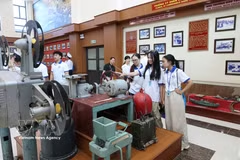
A civil servant at the Chi Lang commune Public Service Centre in Lang Son province guides a resident in how to use an AI-supported public service kiosk. (Photo: VNA)

Lang Son (VNA) – Digital transformation is becoming increasingly visible in the mountainous border areas of northern Lang Son province, where many ethnic minority communities are gradually embracing digital technologies in their daily lives.​

At the Public Administration Service Centre in Quan Son commune, residents no longer need to carry stacks of documents or spend hours waiting to complete administrative procedures.​

Instead, they just bring a smartphone, and officials help them log into their electronic identification (VNeID) accounts, submit applications through the National Public Service Portal, and track their application progress online.​

For local officials, every administrative application is also an opportunity to teach digital skills. They provide step-by-step guidance on installing applications, verifying digital identities and completing online procedures so that residents can carry out future transactions independently.​

Hoang Duc Binh, Vice Chairman of the Quan Son commune People's Committee, said digital transformation has significantly improved both government operations and public awareness.​

As local people become more familiar with digital skills, they save time and travel costs while administrative agencies can provide services more efficiently and transparently, he said.​

All administrative records in Quan Son are now digitised and processed electronically, with online submissions accounting for 100% of applications. Every application has been processed on or ahead of schedule.​

Nguyen Van Tuan, a resident of Suoi Ma village, said completing land-related procedures used to require multiple trips because documents often needed revisions.​

"Now many procedures can be completed online, which has saved me a great deal of time," he said, adding that people in the commune have also become accustomed to using online public services, making administrative procedures much faster and more convenient.​

Recognising that access to technology remains uneven in mountainous areas, local authorities have mobilised community digital technology teams, youth volunteers and mass organisations to help residents install VNeID, use the National Public Service Portal, adopt cashless payment methods and access other digital platforms.​

Local governments have also introduced more innovative communication methods. Artificial intelligence (AI) is being used to create infographics, visual materials and audio bulletins generated through text-to-speech technology, helping explain new Party and State policies in a more accessible way.​

Ma Van Thien, a local official, said AI-generated content has made public information easier for rural residents to understand.​

He added that information is now disseminated more quickly through the commune's Facebook page and village Zalo groups, enabling residents to receive timely updates on important policies and programmes.​

Modern public services within easier reach​

vnanet-potal-ky-nang-so-lan-toa-mien-nui-xu-lang-8883106.jpg
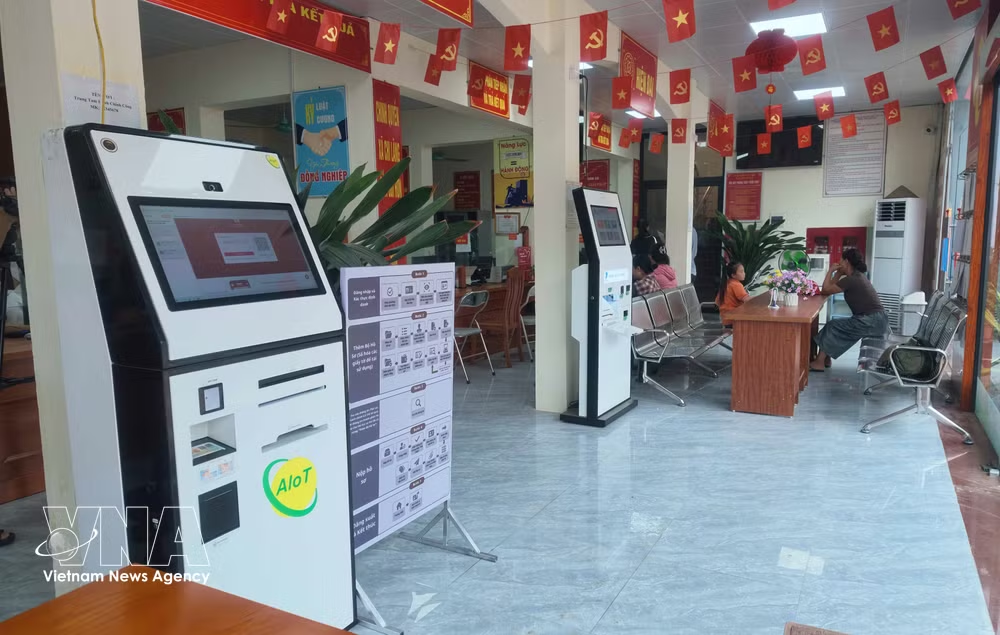
AI-supported public service kiosks at the Chi Lang commune Public Service Centre. (Photo: VNA)

In Chi Lang commune, newly established Digitalisation Stations and AI-powered Public Service Kiosks are making online administrative services more accessible.​

Although many residents were initially unfamiliar with digital procedures, direct guidance from officials has helped them learn how to scan documents, complete online forms and submit applications electronically.​

Instead of preparing multiple paper documents and waiting in line, residents can now digitise their records at the stations before completing procedures through the electronic system.​

The model not only makes things more convenient for citizens but also eases the load on one-stop administrative service counters, while boosting transparency in how applications are processed.​

Luong Trung Do, a resident of Chi Lang commune, said the system is still new but easy to use with staff assistance.​

The digital stations currently support a range of essential public services, including marriage registration, birth registration, issuance of civil status extracts, certification of wills and copies of original documents.​

Once digitised, these records are stored electronically and can be reused for future administrative procedures, reducing paperwork and simplifying subsequent applications.​

According to Deputy Director of Chi Lang commune's Public Administration Service Centre Trieu Minh Hieu, the centre receives an average of 50-60 applications each day across various sectors.​

Since the beginning of the year, it has processed more than 7,000 administrative applications, including over 3,700 submitted online.​

Hieu said the centre will continue improving the digital skills of civil servants while updating applications and administrative procedures to help residents access public services more quickly and efficiently.​

The rollout of Digitalisation Stations and AI-powered Public Service Kiosks reflects Lang Son's broader efforts to build a digital administration centred on citizens and businesses.​

However, officials say technology infrastructure alone is not enough. Continued investment in digital literacy, particularly for older people, ethnic minority communities and residents in remote mountainous areas, along with better training for frontline public servants, will be essential to ensure that everyone can confidently access and benefit from online public services./.

VNA

See more

A performance at the art programme (Photo: VNA)

Art programme honours fallen heroes, reaffirms commitment to identifying martyrs' remains

The programme was a profoundly significant political communication event, reflecting the care and responsibility of the Party, State, military and society towards the search, recovery and identification of fallen soldiers' remains. It also expressed the deep gratitude of today's generation to the martyrs who sacrificed their youth for national independence, freedom and peace and happiness.

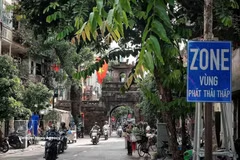
A sign marking a Low Emission Zone stands near the O Quan Chuong gate, one of the gateways to Hanoi's Old Quarter. (Photo: VNA)

Hanoi to support low-income residents in replacing high-emission motorbikes

A key task is to formulate a support scheme for low-income residents to replace ageing motorcycles and mopeds that fail to meet emission standards and pose a high risk of pollution. It will also propose funding to provide free first-time emission testing for motorcycles and mopeds across the city.

Photo exhibition celebrates 50 years of Vietnam-Thailand diplomatic relations

Photo exhibition celebrates 50 years of Vietnam-Thailand diplomatic relations

The Royal Thai Embassy in Vietnam, in coordination with the Vietnam News Agency (VNA), opened a photo exhibition themed “The Lens of Diplomacy: 50 Years of Thailand–Vietnam Relations” in Hanoi on July 24 morning, in celebration of the 50th founding anniversary of the diplomatic relations between the two countries (August 6, 1976–2026).

The Vietnamese Knowledge Network in New Zealand is launched on July 23. (Photo courtesy of Vietnamese Embassy in New Zealand)

Vietnamese Knowledge Network in New Zealand launched

The launch marked an important milestone in connecting Vietnamese knowledge, experience, and expertise, fostering a stronger, more connected community, and contributing to the growing partnership between Vietnam and New Zealand.

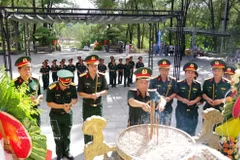
Lieutenant General Ha Tho Binh, Commander of Military Region 4, and the delegation pay tribute to heroic martyrs at Truong Son National Martyrs Cemetery. (Photo: VNA)

Meaningful activities held to honour revolution contributors

Ahead of the 79th anniversary of War Invalids and Martyrs' Day (July 27, 1947 – July 27, 2026), commemorative and tribute activities honouring heroic martyrs and people with meritorious services to the revolution have been organised across various localities nationwide.

Dishes from Da Nang and central Vietnam are introduced to tourists at the Da Nang Food Tour Festival 2026 (Photo: VNA)

Food shapes Vietnamese travel choices: Agoda report

As late summer approaches, the online travel platform Agoda has unveiled its list of the destinations most searched by Vietnamese travellers. The list spans Vietnam's popular beach cities and Asia's leading urban hubs, with the signature local dishes that make each destination a culinary attraction in its own right.

Vietnamese Ambassador to Japan Pham Quang Hieu (standing) briefs the delegation on the development of the Vietnamese community and related affairs in Japan. (Photo: VNA)

Vietnamese community in Japan urged to strengthen unity, contribute to homeland's development

The representatives expressed appreciation for the support provided by the Party, the State, the VFF Central Committee and the Vietnamese Embassy. They reaffirmed their commitment to fostering a united and law-abiding community, enhancing the image of Vietnamese people in Japan, supporting members' integration into local society, and promoting Vietnam's culture and people to Japanese friends.

Soldiers visit the exhibition (Photo: VNA)

Exhibition showcases over 400 documents, artefacts on Agent Orange legacy

Da Nang remains one of the localities most severely and persistently affected by toxic chemicals after the war. The city has more than 37,700 people who rendered services to the revolution, including about 4,790 exposed to toxic chemicals. Among 17,350 people affected by toxic chemicals, nearly 3,900 benefit from policies for persons with disabilities.

The burned-out shell of the bus after the crash (Photo: VNA)

Drowsy driver detained after Dong Nai coach accident kills seven

Tran Thanh Hai, 41, a resident of the central province of Khanh Hoa, was charged for violating road traffic regulations under Article 260 of the Criminal Code, after his coach slammed into highway guardrails in Dong Nai city and caught fire, killing seven passengers and injuring five others. ​

Vietnamese language teachers from the CVCEC and the Viet Youth Readiness Hub guide young Vietnamese expatriates at a class. (Photo published by VNA)

Expatriate woman helps bridge Vietnam, Canada

Phan Thi Quynh Trang is the founder and Chair of the Canada–Vietnam Culture and Education Council (CVCEC), a Canada-based non-profit organisation that targets culture as a foundation for integration, and education and technology as tools to empower young people.

Delegation members visit the family of Tran Thi Yen (centre), daughter of martyr Tran Quang Tien. (Photo: VNA)

Vietnamese veterans visit martyrs’ families in Berlin

The Vietnam War Veterans Association in Berlin-Brandenburg has run multiple events in recent years to honour war invalids, martyrs and their families, paying tribute to earlier generations while bolstering solidarity within the Vietnamese community in Germany and keeping the nation's cherished traditions alive.