Dak Lak focuses on promoting marine-based economy, logistics

With a coastline stretching nearly 189 kilometers, featuring a network of straits, bays, lagoons, and seaports with significant development potential, Dak Lak is well positioned to advance its marine economy, particularly through the harvesting, aquaculture, and processing of high-value seafood products.

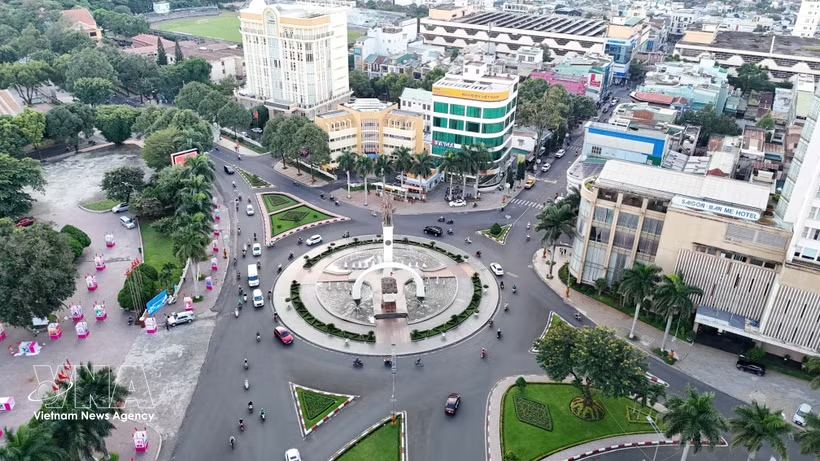
A corner of Buon Ma Thuot ward of Dak Lak province. (Photo: VNA)

Dak Lak (VNA) – Party General Secretary and State President To Lam's call for integrated management of the seaports, logistics and economic corridors at the opening ceremony of the 14th Party Central Committee's third plenum is reshaping the central province of Dak Lak's development strategy.

Following its its merger with Phu Yen province, Dak Lak now combines the Central Highlands' vast agricultural resources with a long coastline, seaports and coastal economic zones, creating new opportunities for marine-based growth and logistics.

New growth space

Developing the marine economy is a major strategic priority of the Party and State, as clearly set out in Resolution No. 36-NQ/TW, issued on October 22, 2018, by the 12th Party Central Committee on the Strategy for the Sustainable Development of Vietnam’s Marine Economy through 2030, with a vision to 2045.

With a coastline stretching nearly 189 kilometers, featuring a network of straits, bays, lagoons, and seaports with significant development potential, Dak Lak is well positioned to advance its marine economy, particularly through the harvesting, aquaculture, and processing of high-value seafood products.

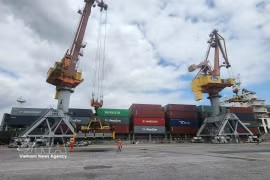
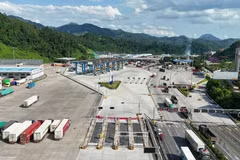
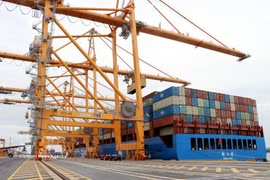
Its eastern area is home to the South Phu Yen Economic Zone, coastal industrial parks, Bai Goc Port, Vung Ro Port and a logistics network linking the Central Highlands with international markets.

Economist Can Van Luc said Dak Lak is uniquely placed to become a gateway connecting the Central Highlands with the South Central Coast. Strategic infrastructure, including the Khanh Hoa–Buon Ma Thuot Expressway and Buon Ma Thuot and Tuy Hoa airports, could support an integrated value chain spanning raw materials, processing, logistics, seaports and exports.

He urged the province to shift from a raw-material economy towards one driven by deep processing, logistics, marine industries, tourism, renewable energy and digital governance.

Logistics expert Nguyen Thanh Han noted that Dak Lak is the only Central Highlands province with both extensive agricultural production and direct access to seaports. Under Vietnam's national port development plan, the Vung Ro–Bai Goc port complex is expected to expand to 16–17 berths by 2030, enabling it to handle large container and bulk cargo vessels and serve as the Central Highlands' import and export gateway.

The province also boasts major coastal attractions, including Ganh Da Dia, Bai Mon–Mui Dien, Vung Ro Bay and Xuan Dai Bay, offering strong potential for sustainable marine tourism.

Tackling logistics bottlenecks

The provincial Master Plan for 2021–2030, with a vision to 2050, outlines a new spatial development framework comprising three distinct economic regions: the western highlands growth region, the eastern coastal economic growth region, and the transitional midland region.
vnanet-potal-dien-dan-thi-truong-bat-dong-san-giai-doan-moi-8494255.jpg
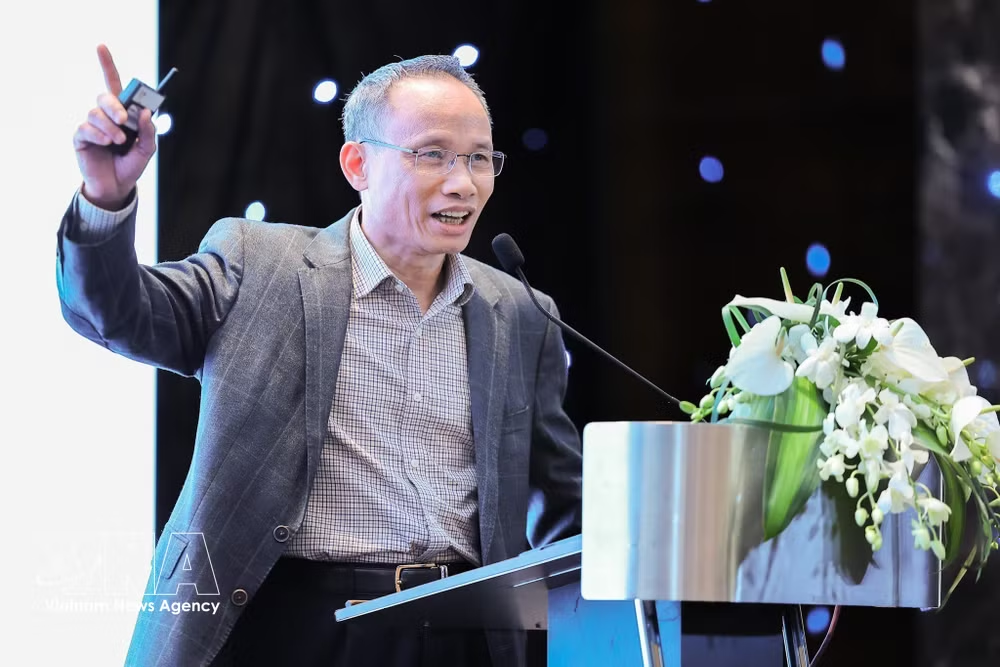
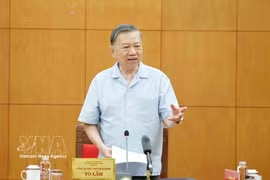
Economist Can Van Luc (Photo: VNA)

The western highlands growth region consists of 30 communes and wards, stretching from Song Cau through Tuy Hoa to Dong Hoa, including the adjacent maritime area. It is designated for the development of a comprehensive marine economy, metallurgical and petrochemical industries, seaport services, offshore energy, and related sectors.

The province also prioritises the expansion of the South Phu Yen Economic Zone, promoting the development of heavy industrial complexes that leverage the advantages of deep-water seaports, including oil refining and petrochemicals, crude oil storage facilities, metallurgy, clean energy, and high-tech industries.

Dak Lak has planned 12 logistics centres covering about 1,000ha, linked with inland ports, industrial parks, Vung Ro and Bai Goc ports, Buon Ma Thuot and Tuy Hoa airports, and key transport routes.

However, major bottlenecks remain. Planned logistics hubs have yet to be completed, while cold storage, bonded warehouses, inland container depots and professional logistics services remain limited. Industrial infrastructure is still incomplete, links between production areas, processors and logistics providers are weak, and digital supply-chain management remains underdeveloped.

According to the provincial Department of Industry and Trade, logistics has become a strategic asset rather than simply a transport service. It will determine the province's ability to integrate into global value chains by reducing logistics costs, attracting investment in deep processing and supporting direct exports through its ports.

The department called for specialised logistics centres serving coffee, durian, fruit, seafood and food processing, greater digitalisation of supply chains, and stronger investment from major logistics and export companies. Better integration of raw material production, deep processing, logistics, seaports and international markets, it said, would help establish Dak Lak as a processing, logistics and export hub for the Central Highlands while supporting sustainable economic growth./.
VNA

See more

At the working session between representatives of the Vietnam Trade Office in Argentina and CMA Paraguay. (Photo: Vietnamese Ministry of Industry and Trade)

Trade office connects South American firms with Vietnamese market

The trade office also highlighted Vietnam’s 100-million-strong consumer market, rising incomes and growing demand for processed, convenience and health-oriented food products. With its strategic location, Vietnam serves not only as a promising market but also as a gateway to Southeast Asia.

Dr Nguyen Thi Bich Nguyet, head of the Office of Environmental Geography and Sustainable Development under the Vietnam Academy of Social Sciences (Photo: VNA)

Integrated marine spatial governance serves sustainable development

When marine spatial governance is implemented through effective cross-sectoral coordination, strengthened by science and technology and supported by expanded international cooperation, the sea will become not only a resource to be exploited but also a long-term development space for the nation.

Experts discuss ways to connect Vietnam's logistics sector with global logistics networks at the forum held in Ho Chi Minh City on July 24. (Photo: VNA)

Global supply chain shift opens new opportunities for Vietnam's logistics

For Vietnam, the current transition presents an opportunity to capitalise on its geo-economic advantages, extensive network of free trade agreements (FTAs) and improving investment climate to attract new investment, expand manufacturing and boost exports, said Deputy Minister of Industry and Trade Phan Thi Thang.

Illustrative photo (Source: VNA)

Vietnam records 16.65 billion USD trade deficit in first half

A comprehensive package of measures is needed to maintain and gradually expand Vietnam's trade surplus. This will provide a solid foundation for the agricultural sector to further strengthen its role as a pillar of the economy and make a more substantial contribution to Vietnam's overall economic growth.

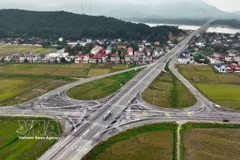
A view of the approach road to the Xuan Quang bridge on the side of Thieu Quang commune, Thanh Hoa province. (Photo: VNA)

Public disbursement recovers, accelerates toward double-digit growth

In the first six months of the year, the disbursement of public investment capital nationwide reached over 356 trillion VND (13.52 billion USD), equivalent to 35.5% of the plan assigned by the Prime Minister. Compared to the same period in 2025, the rate reached a similar level, but the volume of disbursed capital rose by 38.4 trillion VND, thanks to the highest ever increase recorded in the total planned public investment capital for 2026 (1.01 quadrillion VND).

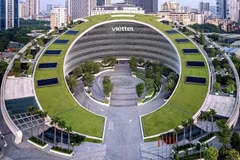
The headquarters of the Viettel Military Industry and Telecoms Group (Photo: Viettel)

Creating runway for Vietnam’s tech "eagles" to take off

Under the national plan for 2026–2030, Vietnam aims to develop at least 10 large strategic technology enterprises by 2030, each generating annual revenue of at least 1 billion USD, employing over 5,000 workers, operating a recognised science and technology organisation, and spending at least 3% of annual revenue on research and development.

Dr. Ho Quoc Tuan, senior lecturer at the UK’s University of Bristol, grants an interview to VNA (Photo: VNA)

Vietnam should focus on competitive niches in global tech value chain: UK-based expert

A young army of software engineers, competitive labour costs and deep mathematical skills have already made Vietnam a magnet for IT outsourcing. Companies like FPT Software and VNG have proved they can compete in international markets. These sectors demand relatively modest infrastructure spending while putting existing human capital to work.

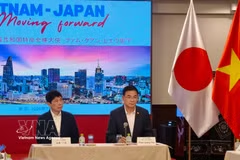
Vietnamese Ambassador to Japan Pham Quang Hieu (R) and Gunma Governor Yamamoto Ichita co-chair the seminar on promoting public-private cooperation in digital transformation. (Photo: VNA)

Vietnam, Japan promote cooperation in digital transformation

The Vietnamese Embassy in Japan reaffirmed its commitment to serving as a trusted bridge connecting Gunma with Vietnamese ministries, localities, universities and businesses to promote concrete cooperation in investment, trade, science and technology, innovation, digital transformation and human resources development.

Minister of Science and Technology Vu Hai Quan delivers a pre-recorded address at the 68th series of meetings of the assemblies of the member states of the World Intellectual Property Organisation (Photo: Permanent Mission of Vietnam in Geneva)

Vietnam strengthens intellectual property system, targets economic value creation

During the recent 68th series of meetings of the assemblies of the member states of the World Intellectual Property Organisation (WIPO), Minister of Science and Technology Vu Hai Quan praised WIPO’s role in developing the global IP system, particularly in strengthening state management capacity, supporting businesses, training human resources, and promoting the commercialisation of intellectual assets.

At a supermarket in the US's Maryland state (Photo: VNA)

USDA to lead agricultural trade mission to Vietnam in November

Luke J. Lindberg, USDA Under Secretary for Trade and Foreign Agricultural Affairs, said the mission will build on the rapid response TRUMP mission that wrapped up in March, and lock in wins for US farmers and agricultural producers in Vietnam.

The signing ceremony of a cooperation agreement among strategic partners for the development of the Da Nang Free Trade Zone on June 13, 2026. (Photo: VNA)

Da Nang completes special administrative framework for free trade zone

The Da Nang Hi-Tech Park and Industrial Zones Authority has now finalised all administrative procedures under its jurisdiction in accordance with the FTZ’s special mechanisms and policies, leaving the system ready for deployment once the zone’s functional areas officially begin operations.