Ho Chi Minh City (VNA) – As global supply chains undergo a major shift towards greater diversification, sustainability and digitalisation, experts say Vietnam's logistics sector must accelerate infrastructure development, digital transformation, green logistics and inter-regional connectivity to strengthen its position in regional supply networks.
Opportunities and challenges from supply chain restructuring
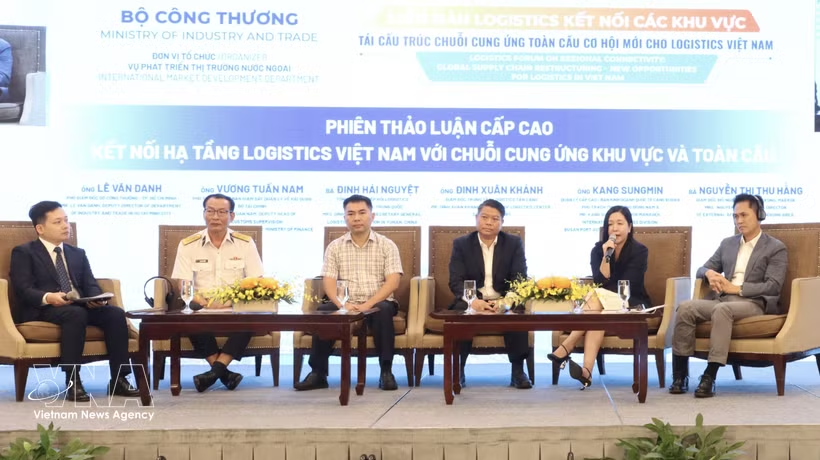
Speaking at a logistics forum on global supply chain restructuring held in Ho Chi Minh City on July 24, Deputy Minister of Industry and Trade Phan Thi Thang said geopolitical tensions, shifting investment flows, digital transformation and green transition are reshaping global trade.
International supply chains are moving away from concentrated production models towards more diversified networks to improve resilience against market shocks, creating both opportunities and challenges for countries with strategic locations, stable investment environments and strong manufacturing capabilities, she said.
For Vietnam, she noted, the current transition presents an opportunity to capitalise on its geo-economic advantages, extensive network of free trade agreements (FTAs) and improving investment climate to attract new investment, expand manufacturing and boost exports.
Despite global economic headwinds, Vietnam's trade continued to post solid growth in the first half of 2026, demonstrating the resilience of its manufacturing and export sectors within regional and global supply chains. However, the rapid expansion of trade also requires logistics capacity to keep pace with growing demand for cargo movement and enhanced competitiveness.
Thang said logistics capability now influences not only the speed of goods circulation but also a country's ability to attract investment, expand markets and strengthen its position in global supply chains. Vietnam's logistics services development strategy for 2025–2035, with a vision to 2050, therefore targets increasing the sector's value added to 5–7% of GDP, achieving annual growth of 12–15%, and reducing logistics costs to 12–15% of GDP from the current 17%.
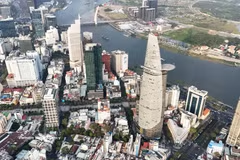
Standing Vice Chairman of the Ho Chi Minh City People's Committee Nguyen Loc Ha said global supply chain restructuring presents a major opportunity for the city to develop into an international logistics hub. As southern Vietnam's economic centre, the city has the advantages needed to become a regional and global supply chain gateway while building an integrated logistics ecosystem spanning infrastructure, logistics centres and value-added services.
To realise this ambition, Ho Chi Minh City has identified four priorities: developing modern, well-connected logistics infrastructure; accelerating digital transformation to improve supply chain transparency; promoting green logistics that meets international standards; and developing a skilled workforce alongside higher value-added logistics services.
Building regional logistics corridors
Vice Chairman of the Quang Tri People's Committee Le Duc Tien said the central province sits at the intersection of the East–West Economic Corridor and Vietnam's North–South transport axis, while serving as the closest gateway linking the Greater Mekong Subregion to the East Sea and international shipping routes. These advantages position Quang Tri to play a larger role in the regional logistics network.
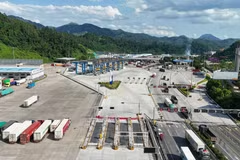
The province plans to integrate transport infrastructure with logistics, industry, trade and services to create greater value for goods rather than simply serving as a transit point. Following its administrative expansion, Quang Tri is well placed to develop into a multimodal logistics hub for central Vietnam, supported by expressways, the North–South railway, deep-water ports and international border gates connecting with Laos, northeastern Thailand and the Greater Mekong Subregion.
It is also studying new development models, including a free trade zone linked to a deep-water port, a Category 4E airport integrated with an aviation industry hub, and the Lao Bao–Densavanh cross-border trade zone with Laos, with the aim of establishing a modern logistics ecosystem directly connected to regional and global supply chains, Tien added.
Meanwhile, Hai Phong city continues to reinforce its role as northern Vietnam's logistics gateway through expanding port infrastructure and transport connectivity.
Pham Tuan Hai, Deputy Director of the municipal Department of Industry and Trade, said the transition towards green ports, green logistics and digitalisation presents both opportunities and challenges for major maritime centres.
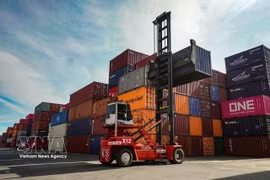
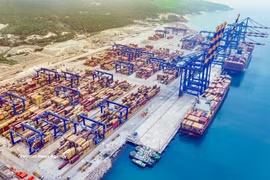
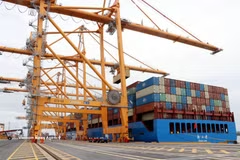
Hai Phong is home to the Lach Huyen deep-water port and a network of 50 port terminals with a combined annual handling capacity of 170–180 million tonnes. The port system can process 7.5–8 million TEUs annually, accounting for nearly 40% of Vietnam's total container throughput. Upgrades to Cat Bi International Airport, the expressway network and key transport facilities have further strengthened the city's inter-regional connectivity.
To achieve its ambition of becoming an international logistics hub, Hai Phong plans to continue investing in logistics infrastructure, expand multimodal transport, and strengthen cooperation with global shipping lines and port operators to increase direct container services to Europe and the Americas while attracting major logistics investors.
The city will also accelerate digital and green transformation by developing smart ports and digital logistics platforms, applying artificial intelligence, big data and automation, establishing shared databases linking ports, businesses and regulators, expanding green port and clean energy infrastructure, improving workforce quality, and strengthening regional connectivity to enhance competitiveness, according to Hai./.