Vietnam bridges interests, strengthens ASEAN solidarity: Indonesian scholar

According to Dr Arisman, Vietnam's greatest strength lies in its ability to bridge diverse interests, promote meaningful cooperation and preserve ASEAN solidarity while adapting to emerging challenges.

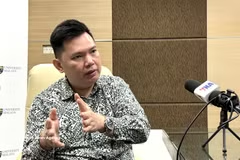
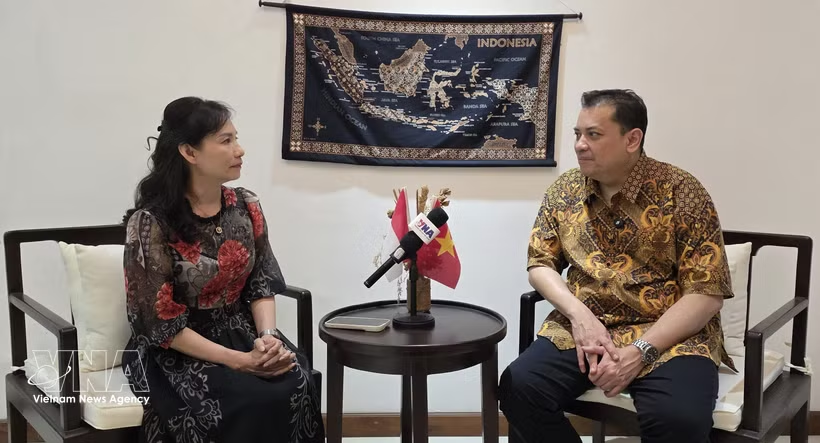
Dr. Arisman (right), Executive Director of the Centre for Southeast Asian Studies (CSEAS) in Indonesia, grants an interview to the Vietnam News Agency. (Photo: VNA)

Jakarta (VNA) – After more than three decades as a member of ASEAN, Vietnam has evolved from an active participant into a key architect of the bloc, playing an increasingly important role in promoting solidarity, cooperation and the building of the ASEAN Community, according to an Indonesian scholar.

Speaking to the Vietnam News Agency correspondent in Jakartar, Dr. Arisman, Executive Director of the Centre for Southeast Asian Studies (CSEAS) in Indonesia, said Vietnam's contributions over the past 31 years have been evident across all three pillars of the ASEAN Community.

In the political-security pillar, Vietnam has consistently supported ASEAN centrality, helping maintain peace and stability while contributing to conflict prevention across the region.

Economically, the country has emerged as one of Southeast Asia's most dynamic economies and an increasingly important link in regional supply chains. Its active participation in the ASEAN Economic Community (AEC), the Regional Comprehensive Economic Partnership (RCEP) and ASEAN-led free trade agreements has strengthened regional economic integration and investment connectivity.

Citing the World Bank, Arisman noted that Vietnam has become one of Southeast Asia's key trading hubs and ranks among the region's fastest-growing economies.

Under the socio-cultural pillar, Vietnam has actively promoted cooperation in sustainable development, climate change response, disaster risk management, education, health care and people-to-people exchanges. It has also taken the initiative in advancing new priorities, including green growth, digital transformation, innovation and inclusive development, helping shape ASEAN's long-term agenda.

Commenting on the outcomes of the 59th ASEAN Foreign Ministers' Meeting, recently held in Manila, the scholar said Vietnam has once again demonstrated its role as a proactive and responsible member in reinforcing ASEAN solidarity, strengthening the bloc's strategic autonomy and advancing practical cooperation amid growing regional and global uncertainties.

Against the backdrop of intensifying major-power competition, Vietnam has continued to stress the importance of upholding ASEAN centrality, enhancing internal cohesion and making full use of ASEAN-led mechanisms, including the East Asia Summit (EAS), the ASEAN Regional Forum (ARF) and ASEAN Plus frameworks, he said.

Vietnam also reaffirmed its commitment to implementing the ASEAN Community Vision 2045 while advocating concrete action plans on regional connectivity, digital transformation, innovation, sustainable growth and institutional capacity-building.

On regional issues, particularly the East Sea, Vietnam has maintained the consistent viewpoint on the peaceful settlement of disputes in accordance with international law, especially the 1982 United Nations Convention on the Law of the Sea (UNCLOS), the scholar said. Such positions demonstrate that the country is not only an active participant in ASEAN processes but also a source of initiatives and practical solutions to strengthen the bloc's resilience and cohesion.

Looking ahead to the implementation of the ASEAN Community Vision 2045, Arisman said Vietnam is well placed to make even greater contributions to the region's shared development goals.

He perceived that it could further advance regional economic integration by strengthening digital connectivity, facilitating cross-border trade, developing resilient supply chains and supporting the digital transformation of small and medium-sized enterprises, thereby enhancing ASEAN's competitiveness in an evolving global economy.

Vietnam also has valuable experience to share in renewable energy, the circular economy, sustainable agriculture and climate adaptation, which could help ASEAN achieve its sustainable development goals while reinforcing regional energy security.

As one of ASEAN's leading agricultural and aquaculture producers, Vietnam could also contribute expertise in building climate-resilient food systems, promoting sustainable fisheries management and expanding cooperation in the blue economy.

In addition, the country is well positioned to support ASEAN's digital transformation through cooperation in digital governance, cybersecurity, artificial intelligence, digital skills development and regulatory harmonisation to facilitate cross-border digital trade.

It could also play a greater role in narrowing development gaps among ASEAN members by expanding technical cooperation, sharing development experience and strengthening subregional cooperation programmes, he added.

According to Arisman, Vietnam's greatest strength lies in its ability to bridge diverse interests, promote meaningful cooperation and preserve ASEAN solidarity while adapting to emerging challenges.

He expressed confidence that these strengths will enable Vietnam to continue playing an important role in advancing the ASEAN Community Vision 2045 and building a more resilient, innovative, sustainable and people-centred ASEAN./.​

VNA

See more

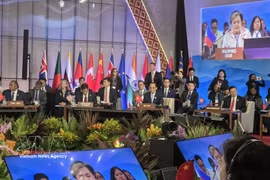
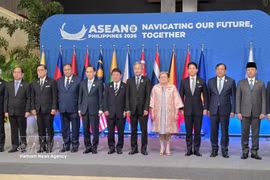
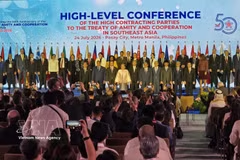
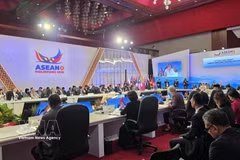
Officials pose for a group photo at the high-level conference of the TAC High Contracting Parties in Manila, the Philippines, on July 24, 2026. (Photo: VNA)

Vietnam attends celebration of TAC’s 50th anniversary in Philippines

In a discussion on enhancing maritime security and cooperation, the Vietnamese delegation underscored that the TAC's principles serve as a "foundational code of conduct" guiding relations among countries amid profound global changes, rising geopolitical tensions, mounting challenges to international law and the erosion of multilateralism.

Collins Chong Yew Keat, a foreign affairs, security and strategy analyst at the University of Malaya, in an interview granted to the Vietnam News Agency (VNA)'s correspondents in Malaysia. (Photo: VNA)

Vietnam emerges as key force shaping ASEAN’s future: Malaysian expert

Amid growing geopolitical shifts that pose increasing challenges to intra-ASEAN consensus, Vietnam’s capacity to build workable common platforms has become more important than ever, particularly as Vietnam serves as a bridge among members at different levels of development and countries with differing strategic relationships with major powers, said Collins Chong Yew Keat, a foreign affairs, security and strategy analyst at the University of Malaya.

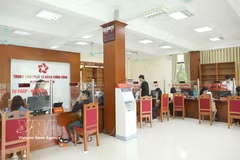
Local residents conduct procedures at the Public Administrative Service Centre of Vinh Yen ward, Phu Tho province. (Photo: VNA)

📝 OP-ED: Indicators of success in streamlining State apparatus

More than a year after Vietnam embarked on its sweeping administrative restructuring, the country's governance system has undergone significant changes. The administrative apparatus at all levels has been streamlined, intermediate layers reduced, and the functions, responsibilities and authority of state agencies gradually clarified. Greater decentralisation has also strengthened the role of grassroots authorities.

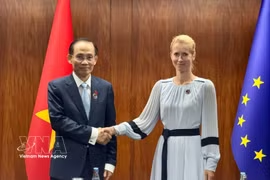
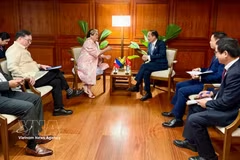
Vietnamese Minister of Foreign Affairs Le Hoai Trung (R) and Philippine Secretary of Foreign Affairs Maria Theresa Lazaro at their meeting on the sidelines of the 59th ASEAN Foreign Ministers' Meeting (AMM-59) and related meetings in the Philippines on July 23, 2026. (Photo: VNA)

Vietnam promotes bilateral cooperation with Philippines, EU, Norway on AMM-59 sidelines

Vietnamese Minister of Foreign Affairs Le Hoai Trung held separate bilateral meetings with Philippine Secretary of Foreign Affairs Maria Theresa Lazaro, Vice-President of the European Commission and EU High Representative for Foreign Affairs and Security Policy Kaja Kallas, and Norwegian Minister of Foreign Affairs Espen Barth Eide, on the sidelines of the 59th ASEAN Foreign Ministers' Meeting (AMM-59) and related meetings in the Philippines on July 23.

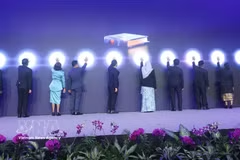
Leaders of ASEAN member states' education ministries launch the ASEAN Education Work Plan 2026–2030. (Photo: VNA)

Vietnam attends ASEAN Education Ministers’ Meeting and related meetings in Singapore

At ASED 14, the ASEAN Education Work Plan 2026–2030 was launched, setting out the region’s shared priorities for building inclusive, comprehensive and transformative education systems. The plan focuses on nurturing resilient and well-rounded individuals, developing a highly skilled and competitive workforce, and strengthening a common ASEAN identity rooted in shared values.

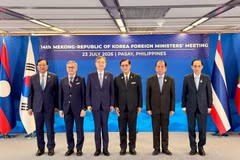
Vietnamese Minister of Foreign Affairs Le Hoai Trung (1st from right) and other participants at the 14th Mekong–Republic of Korea Foreign (RoK) Foreign Ministers' Meeting in Manila, the Philippines, on July 23, 2026. (Photo: Vietnamese Ministry of Foreign Affairs)

Vietnam proposes three priorities to advance Mekong–RoK cooperation

In its capacity as co-chair in 2025, Vietnam worked closely with the RoK and the Mekong countries to maintain high-level exchanges, enhance the effectiveness of the Mekong–RoK Business Forum, organise the Mekong–RoK Forum for the first time to share project outcomes and implementation experience, and promote innovative solutions in water resource management through the third Mekong–RoK Water Forum.

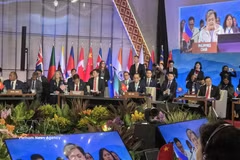
Vietnamese Minister of Foreign Affairs Le Hoai Trung attends the 33rd ASEAN Regional Forum in the Philippines on July 23, 2026. (Photo: VNA)

ASEAN Regional Forum adopts Manila Plan of Action for 2026–2036

Vietnamese Minister of Foreign Affairs Le Hoai Trung affirmed that ASEAN would continue working with China to fully and effectively implement the Declaration on the Conduct of Parties in the East Sea (DOC) and to conclude at an early date a substantive and effective Code of Conduct in the East Sea (COC) that is consistent with international law, particularly the 1982 United Nations Convention on the Law of the Sea (UNCLOS).

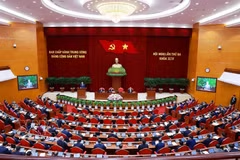
A view of the third plenum of the 14th Party Central Committee on July 23, 2026. (Photo: VNA)

Press release on fourth working day of 14th Party Central Committee's third plenum

The Party Central Committee on July 23 discussed a proposal to transfer responsibility for giving advice on mass mobilisation work from the Party Central Committee's Commission for Information, Education and Mass Mobilisation to the Party Committee of the Vietnam Fatherland Front and central mass organisations, as well as a proposal to rename the Commission for Information, Education and Mass Mobilisation as the Commission for Information and Education.

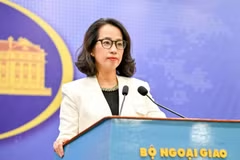
Spokeswoman of the Ministry of Foreign Affairs Pham Thu Hang (Photo: Ministry of Foreign Affairs)

Vietnam calls on parties concerned to fully implement DOC in East Sea

Responding to a reporter's question about recent clashes around Bai Co May (internationally known as Second Thomas Shoal) in the East Sea, Hang said Vietnam urged the parties concerned to act with restraint, respect the sovereign rights and jurisdiction of coastal states over their exclusive economic zones and continental shelves as established in accordance with the 1982 United Nations Convention on the Law of the Sea (UNCLOS), and fully and effectively implement the DOC.