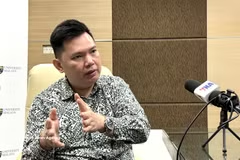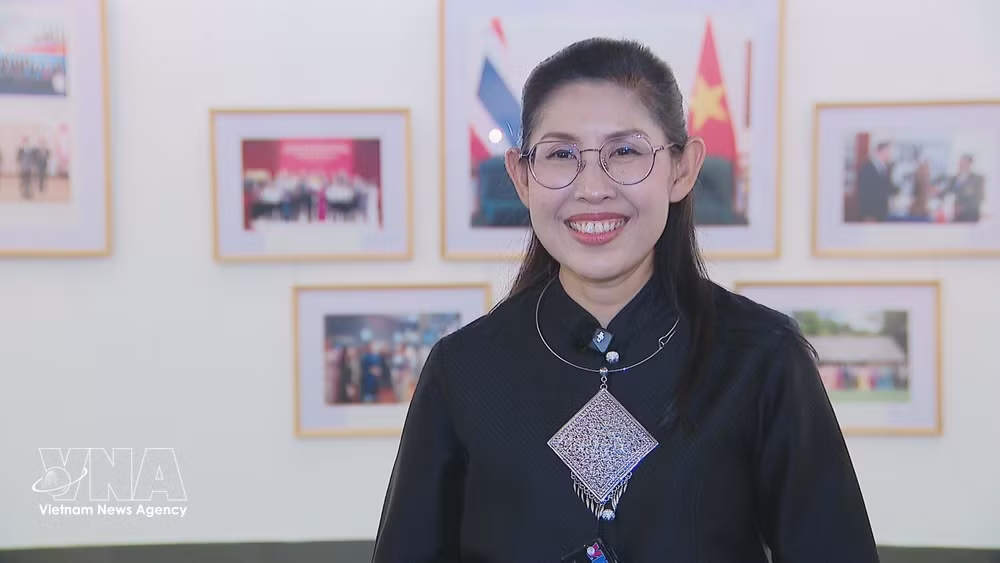
Hanoi (VNA) - High-level political trust and close people-to-people connections have provided a firm foundation for Vietnam–Thailand relations over the past 50 years, Thai Ambassador to Vietnam Urawadee Sriphiromya has said in a recent interview granted to the Vietnam News Agency on July 24.
Reporter: Looking back over the past 50 years, what do you see as the key highlights of Vietnam-Thailand relations?
Urawadee Sriphiromya, Thai Ambassador to Vietnam: The most significant highlight is the meaningful development and continuous elevation of our relationship. The two countries have maintained frequent exchanges of high-level visits. We have welcomed several royal visits, including visits by His Majesty King Rama X when he was Crown Prince and represented His Majesty King Rama IX, as well as regular visits by Her Royal Highness Princess Maha Chakri Sirindhorn.
Through these high-level exchanges, the peoples of our two countries have come to know each other better, developed greater mutual trust and expanded cooperation from people-to-people ties to economic, political and socio-cultural cooperation.
I would also highlight the first visit to Thailand by Nguyen Phu Trong as General Secretary of the Communist Party of Vietnam. It was a memorable occasion that further deepened the bond between our countries. Several Vietnamese prime ministers have also visited Thailand and received a warm welcome.
Our relationship has reached a series of important milestones, progressing from a Strategic Partnership to a Strengthened Strategic Partnership and then to a Comprehensive Strategic Partnership in 2025.
Another major highlight was the visit to Thailand by General Secretary and State President To Lam and his spouse in 2026. Shortly afterwards, Thai Prime Minister Anutin Charnvirakul paid an official visit to Vietnam as the two countries celebrated the 50th anniversary of diplomatic relations.
While high-level exchanges have laid a firm foundation for bilateral relations, we must not overlook the important role played by the peoples of Thailand and Vietnam.
Thailand is home to a large community of Vietnamese people and people of Vietnamese origin. These historical ties have helped connect the two peoples and promote economic cooperation. This is also why the first Vietnam Town in Thailand was established in Udon Thani.
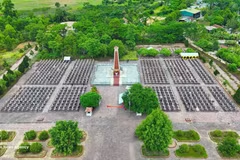
Even before the two countries established official diplomatic relations, President Ho Chi Minh played an important role in building these bonds. Although he lived in Thailand for only a relatively short period, he left a profound legacy of friendship. Thailand now has three memorial sites dedicated to him in Udon Thani, Nakhon Phanom and Phichit.
I am also grateful for the contributions of the Thailand–Vietnam Friendship Association and the Vietnam–Thailand Friendship Association. Through these organisations, people from both countries have come to know and understand each other better, while supporting one another during difficult times. That is the beauty of Thailand–Vietnam relations.
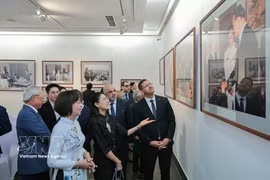
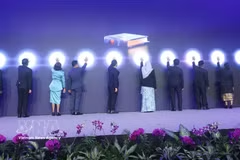
Reporter: The Royal Thai Embassy in Vietnam, in collaboration with the Vietnam News Agency (VNA), is hosting the photo exhibition “The Lens of Diplomacy: 50 Years of Thailand–Vietnam Relations” in Hanoi from July 24 to 30. What role can cultural activities such as this exhibition play in promoting people-to-people exchanges and strengthening mutual understanding between Thailand and Vietnam?
Urawadee Sriphiromya, Thai Ambassador to Vietnam: I have truly enjoyed visiting this photo exhibition, which is open to the public from July 24 until the end of the month.
The exhibition focuses on the people because relations between two countries cannot be advanced by governments alone. They must also be built on the shared feelings, mutual trust and friendship of their peoples. Through the exhibition, visitors can see how Thailand–Vietnam relations have developed from the establishment of diplomatic ties in 1976 to their 50th anniversary in 2026.
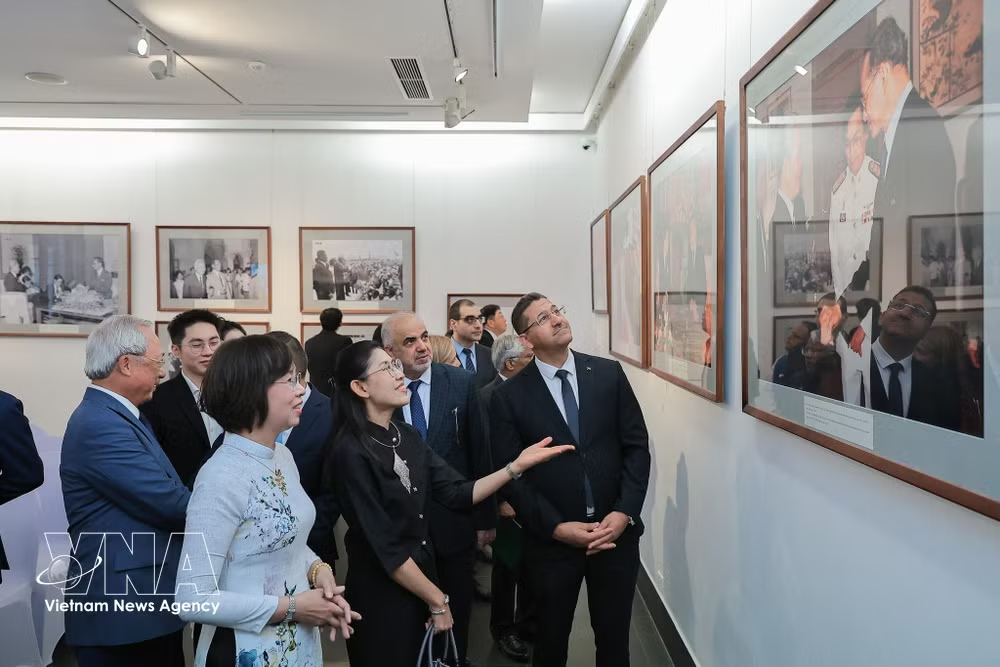
Some sections date back to the agreement establishing diplomatic relations and the first exchanges of visits between the two countries. The exhibition is particularly meaningful because many of these photographs have never been seen by younger generations or even by people of my generation. They allow us to reflect on how bilateral cooperation has expanded across political, economic, social and cultural fields. Today, our cooperation is both intensive and comprehensive.
As Thai Ambassador to Vietnam, I feel privileged to witness the close and cordial relationship that our two countries now enjoy. This achievement is the result of the efforts of the two governments, their leaders, ambassadors and, importantly, their peoples.
The exhibition helps members of the public understand how bilateral relations have developed and recognise the contributions they can make as ordinary citizens. It displays not only photographs of leaders and government officials but also images of ordinary people interacting and working together.
The exhibition also features a special edition of ceramic tiles produced by Prime, a Vietnamese brand with Thai private-sector investment. The blue-and-white designs depict Vietnamese and Thai architecture and demonstrate how historical ties can be expressed through creativity, innovation and technology. They also feature the lotus, a symbol closely associated with Vietnam. This is another example of how bilateral relations are shaped not only by governments but also by businesses and ordinary people.
Reporter: How do you expect Vietnam-Thailand relations to develop over the next 50 years?
Urawadee Sriphiromya, Thai Ambassador to Vietnam: We need to consider this question within the broader regional and global context. The geopolitical and economic situation is changing rapidly, and both countries face numerous challenges. However, our friendship and close cooperation will help both countries respond to those challenges, thrive and achieve greater success in political security, economic development and socio-cultural progress.
I expect Thailand and Vietnam to cooperate more intensively in economic integration, trade and investment. Thai private-sector companies have invested in Vietnam because they trust the country and believe their investments can grow here. The two countries can support each other in becoming stronger participants in global supply chains while improving the well-being of their peoples.
We will also need to strengthen cooperation in responding to challenges such as climate change, food security and climate resilience. As close and cordial friends, Thailand and Vietnam will continue consulting and coordinating with each other at both regional and global levels.
As fellow ASEAN members, we share a common vision of sustainable development and can help shape the future direction of the region.
I also foresee closer cooperation in science, technology and innovation, which are priorities for both countries. Other promising areas include human-resource development, public health, agriculture and production.
As our Prime Minister has said, we are entering a new era in which Thailand and Vietnam will grow and prosper together. Our friendship will become even deeper in the coming decades.
We are already beginning to see more Vietnamese people working in Thailand and more Thai people working in Vietnam. Universities in both countries are also promoting the study of each other’s languages, with Vietnamese students learning Thai and Thai students learning Vietnamese.
These people-to-people connections will provide a solid foundation for bilateral cooperation to continue growing, perhaps at an even faster pace over the next 50 years.
I also agree that more activities should be organised to promote public understanding of Thailand-Vietnam relations. Throughout this anniversary year, the Thai Embassy has worked with Vietnamese partners to organise activities almost every month.
Thailand Week was held in January, followed by an academic dialogue with the Diplomatic Academy of Vietnam in February and the Thai Festival in March. Thai Connect was organised in June, bringing leading Thai businesses to Vietnam to explore opportunities, while this photo exhibition is taking place in July.
On August 6, the anniversary of the establishment of diplomatic relations, we will hold an exhibition of Vietnamese ao dai and Thai national dress at the Vietnam Women’s Museum. The event will also pay tribute to Her Majesty the Queen Mother, who created the eight styles of Thai national dress.
The Vietnam-Thailand Friendship Association in Nghe An is also expected to organise a special exhibition, to which the Thai Embassy will contribute a collection of photographs highlighting President Ho Chi Minh’s connections with Thailand.
Another meaningful anniversary activity was a visit by a Royal Thai Navy vessel to Ho Chi Minh City - the first such port visit in about a decade. Photographs of that visit are also displayed at this exhibition.
I hope the public will enjoy these activities, cherish the friendship between our two countries and join us in celebrating this important anniversary./.