Kuala Lumpur (VNA) - Vietnam has demonstrated remarkable consistency in upholding ASEAN’s fundamental principles and served as a “bridge-builder” that helps narrow differences and strengthen consensus among member states, a Malaysian expert has said.
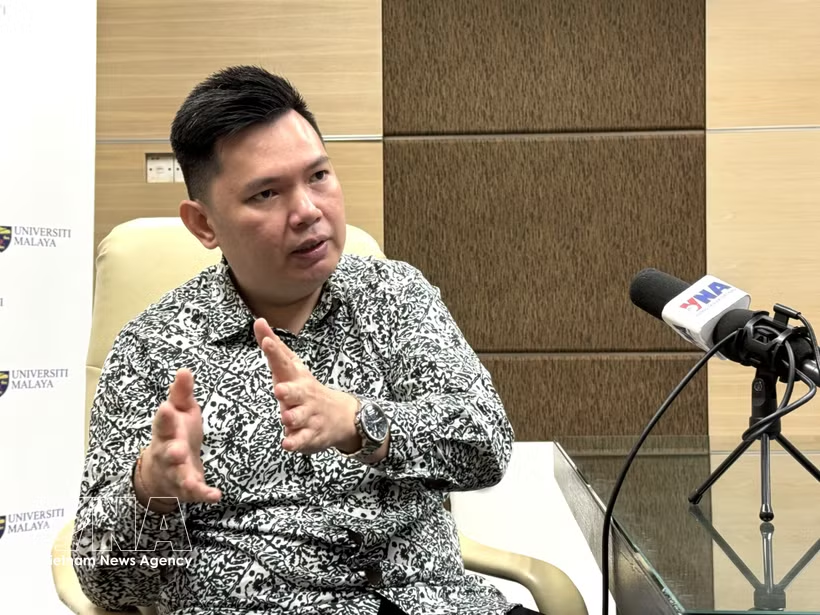
In an interview granted to the Vietnam News Agency (VNA) correspondents in Malaysia, Collins Chong Yew Keat, a foreign affairs, security and strategy analyst at the University of Malaya, said as ASEAN embarks on a new chapter with the implementation of the ASEAN Community Vision 2045, Vietnam is emerging not merely as an active member but as a key player in shaping the bloc’s future.
Chong stressed that Vietnam’s strategic value lies in its ability to place ASEAN at the centre of its multilateral diplomatic policy, thereby helping reconcile the diverse interests of mainland and maritime Southeast Asian countries.
Amid growing geopolitical shifts that pose increasing challenges to intra-ASEAN consensus, Vietnam’s capacity to build workable common platforms has become more important than ever, particularly as Vietnam serves as a bridge among members at different levels of development and countries with differing strategic relationships with major powers, he noted.
In this way, Vietnam has made a direct contribution to strengthening the bloc’s unity in the face of the turbulent forces of the times, he added. Beyond traditional diplomatic efforts, Chong said Vietnam has also contributed to giving substantive meaning to the concept of “ASEAN’s central role” by consistently advocating respect for international law, addressing disputes by peaceful measures and ensuring freedom of navigation.
Regarding the East Sea, Vietnam has supported the full and effective implementation of the Declaration on the Conduct of Parties in the East Sea (DOC) and efforts to accelerate negotiations on a substantive and effective Code of Conduct in the East Sea (COC) in line with international law, particularly the 1982 United Nations Convention on the Law of the Sea (UNCLOS).
These commitments, the expert said, not only safeguard Vietnam’s national interests but also uphold the legitimacy of ASEAN-led mechanisms.
The ASEAN Future Forum, an initiative launched by Vietnam, is another example of its agenda-setting role, Chong said. The forum has become an inclusive platform bringing together governments, scholars, businesses and young people to discuss the bloc’s long-term direction. At its recent discussions for 2026, the forum covered issues ranging from unity and conflict prevention to AI governance, energy security and green transition — all central to the success of the ASEAN Community Vision 2045.
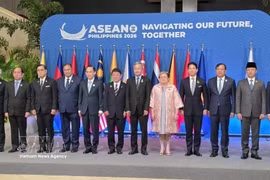
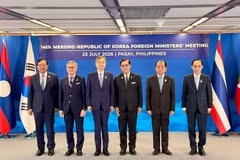
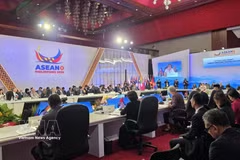
At the 59th ASEAN Foreign Ministers’ Meeting, Vietnam put forward strategic proposals to strengthen adherence to ASEAN principles and promote deeper and more resilient economic integration. These proposals reflect a forward-looking view that ASEAN’s central role must be built through substantive unity, relevant policies and the capacity for collective responses to crises, rather than relying solely on geography or diplomatic tradition.
According to the expert, Vietnam’s greatest contribution lies in its potential to help ASEAN move from consensus-based reactions to proactive regional leadership.
Looking ahead, Chong said Vietnam could lead practical and measurable initiatives to help turn the ASEAN Community Vision 2045 into reality, including an ASEAN strategic framework for recovery and crisis response integrating early-warning systems, emergency consultations, citizen protection and supply-chain monitoring to coordinate responses to disruptions in energy, food or transport.
Vietnam’s efforts to promote greater use of the ASEAN Power Grid, the Trans-ASEAN Gas Pipeline and regional oil, gas and food security mechanisms could lay the groundwork for a permanent cross-pillar architecture, rather than mechanisms activated separately only when a crisis occurs, the expert said.
Vietnam could also promote an ASEAN green and digital growth corridor linking regional payment systems, promoting cybersecurity cooperation, trusted data governance and responsible AI applications in production and logistics.
According to the expert, with its rapidly expanding technology and manufacturing ecosystem, Vietnam is well placed to link the digital transformation agenda with resilient regional supply chains. At the same time, the country is seen as capable of taking a leading role in regional energy connectivity by promoting cross-border renewable energy trading and supporting common standards for grid modernisation and sustainable finance. Energy connectivity will not only reduce vulnerability to external shocks but also serve as a tangible demonstration of positive interdependence among ASEAN countries.
In maritime security, he said Vietnam should continue to promote peace and practical cooperation through confidence-building measures, stronger hotlines, incident-prevention procedures, joint scientific research and marine environmental protection, thus protecting the shared interests of coastal communities.
He also suggested an ASEAN future skills and innovation network linking universities, research institutes and businesses in high-tech fields such as semiconductors, biotechnology and climate science, making the ASEAN Community Vision 2045 more meaningful to younger generations.
Ultimately, Chong stressed, Vietnam’s contribution should be measured not by the number of initiatives it advances, but by its ability to build coalitions and turn regional commitments into tangible results for ASEAN people./.