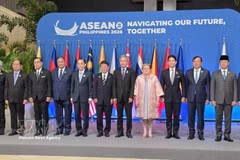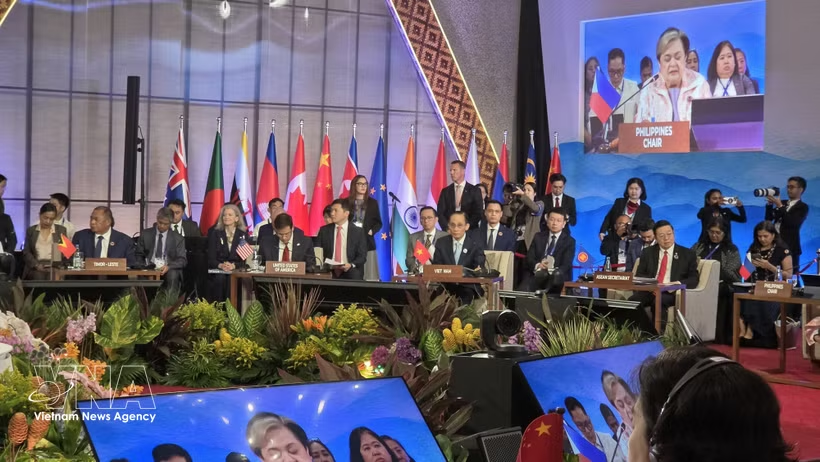
Hanoi (VNA) – Fifty years after the Treaty of Amity and Cooperation in Southeast Asia (TAC) was signed and 31 years since Vietnam joined the Association of Southeast Asian Nations (ASEAN), the treaty’s core principles of dialogue, respect for sovereignty, peaceful settlement of disputes and mutually beneficial cooperation continue to demonstrate their enduring relevance.
Serving not only as a cornerstone of the ASEAN Community, the TAC has also enabled member states, including Vietnam, to reinforce regional solidarity, uphold ASEAN centrality and respond effectively to an evolving strategic landscape.
Enduring values in a new context
Over the past five decades, the regional strategic environment has witnessed profound changes, marked by intensifying major-power competition alongside emerging challenges such as cybersecurity, climate change, energy security, supply chain disruptions and transnational crime. These developments have underscored the need for ASEAN to strengthen not only regional peace and stability but also its collective resilience and coordinated action.
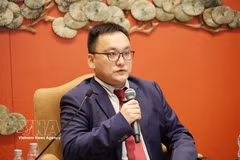
According to experts, the principles enshrined in the TAC remain as relevant as ever; what must evolve is the way they are applied. Dr. Arisman, Executive Director of the Centre for Southeast Asian Studies (CSEAS) in Indonesia, said the treaty’s strength lies in its flexibility. Respect for sovereignty, peaceful dispute settlement, the renunciation of the threat to use or use of force and mutually beneficial cooperation remain fundamental principles, he noted, but ASEAN should interpret and implement them in ways that address emerging security challenges.
He stressed the importance of preventive diplomacy, confidence-building measures, enhanced maritime cooperation and continued adherence to international law, particularly the 1982 United Nations Convention on the Law of the Sea (UNCLOS), as the basis for resolving disputes.
Sharing this view, Beni Sukadis, Senior Coordinator at the Indonesian Institute for Defence and Strategic Studies (Lesperssi), said adherence to the TAC should go hand in hand with deeper practical cooperation. He highlighted the need for ASEAN to accelerate economic integration, digital transformation and supply chain resilience, and expand cooperation in maritime security, cybersecurity, climate change and other non-traditional security issues.
The TAC's adaptability has enabled it to evolve from a treaty designed for Southeast Asian nations into a widely recognised code of conduct governing ASEAN's relations with external partners. It has also provided a framework for managing differences, broadening cooperation and preserving peace and stability across the region.
Advancing the treaty's values together
Vietnam's 31-year journey within ASEAN reflects the country's consistent commitment to translating the TAC's principles into concrete action. Since joining the bloc on July 28, 1995, during ASEAN's post-Cold War expansion, Vietnam has developed from a new member into an proactive, active and responsible participant, contributing to all three pillars of the ASEAN Community while helping strengthen unity, consensus and centrality.
Vietnam has consistently upheld the TAC's principles of respect for sovereignty, peaceful dispute settlement, non-use or threat of force, dialogue and mutually beneficial cooperation. These principles also underpin the country's foreign policy of independence, self-reliance, multilateralisation and diversification of international relations.
The country's contributions have been evident throughout ASEAN's development, particularly during its two terms as ASEAN Chair in 2010 and 2020 when Vietnam worked closely with fellow member states to promote dialogue, strengthen cooperation and advance ASEAN Community building. During its 2020 chairmanship, despite the unprecedented challenges posed by the COVID-19 pandemic, Vietnam helped maintain ASEAN's cooperation mechanisms, demonstrating the bloc's resilience and reinforcing its central role in the regional architecture.
As ASEAN moves forward with implementing the ASEAN Community Vision 2045, Vietnam remains committed to working with fellow members to build a resilient, innovative and sustainable regional community. In this new phase, steadfast adherence to, and flexible application of the TAC's principles will continue to underpin ASEAN's unity and centrality.
ASEAN Secretary-General Kao Kim Hourn has described Vietnam as an important and constructive member of ASEAN over the past three decades, highlighting its significant contributions to the political-security, economic and socio-cultural pillars. He expressed confidence that Vietnam will continue playing an active role in advancing the ASEAN Community Vision 2045.
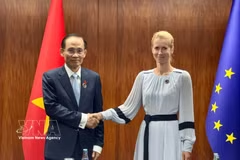
New Zealand's Ambassador to ASEAN Joanna Anderson praised Vietnam's effective coordination role, particularly in energy security and economic cooperation, while Indonesia's Ambassador to ASEAN Derry Aman considered Vietnam a cohesive force with a strong commitment to ASEAN's core principles. Their assessments reflect growing international recognition of Vietnam's increasingly proactive and substantive role within the regional grouping.
Half a century after its signing, the TAC has become more than the foundation of cooperation among Southeast Asian nations. It has evolved into a set of internationally respected norms that continue to guide regional peace and cooperation. As the strategic environment grows increasingly complex, the treaty's enduring values of dialogue, trust-building, respect for international law and peaceful dispute settlement remain essential to strengthening ASEAN unity and safeguarding its central role in the evolving regional architecture.
Through its active engagement over the past 31 years, Vietnam has helped translate those principles into action and will continue working with ASEAN to promote peace, stability and sustainable development in the region and the world./.
See more
President of Cambodian National Assembly to visit Vietnam next week
President of the Cambodian National Assembly Samdech Khuon Sudary will pay an official visit to Vietnam from July 27 - 29.
People-to-people diplomacy reform contributes to building overall strength of Vietnam's diplomacy: official
Under the leadership of the Party and the unified management of the State, people-to-people diplomacy will continue to be a sustainable bridge of friendship, an important channel for converging resources, spreading soft power, and protecting national interests, contributing to building the overall strength of Vietnamese diplomacy in the new era of development.
📝 OP-ED: Indicators of success in streamlining State apparatus
More than a year after Vietnam embarked on its sweeping administrative restructuring, the country's governance system has undergone significant changes. The administrative apparatus at all levels has been streamlined, intermediate layers reduced, and the functions, responsibilities and authority of state agencies gradually clarified. Greater decentralisation has also strengthened the role of grassroots authorities.
Vietnam calls for global cooperation on natural resource governance for peace, security
Vietnam is commited to responsible natural resource governance and stands ready to work closely with international partners to ensure natural resources become a driver of peace, prosperity and sustainable development.
500-day campaign: Using DNA sequencing to reunite fallen soldiers with families
Science and technology are playing an increasingly important role in identifying fallen soldiers' remains. In particular, next-generation gene sequencing technologies have opened new possibilities by significantly improving the ability to identify severely degraded DNA samples.
☀️ Morning digest on July 24
The following is a list of selected news summaries reported last night by the Vietnam News Agency.
Vietnam, US seek to substantially promote Comprehensive Strategic Partnership
Hang affirmed Vietnam regards the US as one of its leading important partners, noting that bilateral relations are built on a solid foundation and hold significant potential for further development.
Vietnam promotes bilateral cooperation with Philippines, EU, Norway on AMM-59 sidelines
Vietnamese Minister of Foreign Affairs Le Hoai Trung held separate bilateral meetings with Philippine Secretary of Foreign Affairs Maria Theresa Lazaro, Vice-President of the European Commission and EU High Representative for Foreign Affairs and Security Policy Kaja Kallas, and Norwegian Minister of Foreign Affairs Espen Barth Eide, on the sidelines of the 59th ASEAN Foreign Ministers' Meeting (AMM-59) and related meetings in the Philippines on July 23.
Vietnam attends ASEAN Education Ministers’ Meeting and related meetings in Singapore
At ASED 14, the ASEAN Education Work Plan 2026–2030 was launched, setting out the region’s shared priorities for building inclusive, comprehensive and transformative education systems. The plan focuses on nurturing resilient and well-rounded individuals, developing a highly skilled and competitive workforce, and strengthening a common ASEAN identity rooted in shared values.
Vietnam proposes three priorities to advance Mekong–RoK cooperation
In its capacity as co-chair in 2025, Vietnam worked closely with the RoK and the Mekong countries to maintain high-level exchanges, enhance the effectiveness of the Mekong–RoK Business Forum, organise the Mekong–RoK Forum for the first time to share project outcomes and implementation experience, and promote innovative solutions in water resource management through the third Mekong–RoK Water Forum.
Vietnam urges EAS to step up practical cooperation benefiting people
Vietnamese Minister of Foreign Affairs Le Hoai Trung stressed the importance of maintaining peace and stability and upholding international law and commonly accepted norms of conduct across all regions, including the East Sea.
ASEAN Regional Forum adopts Manila Plan of Action for 2026–2036
Vietnamese Minister of Foreign Affairs Le Hoai Trung affirmed that ASEAN would continue working with China to fully and effectively implement the Declaration on the Conduct of Parties in the East Sea (DOC) and to conclude at an early date a substantive and effective Code of Conduct in the East Sea (COC) that is consistent with international law, particularly the 1982 United Nations Convention on the Law of the Sea (UNCLOS).
Press release on fourth working day of 14th Party Central Committee's third plenum
The Party Central Committee on July 23 discussed a proposal to transfer responsibility for giving advice on mass mobilisation work from the Party Central Committee's Commission for Information, Education and Mass Mobilisation to the Party Committee of the Vietnam Fatherland Front and central mass organisations, as well as a proposal to rename the Commission for Information, Education and Mass Mobilisation as the Commission for Information and Education.
Vietnam calls on parties concerned to fully implement DOC in East Sea
Responding to a reporter's question about recent clashes around Bai Co May (internationally known as Second Thomas Shoal) in the East Sea, Hang said Vietnam urged the parties concerned to act with restraint, respect the sovereign rights and jurisdiction of coastal states over their exclusive economic zones and continental shelves as established in accordance with the 1982 United Nations Convention on the Law of the Sea (UNCLOS), and fully and effectively implement the DOC.
Vietnamese, Chinese Parties’ mutual learning makes bilateral ties more substantive: scholar
The CPV and CPC have maintained direct interactions, particularly in relation to their respective theories of reform and the formulation of many current policies, enabling them to learn from each other’s experience.
☕ Afternoon briefing on July 23
The following is a brief review of the day’s events as reported by the Vietnam News Agency.
Politburo, Party Central Committee's Secretariat announce personnel assignments
At the conference, Hoang Trung Dung, Member of the Party Central Committee, Vice Chairman of the Party Central Committee’s Organisation Commission, announced five decisions on personnel assignments.
AMM-59: Vietnam proposes substantive, sustainable ASEAN-EU ties
Looking ahead, Vietnam proposed the two sides prioritise stronger regional resilience by scaling up energy cooperation, pooling financial resources and cracking down on illegal, unreported and unregulated fishing, all aimed at building a resilient and sustainable blue economy.
Vietnam urges stronger connectivity, resilience in ASEAN+3 cooperation
The Vietnamese minister underscored ASEAN+3's role as a strategic platform for deepening regional economic integration, strengthening resilience and helping build a peaceful and prosperous future for the region.
Caring for revolution contributors reflects Vietnam’s deep humanitarian value: PM
The PM urged all-level authorities, sectors, localities, and the public to fully implement relevant Party resolutions and directives as well as preferential policies for revolution contributors, push ahead with the 500-day campaign, expand gratitude movements, accelerate housing support for children of Agent Orange/dioxin victims and strengthen patriotic education.