Top leader calls for swift implementation of newly adopted Party decisions

Every decision must clearly identify the lead agency, responsible focal point, authority, conditions for implementation, timeline and expected outputs, the General Secretary and President stressed.

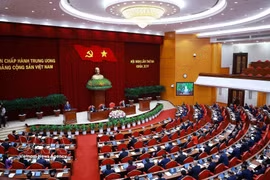
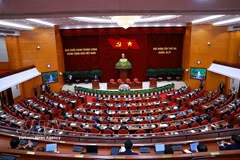
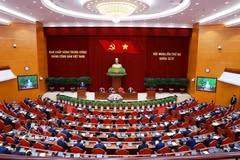
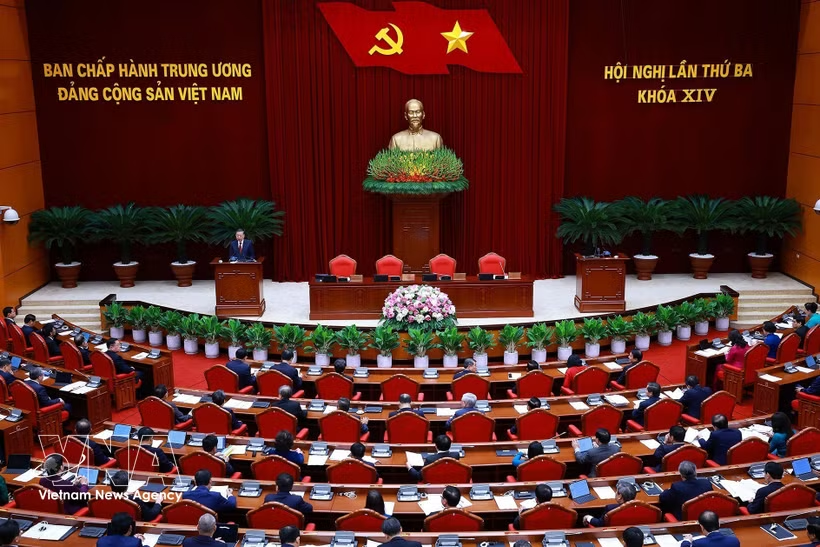
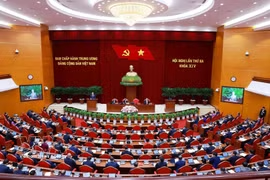
A view of the closing session of the third plenum of the 14th Party Central Committee in Hanoi on July 24 (Photo: VNA)

Hanoi (VNA) – Party General Secretary and State President To Lam urged the Party and the entire political system to quickly turn major policies adopted at the third plenum of the 14th Party Central Committee into real actions and tangible results, emphasising that every decision must result in implementation.

In his remarks at the closing session of the plenum in Hanoi on July 24, the leader said the Party Central Committee reached broad consensus on major decisions concerning Party building, the political system, and national development and defence, and had approved the plenum’s resolution and other documents on the agenda.

According to General Secretary and President Lam, the committee noted that the rollout of the 14th National Party Congress Resolution and other key strategic resolutions picked up speed in the first half of 2026. The restructured political system has been running smoothly and is starting to show results.

However, implementation remains the biggest bottleneck, he said, pointing out that authority in some cases has not been matched by accountability. Decentralisation has yet to be fully aligned with resources, data, tools, officials' capacity and oversight, while resources remain fragmented. Growth has yet to be driven by productivity and domestic strengths, and forecasting and risk prevention in some sectors and localities have not kept pace with changing conditions.
vnanet-meeting2.jpg
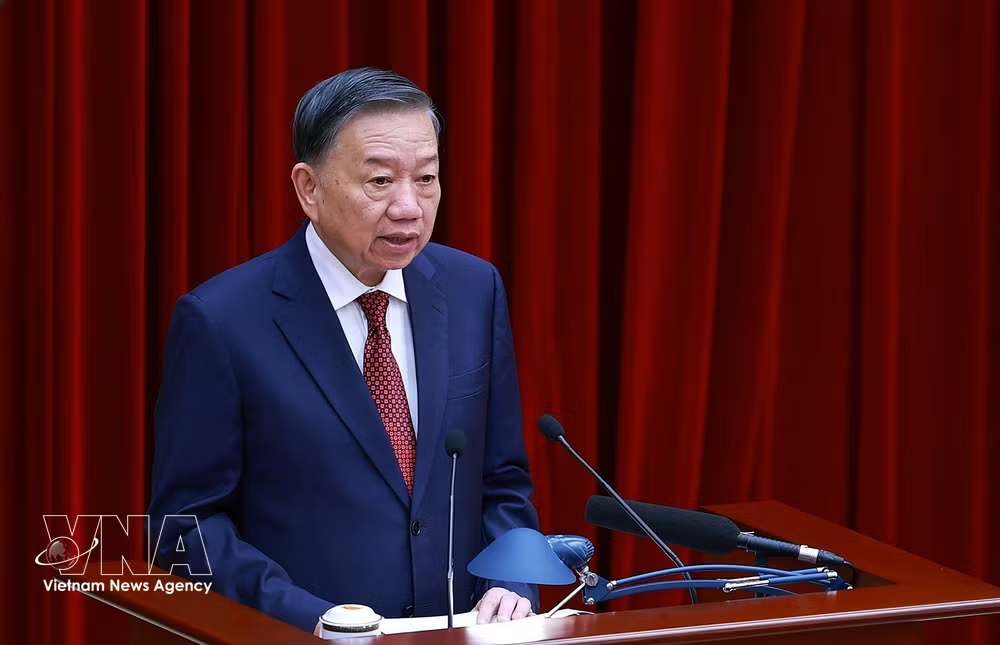
Party General Secretary and State President To Lam speaks at the closing session of the third plenum of the 14th Party Central Committee in Hanoi on July 24 (Photo: VNA)

Given this, he stressed that these issues must be addressed at their root through coordinated reforms in institutions, organisation, personnel and leadership and governance methods, linking Party building with national governance, socio-economic development and national defence.

Regarding Party and political system building, committee members consented to continue improving the functioning of agencies, and to issue new regulations on what Party members must not do, meeting the requirements of the new situation and ensuring consistency with other Party regulations, the leader said.

The plenum approved in principle the establishment of Quang Ninh and Bac Ninh cities, as well as orientations for amendments to the Land Law and related legislation.

The committee also agreed to issue a new resolution on developing Vietnam into a strong maritime nation, defining the sea as a strategic space for the country's survival, development and national defence. It said the development of a modern marine economy must go hand in hand with protecting marine ecosystems, improving people's livelihoods and safeguarding national sovereignty.

The committee set the goal of economic growth of at least 10% in 2026 while maintaining macroeconomic stability, controlling inflation and ensuring major economic balances, jobs, incomes and social welfare. It approved a resolution on renewing Vietnam’s development model, describing the undertaking as significant for shaping the country’s development model through 2045 and beyond.

It endorsed major orientations for a national security strategy that places security within the overall development of the country and calls for early identification, prevention and handling of traditional and non-traditional risks. It also adopted conclusions on environmental protection and proactive climate change response.

Every decision must clearly identify the lead agency, responsible focal point, authority, conditions for implementation, timeline and expected outputs, the General Secretary and President stressed, noting that regular inspection and supervision are required to enable timely warnings and adjustments, while actual results and the satisfaction of people and businesses should serve as key criteria for assessing organisations and officials, particularly those in leadership positions.

Calling for the immediate translation of policy consensus into action, he outlined five priorities - identifying key tasks and breakthroughs; ensuring the Party’s unified leadership and coordinated implementation; clearly defining responsibilities among the central, provincial and commune-level authorities; turning each decision into a concrete action programme and plan with clear resources, roadmaps, outputs and accountability; and strengthening inspection and supervision based on data, outputs and actual results.

He said the central, provincial and grassroots levels must operate smoothly and coordinate closely, with the grassroots level serving as the frontline of public governance and directly addressing issues arising from the daily lives and needs of people and businesses.

The top leader asked for implementation progress to be incorporated into every task, with the performance of officials, particularly leaders, assessed based on actual results. He urged the authorities to commend those with outstanding performance and protect officials who dare to innovate, while strictly dealing with avoidance of responsibility, delays, and formalistic implementation.

He said that the success of the plenum was only a beginning. Amid a rapidly changing and complex global situation, Vietnam must remain steadfast in its goals and principles, strengthen unity and discipline, and act proactively and creatively while taking responsibility for the common interest.

On the occasion of the 79th anniversary of War Invalids and Martyrs' Day (July 27, 1947–2026), the Party and State leader expressed deep gratitude to people with meritorious services to the nation and called for continued care for their families, as well as the 500-day campaign to search and identify martyrs’ remains./.
VNA

See more

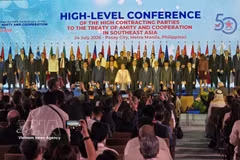
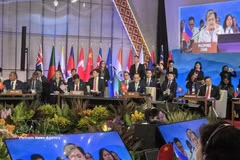
Officials pose for a group photo at the high-level conference of the TAC High Contracting Parties in Manila, the Philippines, on July 24, 2026. (Photo: VNA)

Vietnam attends celebration of TAC’s 50th anniversary in Philippines

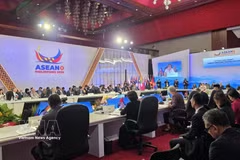
In a discussion on enhancing maritime security and cooperation, the Vietnamese delegation underscored that the TAC's principles serve as a "foundational code of conduct" guiding relations among countries amid profound global changes, rising geopolitical tensions, mounting challenges to international law and the erosion of multilateralism.

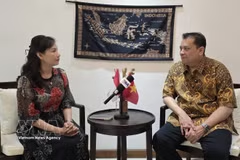
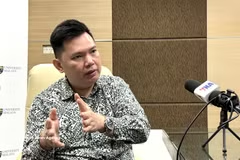
Collins Chong Yew Keat, a foreign affairs, security and strategy analyst at the University of Malaya, in an interview granted to the Vietnam News Agency (VNA)'s correspondents in Malaysia. (Photo: VNA)

Vietnam emerges as key force shaping ASEAN’s future: Malaysian expert

Amid growing geopolitical shifts that pose increasing challenges to intra-ASEAN consensus, Vietnam’s capacity to build workable common platforms has become more important than ever, particularly as Vietnam serves as a bridge among members at different levels of development and countries with differing strategic relationships with major powers, said Collins Chong Yew Keat, a foreign affairs, security and strategy analyst at the University of Malaya.

Minister of Foreign Affairs Le Hoai Trung attends the 33rd ASEAN Regional Forum (ARF-33). (Illustrative photo: VNA)

Vietnam, ASEAN continue to strengthen foundations of regional peace

ASEAN Secretary-General Kao Kim Hourn has described Vietnam as an important and constructive member of ASEAN over the past three decades, highlighting its significant contributions to the political-security, economic and socio-cultural pillars. He expressed confidence that Vietnam will continue playing an active role in advancing the ASEAN Community Vision 2045.

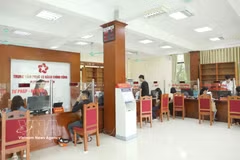
Local residents conduct procedures at the Public Administrative Service Centre of Vinh Yen ward, Phu Tho province. (Photo: VNA)

📝 OP-ED: Indicators of success in streamlining State apparatus

More than a year after Vietnam embarked on its sweeping administrative restructuring, the country's governance system has undergone significant changes. The administrative apparatus at all levels has been streamlined, intermediate layers reduced, and the functions, responsibilities and authority of state agencies gradually clarified. Greater decentralisation has also strengthened the role of grassroots authorities.

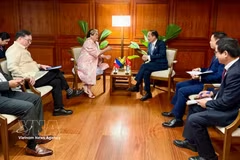
Vietnamese Minister of Foreign Affairs Le Hoai Trung (R) and Philippine Secretary of Foreign Affairs Maria Theresa Lazaro at their meeting on the sidelines of the 59th ASEAN Foreign Ministers' Meeting (AMM-59) and related meetings in the Philippines on July 23, 2026. (Photo: VNA)

Vietnam promotes bilateral cooperation with Philippines, EU, Norway on AMM-59 sidelines

Vietnamese Minister of Foreign Affairs Le Hoai Trung held separate bilateral meetings with Philippine Secretary of Foreign Affairs Maria Theresa Lazaro, Vice-President of the European Commission and EU High Representative for Foreign Affairs and Security Policy Kaja Kallas, and Norwegian Minister of Foreign Affairs Espen Barth Eide, on the sidelines of the 59th ASEAN Foreign Ministers' Meeting (AMM-59) and related meetings in the Philippines on July 23.

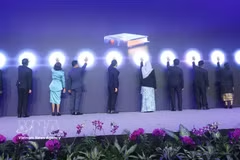
Leaders of ASEAN member states' education ministries launch the ASEAN Education Work Plan 2026–2030. (Photo: VNA)

Vietnam attends ASEAN Education Ministers’ Meeting and related meetings in Singapore

At ASED 14, the ASEAN Education Work Plan 2026–2030 was launched, setting out the region’s shared priorities for building inclusive, comprehensive and transformative education systems. The plan focuses on nurturing resilient and well-rounded individuals, developing a highly skilled and competitive workforce, and strengthening a common ASEAN identity rooted in shared values.

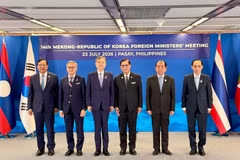
Vietnamese Minister of Foreign Affairs Le Hoai Trung (1st from right) and other participants at the 14th Mekong–Republic of Korea Foreign (RoK) Foreign Ministers' Meeting in Manila, the Philippines, on July 23, 2026. (Photo: Vietnamese Ministry of Foreign Affairs)

Vietnam proposes three priorities to advance Mekong–RoK cooperation

In its capacity as co-chair in 2025, Vietnam worked closely with the RoK and the Mekong countries to maintain high-level exchanges, enhance the effectiveness of the Mekong–RoK Business Forum, organise the Mekong–RoK Forum for the first time to share project outcomes and implementation experience, and promote innovative solutions in water resource management through the third Mekong–RoK Water Forum.

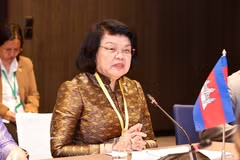
Vietnamese Minister of Foreign Affairs Le Hoai Trung attends the 33rd ASEAN Regional Forum in the Philippines on July 23, 2026. (Photo: VNA)

ASEAN Regional Forum adopts Manila Plan of Action for 2026–2036

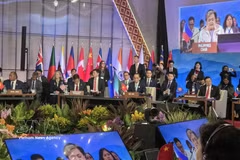
Vietnamese Minister of Foreign Affairs Le Hoai Trung affirmed that ASEAN would continue working with China to fully and effectively implement the Declaration on the Conduct of Parties in the East Sea (DOC) and to conclude at an early date a substantive and effective Code of Conduct in the East Sea (COC) that is consistent with international law, particularly the 1982 United Nations Convention on the Law of the Sea (UNCLOS).

A view of the third plenum of the 14th Party Central Committee on July 23, 2026. (Photo: VNA)

Press release on fourth working day of 14th Party Central Committee's third plenum

The Party Central Committee on July 23 discussed a proposal to transfer responsibility for giving advice on mass mobilisation work from the Party Central Committee's Commission for Information, Education and Mass Mobilisation to the Party Committee of the Vietnam Fatherland Front and central mass organisations, as well as a proposal to rename the Commission for Information, Education and Mass Mobilisation as the Commission for Information and Education.